
Gate's Layer 2 Network and Its Strategic Implications for Blockchain Scalability
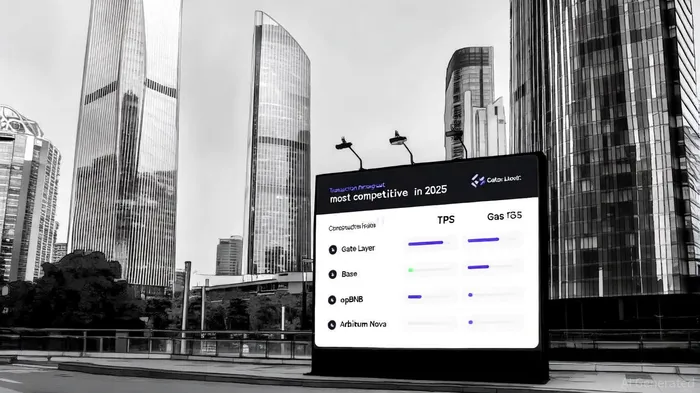
In the rapidly evolving blockchain landscape of 2025, scalability remains a critical bottleneck for mass adoption. GateChain's recent launch of Gate Layer, a high-performance Layer 2 (L2) network built on the OptimismOP-- OP Stack, has positioned the project as a formidable contender in the L2 space. By leveraging the modular architecture of the OP Stack and integrating a deflationary token model, GateChainWAN-- aims to disrupt existing L2 markets while addressing key pain points in transaction speed, cost, and developer accessibility.
GateChain's OP Stack Architecture: A Modular Approach to Scalability
Gate Layer's design is rooted in the OP Stack's principles of modularity and interoperability. The OP Stack, developed by Optimism, enables customizable L2 solutions by decoupling components such as the Data Availability (DA) Layer, Sequencer, and Settlement Layer. GateChain's implementation uses its existing chain as the settlement layer, ensuring security while allowing for rapid transaction finality. According to Gate's official documentation, GatePORTAL-- Layer achieves 5,700 transactions per second (TPS) with a 1-second block time, outpacing Ethereum-based L2s like ArbitrumARB-- Nova (1,200 TPS) and even ZK Rollups such as Immutable X (9,000 TPS) in cost efficiency[1].
The modular nature of the OP Stack also allows GateChain to adopt multi-proof schemes, enhancing flexibility for future upgrades. For instance, the Bedrock upgrade introduced by Optimism has been adapted to support hybrid proof mechanisms, reducing reliance on single points of failure[2]. This adaptability contrasts with monolithic L2 solutions like Arbitrum, which prioritize sovereign scalability over modular customization[3].
Competitive Positioning: Gate Layer vs. Leading L2s
Gate Layer's performance metrics place it in direct competition with Ethereum-focused L2s like Base and opBNB. Base, backed by Coinbase, has seen explosive growth in developer activity (3,786 active developers in Q1 2025) and TVL ($3.3 billion), but its transaction costs remain significantly higher than Gate Layer's. Data from Q1 2025 indicates that 1 million transfers on Base cost $700, compared to less than $30 on Gate Layer[4]. Similarly, opBNB, which scales the BNBBNB-- Smart Chain (BSC), processes over 4,000 TPS with fees as low as $0.0005 but lacks the EVM compatibility and EthereumETH-- ecosystem integration that Gate Layer offers[5].
A critical differentiator for Gate Layer is its dual deflationary model for the GT token. By combining scheduled quarterly burns tied to business performance with EIP-1559-style on-chain burns, Gate has reduced GT's circulating supply by over 60% as of Q2 2025. This tokenomics strategy notNOT-- only incentivizes gasGAS-- usage but also aligns with broader trends in token-driven network security[6]. In contrast, Ethereum-based L2s like Arbitrum and Optimism rely on inherited security from the Ethereum mainnet, which may limit their ability to innovate in token-driven governance models[7].
Market Adoption and Developer Ecosystem
The broader L2 market in 2025 is characterized by intense competition and rapid innovation. Ethereum-based L2s like Arbitrum and Optimism dominate in TVL and developer activity, with Arbitrum's TVL reaching $2.28 billion and 3,450 monthly active developers[8]. However, Gate Layer's “All in Web3” strategy—encompassing tools like PerpPERP-- (a decentralized perpetuals hub) and Gate Fun (a no-code token launchpad)—is attracting a hybrid audience of traders, developers, and DeFi users. On-chain data reveals that GateChain's daily transaction volume surged by 43% year-over-year in Q1 2025, with DeFi TVL growing 215% to $1.85 billion[9].
This growth is further supported by Gate's strategic integration of the OP Stack, which reduces migration barriers for Ethereum developers. For example, Gate Layer's EVM compatibility allows seamless deployment of Ethereum-based dApps without major code rewrites, a feature that opBNB and Base also leverage but with less emphasis on token-driven incentives[10].
Strategic Implications for Blockchain Scalability
GateChain's entry into the L2 market underscores a broader trend: the convergence of high-performance infrastructure and tokenomics-driven ecosystems. By combining the OP Stack's modular design with a deflationary GT token, Gate Layer addresses two critical challenges in blockchain scalability:
1. Cost Efficiency: Gate Layer's sub-$0.001 per-transaction fees make it viable for microtransactions and high-frequency DeFi use cases.
2. Developer Accessibility: EVM compatibility and standardized tooling lower the barrier for Ethereum developers to experiment with L2 solutions.
However, challenges remain. While Gate Layer's TPS and fees are competitive, its TVL and developer activity lag behind established L2s like Arbitrum and Base. Additionally, the project's reliance on Gate's centralized exchange (CEX) ecosystem may raise concerns about decentralization compared to fully open-source L2s.
Conclusion: A Disruptive Force in the L2 Space
GateChain's Gate Layer represents a compelling value proposition in the 2025 L2 landscape. Its high throughput, low fees, and innovative tokenomics position it to capture market share from both Ethereum-focused and BSC-based L2s. While it faces stiff competition from projects with larger ecosystems, its modular OP Stack implementation and deflationary GT model offer a unique blend of scalability and economic incentives. For investors, GateChain's strategic alignment with Web3's growth trajectory—coupled with its execution on key metrics like TPS and token burns—makes it a high-potential candidate in the ongoing race to solve blockchain's scalability trilemma.






Comentarios
Aún no hay comentarios