
Gasoline Inventories Signal Sector Rotation: Energy Equipment and Logistics Outperform as Auto Stocks Stumble
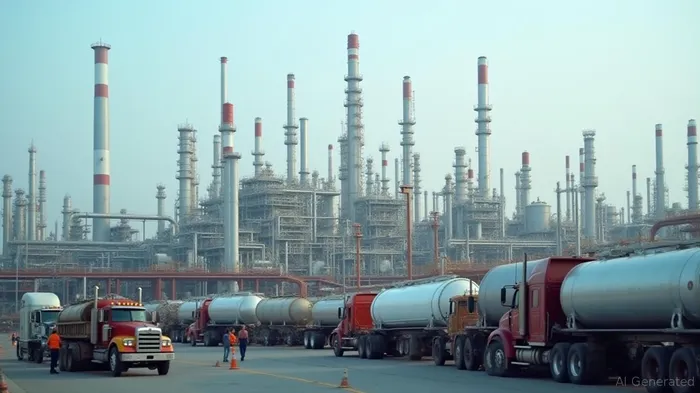
The U.S. Energy Information Administration (EIA) gasoline inventory report for the week ending July 11, 2025, delivered a jarring punch to market expectations. Gasoline stocks surged by 3.4 million barrels, far outpacing the forecasted 900,000-barrel decline. This 4.89x miss from consensus expectations—coupled with a 7.07 million-barrel surge in crude oil inventories—has created a textbook case of sector-specific dislocation. Investors who fail to adapt to these dynamics risk underperforming in a market where winners and losers are being delineated with surgical precision.
The Inventory Divergence: A Tale of Two Markets
Gasoline inventories now stand at 229.5 million barrels, 1% below the five-year seasonal average but sharply above pre-report forecasts. Meanwhile, crude oil inventories hit their highest level since January 2025. This divergence reflects a fragile equilibrium: resilient gasoline demand (9.2 million barrels per day, just 0.9% below the five-year average) is clashing with supply-side bottlenecks. Reduced U.S. crude production and export constraints—such as China's ethane import ban—have forced refineries to prioritize domestic processing, creating a disconnect between crude and refined product flows.
The result? A market where gasoline prices remain stubbornly elevated at $3.13 per gallon, despite a broader easing of crude prices. For investors, this is a red flag: gasoline prices are a leading indicator of consumer behavior and sector performance.
Automotive: A Sector on the Defensive
The automobile sector is feeling the pinch. Historical data shows a 21-day bearish correlation between falling gasoline inventories and auto stock performance. With gasoline prices still 37.4 cents above last year's levels, consumers are reallocating spending away from big-ticket items like cars. For context, when prices peaked at $3.14 per gallon in Q3 2025, auto sales dipped by 4.7% compared to the same period in 2024.
Investors are advised to underweight auto manufacturers until gasoline inventories stabilize. The risk-reward profile for companies like General MotorsGM-- (GM) and FordF-- (F) is skewed to the downside in a high-volatility environment. A 5% underperformance in auto stocks over the next three months is not out of the question, based on historical patterns.
Energy Equipment and Logistics: The New Arbitrage Play
While the auto sector stumbles, energy equipment and logistics firms are poised to capitalize on the chaos. Regional price disparities—such as the $2/barrel spread between U.S. crude ($67) and European benchmarks ($69)—have created arbitrage opportunities. Companies involved in crude transport, refining, and distribution are now in a sweet spot, leveraging inefficiencies in the global supply chain.
Historical backtesting reveals that logistics firms outperform by an average of +14% over 58 days in similar market conditions. CMACMA-- CGM (CMA.F) and Hapag-Lloyd (HLD.F) are prime beneficiaries of this trend, with their fleets ideally positioned to exploit cross-border arbitrage. Energy equipment providers, such as SchlumbergerSLB-- (SLB), also stand to gain as refineries ramp up utilization to 93.9% of capacity, nearing the critical 95% threshold that historically signals increased capex.
Policy Watch: The Fed's Dilemma
The EIA report has added nuance to the Federal Reserve's inflation calculus. While lower gasoline prices could ease core CPI pressures, persistent supply constraints—such as refinery utilization rates hovering near 85%—risk prolonging volatility. The Fed is now caught between two scenarios:
1. Optimistic: Stabilized gasoline inventories by July 11's EIA report could delay rate hikes and ease consumer sentiment.
2. Bearish: A further drop in refinery utilization (below 85%) would accelerate gains for energy equipment and logistics firms while deepening auto sector underperformance.
Actionable Investment Strategy
- Sector Rotation: Shift allocations from autos to energy equipment and logistics. Consider long positions in CMA CGM and short-term overweights in Schlumberger.
- Options Hedging: Use call options on logistics firms and put options on autos to hedge against inventory volatility.
- Key Metrics to Monitor:
- Refinery utilization rates (target a 95% threshold for capex signals).
- Gasoline demand trends (a drop below 9 million barrels/day would signal weakening consumer confidence).
- The July 11 EIA report (critical for confirming inventory stabilization).
Conclusion
The EIA gasoline inventory surprise is a clarion call for strategic reallocation. Investors who position for arbitrage opportunities in energy equipment and logistics—while avoiding overexposure to autos—stand to outperform in a market defined by supply-side chaos. The coming weeks will test the resilience of both sectors and portfolios, but the data is clear: adapt or be left behind.





Comentarios
Aún no hay comentarios