
Garrett Jin's Emerging Role in a Billion-Dollar Crypto Movement: Institutional Adoption and Retail Implications
The cryptocurrency landscape in 2025 is defined by a seismic shift in institutional adoption, driven by regulatory clarity, technological innovation, and the rise of tokenized assets. Amid this transformation, figures like Garrett Jin-founder of BitForex and a key player in the IOTAIOTA-- ecosystem-are emerging as pivotal actors in shaping the next phase of the crypto market. While Jin's direct influence on institutional strategies remains underreported, his affiliations with blockchain projects and ventures align with broader trends that are redefining how traditional finance interacts with digital assets.
Institutional Adoption: A New Era of Legitimacy
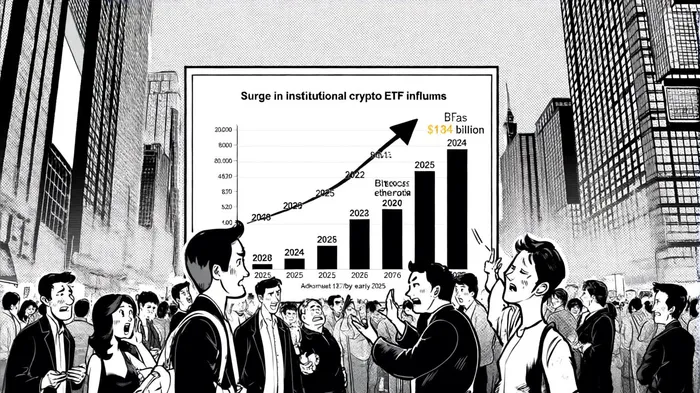
Institutional adoption of cryptocurrencies has accelerated in 2025, fueled by regulatory frameworks like the U.S. GENIUS Act and the EU's MiCA regulation. These policies have reduced uncertainty, enabling firms like BlackRockBLK--, Fidelity, and JPMorganJPM-- to integrate BitcoinBTC-- and EthereumETH-- into their portfolios. By mid-2025, spot ETFs alone had amassed $138 billion in assets under management (AUM), with BlackRock's iShares Bitcoin Trust (IBIT) alone reaching $87.2 billion in AUM, according to an institutional crypto adoption report (https://pakwaqt.teambarry.blog/category/crypto_finance_trends/institutional-crypto-adoption-2025). The approval of altcoin ETFs-particularly for SolanaSOL-- (SOL) and XRP-is expected to further diversify institutional exposure, unlocking billions in new capital, as noted in a crypto ETF analysis (https://www.walbi.com/blog/the-crypto-etf-revolution-institutional-adoption-altcoin-etfs-in-2025).
This institutional shift is not limited to direct crypto holdings. Tokenization of real-world assets (RWAs), such as real estate and Treasury Bills, is gaining traction. For instance, IOTA's partnership with Zodia Custody in May 2025 enables institutional investors to securely manage and tokenize digital assets on the IOTA Rebased Mainnet, bridging traditional finance and blockchain ecosystems. Such initiatives highlight how tokenization is becoming a cornerstone of institutional strategy, offering enhanced liquidity and efficiency.
Garrett Jin: From BitForex to Tokenization Pioneering
Garrett Jin's career trajectory reflects the evolving dynamics of the crypto industry. As founder of BitForex-a Shenzhen-based exchange that faced regulatory scrutiny and operational challenges-he has navigated the volatile landscape of crypto trading. Despite BitForex's eventual shutdown in 2024, Jin's ventures, including GroupFi (an IOTA-related project) and TanglePay, underscore his focus on blockchain innovation.
Jin's indirect influence on institutional adoption is evident in his association with IOTA, a project that has partnered with Zodia Custody to facilitate institutional access to tokenized assets. This collaboration, set to launch on May 5, 2025, allows institutions to custody and stake IOTA tokens while adhering to regulatory standards, as detailed in an IOTA blog post (https://blog.iota.org/iota-partnership-zodia/). While Jin's direct role in this partnership is not explicitly detailed, his historical engagement with IOTA and tokenization initiatives positions him as a figure aligned with the sector's institutionalization.
Retail Implications: A Double-Edged Sword
For retail investors, the institutionalization of crypto presents both opportunities and risks. On one hand, the influx of institutional capital has normalized digital assets as a legitimate asset class, reducing volatility and fostering new products like tokenized ETFs. For example, Grayscale's GDLC ETF, which includes exposure to Bitcoin, Ethereum, and altcoins like XRPXRP--, has attracted significant retail interest by offering diversified, regulated access, as detailed in a Grayscale analysis (https://fakto.top/grayscale-investments-2025-institutional-crypto-etfs-gdlc-approval-and-strategic-market-impact/).
On the other hand, the dominance of institutional players raises concerns about market concentration and regulatory overreach. The U.S. SEC's evolving stance under Chair Paul Atkins, while supportive of innovation, has also introduced compliance hurdles for smaller projects. Retail investors must navigate this duality: leveraging institutional-driven growth while remaining cautious about potential market distortions.
The Road Ahead: Tokenization and Regulatory Synergy
The future of institutional adoption hinges on the convergence of tokenization and regulatory frameworks. By 2025, tokenized assets are projected to reach $18.34 billion in value, with platforms like Ondo Finance and BlockInvest demonstrating scalable solutions, according to a tokenization trends report (https://tokenize-event.com/blog/tokenization-trends-2025-institutional-adoption-technology-integration). For figures like Jin, the challenge lies in aligning their projects with these trends while addressing infrastructure gaps and legal uncertainties.
Conclusion
Garrett Jin's role in the crypto movement of 2025 is emblematic of a broader shift toward institutional integration. While his direct impact on ETFs or regulatory compliance remains indirect, his affiliations with tokenization-focused projects like IOTA highlight his alignment with the sector's future. For retail investors, this era of institutional adoption offers unprecedented access to digital assets but demands a nuanced understanding of market dynamics. As the crypto industry matures, the interplay between innovation and regulation will continue to shape its trajectory-presenting both challenges and opportunities for all participants.





Comentarios
Aún no hay comentarios