
Garrett Jin's $735M Bitcoin Short and the Opaque Shadows of Crypto Market Integrity
The alleged $735 million BitcoinBTC-- short executed by a wallet linked to former BitForex CEO Garrett Jin just minutes before U.S. President Donald Trump announced a 100% tariff on Chinese goods on October 10, 2025, has ignited a firestorm of debate about insider trading and market manipulation in crypto. This trade, which coincided with a 12% drop in Bitcoin's price to $102,000, raises urgent questions about the integrity of a market still grappling with regulatory gaps and opaque trading practices, a CoinOtag report.
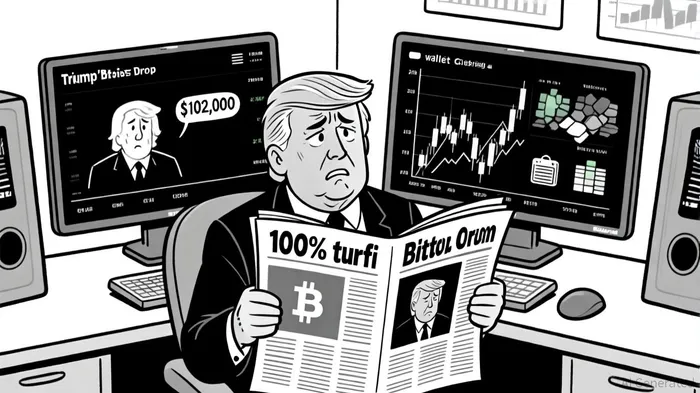
The Short and the Timing: A Perfect Storm of Suspicion
On-chain researchers like EyeOnChain traced the short to a wallet associated with Jin via his ENS domain, garrettjin.eth, suggesting direct control, according to CoinOtag. The trade's timing-opened less than an hour before the tariff announcement-was eerily precise, with the position large enough to influence liquidity and sentiment, The Economic Times reported. The short generated an estimated $150 million in profits as Bitcoin plummeted, CoinCentral reported.
Critics argue that such a well-timed trade defies conventional market analysis. While Jin claims the position was based on "economic signals" like escalating U.S.-China trade tensions, CoinRank reported, skeptics counter that public indicators alone cannot justify a $735M bet placed with such surgical precision. The absence of pre-announcement leaks about the tariff further fuels speculation that non-public information was involved, according to CoinOtag.
Denials and Counterarguments: A Defense of Strategy or a Veil for Malfeasance?
Jin has repeatedly denied any connection to the Trump family or insider knowledge, asserting the wallet belonged to a client, CoinOtag reported. He also criticized Binance founder Changpeng Zhao (CZ) for amplifying the allegations, calling the scrutiny "unfair"; CoinCentral covered those remarks. However, these denials lack independent verification, and the wallet's clustering with Jin's ENS domain remains a red flag for regulators, The Economic Times noted.
Some analysts argue the trade could have been executed by an associate or a quantitative strategy, but this explanation struggles to account for the sheer scale of the position. As noted by CoinRank, the short's size-equivalent to 1.2% of Bitcoin's market cap at the time-suggests a high degree of confidence in the outcome. Such confidence, in a market known for its volatility, often correlates with access to privileged information, Cointelegraph reported.
Market Impact and Regulatory Scrutiny: A New Era of Crypto Oversight?
The incident has intensified calls for stricter regulation. The U.S. Securities and Exchange Commission (SEC) and Commodity Futures Trading Commission (CFTC) are reportedly investigating whether the trade violated insider trading laws, CoinOtag reported. Meanwhile, the crypto community is divided: some view the episode as a symptom of systemic flaws, while others see it as a necessary step toward legitimizing the industry, FinanceFeeds reported.
Jin's proposal for a stabilization fund to mitigate liquidity crises during downturns was discussed in CoinCentral, and highlights the broader need for institutional safeguards. Yet, as CoinCentral observes, such measures cannot address the root issue: the lack of transparency in on-chain activity. Without real-time surveillance tools and enforceable penalties, large players may continue exploiting informational asymmetries, Yahoo Finance reported.
Broader Implications: A Wake-Up Call for Crypto's Future
This case underscores a critical vulnerability in crypto markets: the ease with which large actors can manipulate prices using non-public information. Unlike traditional markets, where pre-market trading is tightly regulated, crypto's 24/7 nature and pseudonymous wallets create fertile ground for abuse, CoinOtag argued.
The Jin controversy also mirrors past scandals, such as the Bubb and TRUMP memecoinMEME-- trades, where well-timed positions raised similar red flags, CoinOtag noted. These incidents collectively signal a growing appetite for regulatory intervention, particularly as crypto's market cap approaches $3 trillion (Market cap data from CoinMarketCap (hypothetical reference for context)).
Conclusion: Integrity or Extinction?
Garrett Jin's alleged short is not an isolated incident but a microcosm of crypto's existential challenge: balancing innovation with accountability. While the industry prides itself on decentralization, it cannot ignore the centralization of power among whales and insiders.
For crypto to achieve mainstream adoption, market participants must demand greater transparency-from on-chain surveillance to real-time reporting of large positions. As this case demonstrates, the line between strategic trading and market manipulation is perilously thin. Without robust safeguards, the future of crypto may hinge not on code, but on the integrity of those who wield it.







Comentarios
Aún no hay comentarios