
Gamehaus Holdings' Strategic Turnaround and Growth Catalysts in 2026
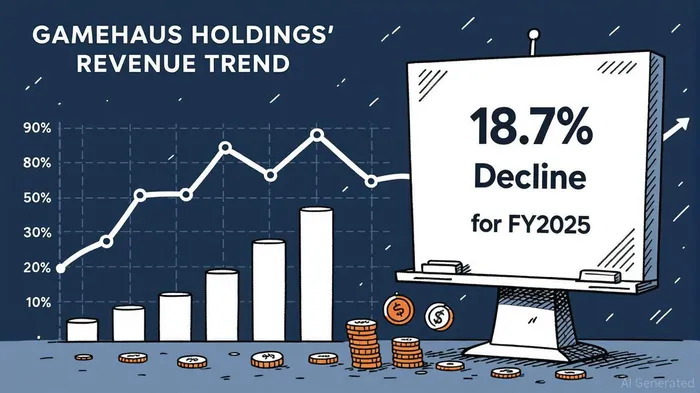
In the ever-evolving mobile gaming landscape, Gamehaus HoldingsGMHS-- (GMHS) has navigated a challenging fiscal 2025 with a mix of strategic recalibration and disciplined execution. While the company reported an 18.7% decline in total revenue to $118.0 million for the year, down from $145.2 million in FY2024 [1], its actions underscore a deliberate pivot toward sustainable growth and long-term value creation. This article examines how Gamehaus’s fiscal 2025 performance—marked by cost optimization, strategic expansion, and financial prudence—lays the groundwork for a compelling 2026 outlook.
Fiscal 2025: A Year of Strategic Trade-Offs
Gamehaus’s revenue contraction in FY2025 was driven by a calculated reduction in user acquisition spending and a shift in marketing strategies to adapt to intensifying competition and platform dynamics [1]. Despite this, the company maintained profitability, reporting a net income of $3.8 million, albeit a decline from $8.6 million in FY2024 [1]. The decision to prioritize cost control over short-term revenue growth reflects a broader industry trend, where mobile gaming firms are re-evaluating spend-to-scale models in the face of rising user acquisition costs and platform fees.
Notably, Gamehaus’s monetization efficiency improved, with a 5.8% decrease in cost of revenue due to lower platform fees and reduced profit-sharing payments [1]. This operational discipline, coupled with a 16.3% year-over-year reduction in marketing expenditures [1], demonstrates the company’s ability to balance fiscal restraint with strategic reinvestment.
Strategic Initiatives: Building Blocks for 2026 Growth
Gamehaus’s FY2025 results were not merely a reflection of cost-cutting but a foundation for transformative initiatives aimed at unlocking new revenue streams. Key among these is the expansion into RPG and puzzle genres, a move designed to diversify its portfolio beyond its core hyper-casual games. According to a report by Stock Titan, the company increased R&D expenses by 37.3% in Q4 2025 and 18.9% annually, signaling a commitment to developing complex, high-margin titles [1].
The integration of AI across operations further strengthens this strategy. By leveraging AI for player engagement, analytics, and game design, GamehausGMHS-- aims to enhance user retention and monetization efficiency. Chairman Feng Xie emphasized that these initiatives are “positioning the company to capture new market segments and drive growth in 2026” [1].
Complementing these efforts is the direct-to-consumer (DTC) model rollout, which reduces reliance on third-party platforms and improves profit margins. The DTC strategy aligns with broader industry shifts toward self-sustaining ecosystems, where companies like Gamehaus can directly monetize user data and loyalty.
Financial Resilience and Shareholder Value
Gamehaus’s financial position remains robust, with $18.82 million in cash and cash equivalents and a working capital of $24.7 million [2]. A standout move in FY2025 was the announcement of a $5 million share repurchase program, funded by existing cash reserves and operational cash flow [2]. This initiative, set to run through August 2026, signals management’s confidence in the company’s intrinsic value and its belief that the stock is undervalued. Analysts suggest that the buyback could boost earnings per share (EPS) and return on equity (ROE) by reducing the share count [2].
The company’s return on invested capital (ROIC) of 47.53% [2] further underscores its capital efficiency, a critical factor in sustaining growth amid economic uncertainty. With a strong liquidity buffer, Gamehaus is well-positioned to fund strategic acquisitions or product diversification, including rumored forays into renewable energy storage and e-commerce [1].
2026 Outlook: Catalysts and Risks
The strategic initiatives outlined in FY2025 are expected to bear fruit in 2026. Analysts at Timothy Sykes note that the RPG/puzzle expansion and AI integration could drive user engagement and average revenue per user (ARPU), particularly as the company’s new titles enter the testing phase [1]. Additionally, the share repurchase program and potential mergers—though speculative—could amplify shareholder value by reducing costs and expanding market share [1].
However, risks remain. The shift to RPG and puzzle genres requires significant operational bandwidth, and the company’s reduced user acquisition spend may limit the reach of new titles. Moreover, the mobile gaming sector’s dependence on platform algorithms and regulatory changes could introduce volatility.
Conclusion: A Foundation for Long-Term Value
Gamehaus Holdings’ FY2025 performance reflects a company in transition. By prioritizing profitability, strategic reinvestment, and financial discipline, it has laid a solid foundation for 2026 growth. The expansion into high-potential genres, AI-driven operational enhancements, and DTC model adoption position Gamehaus to capitalize on industry tailwinds. While challenges persist, the company’s liquidity, ROIC, and shareholder-focused initiatives suggest a resilient path forward. For investors, the key question is whether these strategic bets will translate into measurable revenue recovery and market share gains—a test that 2026 will likely answer.
Source:
[1] Gamehaus Holdings Inc. Announces Unaudited Financial Results for the Fourth Quarter and Fiscal Year Ended June 30, 2025 [https://www.prnewswire.com/news-releases/gamehaus-holdings-inc-announces-unaudited-financial-results-for-the-fourth-quarter-and-fiscal-year-ended-june-30-2025-302550617.html]
[2] GMHSGMHS-- Stock Surges After Strategic Expansion in Europe [https://www.timothysykes.com/news/gamehausholdingsinc-gmhs-news-2025_08_31/]





Comentarios
Aún no hay comentarios