
The Game-Changing Implications of the First US Spot XRP ETF Launch
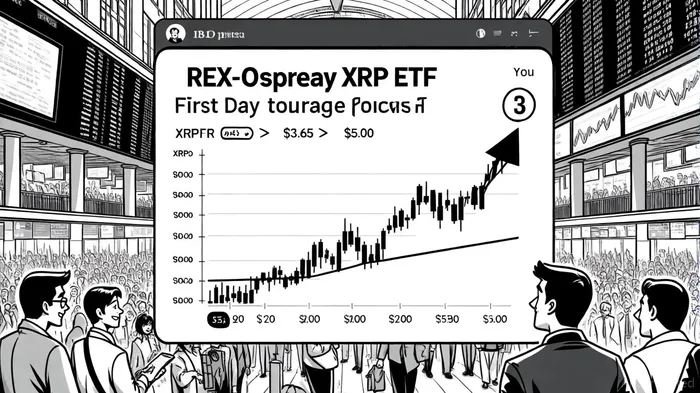
The launch of the REX-Osprey Spot XRPXRP-- ETF (ticker: XRPR) on September 18, 2025, marked a seismic shift in the cryptocurrency market, redefining institutional access to digital assets and challenging long-held assumptions about market structure. With a record-breaking $37.7 million in first-day trading volume[1], the ETF's debut not only shattered expectations but also signaled a maturation of the crypto-asset class. This development, coupled with the SEC's recent adoption of generic listing standards for crypto ETFs[2], has created a regulatory framework that could catalyze a wave of institutional adoption, fundamentally altering liquidity dynamics and price discovery mechanisms for XRP.
Market Structure Disruption: Liquidity, Derivatives, and Price Stability
The XRPR ETF's hybrid structure—combining direct XRP holdings with derivatives and Treasuries—introduces a novel model for crypto exposure[3]. Unlike traditional spot ETFs, which hold physical assets exclusively, this approach allows for flexibility in managing liquidity and mitigating volatility. According to a report by Bloomberg analyst Eric Balchunas, the ETF's first-day volume eclipsed that of all prior crypto futures ETFs combined, underscoring its role as a liquidity aggregator[4]. This liquidity concentration could reduce the reliance on decentralized exchanges for XRP trading, shifting capital flows toward regulated custodians and institutional-grade platforms.
However, the immediate price impact of the ETF's launch was muted. Despite $24 million in trading volume within the first 90 minutes[5], XRP's spot price remained stagnant near $3, even as large whale transfers to exchanges raised concerns about selling pressure[6]. Analysts attribute this divergence to short-term profit-taking and broader market volatility, but the long-term implications remain bullish. A Grok model projection suggests that sustained institutional inflows—potentially exceeding $20 billion in the ETF's debut phase—could tighten XRP's circulating supply and drive the price toward $5–$15 by 2035[7].
Institutional Adoption: From Custodians to Capital Flows
The XRPR ETF's success has been underpinned by institutional confidence, particularly in the wake of the SEC's August 2025 settlement with Ripple, which cleared XRP of securities classification[8]. This regulatory clarity has enabled custodians like Galaxy DigitalGLXY-- and CoinShares to expand their XRP holdings, while Ripple's On-Demand Liquidity service processed $1.3 trillion in Q2 2025 alone[9]. With seven additional XRP ETF applications pending SEC review—including proposals from Grayscale, Bitwise, and Franklin Templeton—the market is bracing for a potential $4.3–$8.4 billion influx of capital[10].
Institutional inflows are further amplified by the ETF's role as a gateway for traditional investors. As stated by a CoinDesk analysis, the XRPR ETF's $37.7 million debut volume—five times that of any prior crypto futures ETF—demonstrates that institutional players are now treating XRP as a legitimate asset class[11]. This shift is critical for XRP's adoption in real-world applications, such as Ripple's tokenized treasuries and cross-border payment networks[12].
Price Dynamics and Technical Outlook
While the ETF's launch did not immediately translate to a price surge, technical indicators suggest a looming breakout. XRP's formation of a bull-flag pattern near $3.08, with $3.65 as a key resistance level, has drawn attention from traders[13]. A decisive close above this threshold could trigger a rally toward $5 or higher, particularly if pending ETF approvals materialize. However, short-term volatility remains a risk, as highlighted by The Coin Republic's analysis of whale activity and broader crypto market trends[14].
Conclusion: A New Era for Digital Assets
The REX-Osprey XRP ETF's launch is more than a regulatory milestone—it is a harbinger of structural change in digital asset markets. By bridging the gap between institutional capital and crypto liquidity, the ETF has set a precedent for future products, from BitcoinBTC-- spot ETFs to tokenized real-world assets. As the SEC's streamlined approval process accelerates innovation[15], XRP's journey from a controversial token to a regulated investment vehicle exemplifies the evolving interplay between technology, regulation, and market forces.







Comentarios
Aún no hay comentarios