
GalaxyOne: A Game-Changer for High-Risk, High-Reward Investors in the Evolving Digital Asset Ecosystem
In the ever-shifting landscape of finance, the line between traditional and digital assets is blurring faster than ever. Enter GalaxyOne, a platform launched in 2025 by Galaxy DigitalGLXY-- that's positioning itself as a bridge between institutional-grade infrastructure and retail investors. For those willing to tolerate higher risk, GalaxyOne offers a tantalizing mix of high-yield cash products, crypto trading, and equities access-all underpinned by the same institutional-grade lending and custody systems that have long served institutional clients. But is this the next frontier for retail investors, or a volatile gamble? Let's break it down.
Institutional-Grade Yield: A New Benchmark for Retail
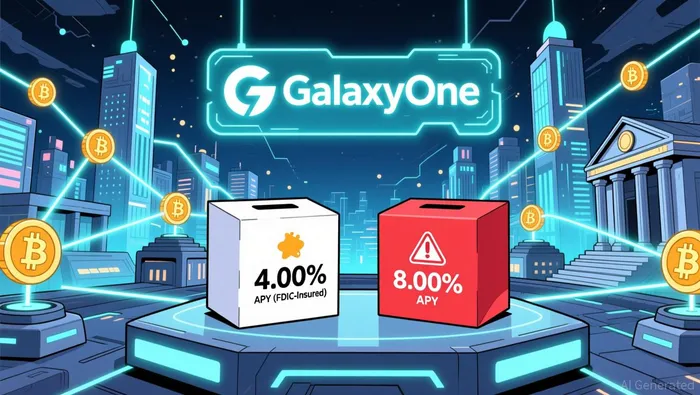
GalaxyOne's most eye-catching offering is the Galaxy Premium Yield note, which delivers an 8.00% annual percentage yield (APY) for accredited investors with a minimum $25,000 investment according to reports. This is a stark contrast to traditional savings accounts, which, as of late 2025, max out at around 5.00% APY for high-yield options according to financial data. For context, the Federal Reserve's national average for savings accounts hovers near 0.40% according to official data, making GalaxyOne's returns look almost otherworldly.
But here's the catch: the 8% APY is not FDIC-insured. Instead, it's backed by Galaxy's institutional lending business, which has a loan book of $9.9 billion as of Q4 2024 according to internal reports. This means investors are exposed to the risks inherent in Galaxy's lending operations-defaults, market volatility, and regulatory scrutiny. For accredited investors, this is a calculated trade-off: higher returns for higher risk.
Meanwhile, GalaxyOne's Cash Account offers a safer bet with a 4.00% APY, FDIC-insured up to $250,000 via Cross River Bank according to platform details. This product competes directly with traditional high-yield savings accounts but with the added allure of being part of a platform that also offers crypto and equities trading.
Risk-Adjusted Returns: A Double-Edged Sword
GalaxyOne's risk profile is no secret. The platform has a beta of 3.85, indicating volatility far exceeding that of traditional savings vehicles according to market analysis. This volatility stems from its exposure to both digital assets and its lending business. For example, Galaxy's Q3 2025 earnings report showed a GAAP net income of $505 million and adjusted EBITDA of $629 million according to financial disclosures, reflecting strong performance. However, such results are contingent on favorable market conditions. If the crypto market sours or defaults rise in Galaxy's loan book, the 8% APY could evaporate-or worse.
Compare this to a Certificate of Deposit (CD), which locks in fixed returns with minimal risk. While CDs may lag in flexibility, they offer stability-a critical factor for conservative investors according to financial experts. GalaxyOne, by contrast, is a high-stakes game. As one expert analysis notes, digital asset treasury companies (DATs) like GalaxyOne face "severe drawdowns when market conditions deteriorate" due to leveraged positions and concentrated asset exposure according to industry research.
Institutional Infrastructure, Retail Access
What sets GalaxyOne apart is its institutional-grade infrastructure. The platform leverages Galaxy's decade-long experience in crypto lending and custody, offering retail investors access to tools typically reserved for institutions. For instance, the stock lending program allows eligible investors to earn passive income by lending their shares-a feature rarely available on platforms like Robinhood or E-Trade according to platform analysis.
Moreover, GalaxyOne's integration of crypto and equities trading under one roof is a game-changer. Investors can auto-reinvest cash yields into cryptocurrencies like BitcoinBTC-- or EthereumETH--, creating compounding opportunities. However, this also introduces crypto-specific risks, such as price swings and regulatory uncertainty. Traditional platforms, by contrast, lack this hybrid model, often siloing crypto and equities into separate ecosystems.
The Integrated Ecosystem: A Unified Front
GalaxyOne's roadmap hints at even more ambitious moves. Future features include business accounts, crypto staking, and expanded lending products according to platform updates. This unified approach mirrors the institutional world, where asset managers juggle multiple strategies across asset classes. For retail investors, it's a rare chance to replicate that complexity without the overhead.
Yet, the platform's success hinges on its ability to maintain institutional-grade security and compliance. Galaxy's acquisition of Fierce, the platform's original developer, has brought in seasoned leadership like Zac Prince and Rob Cornish according to company announcements, but the crypto space remains a wild west.
Conclusion: A High-Stakes Opportunity
GalaxyOne is undeniably a disruptor. It offers retail investors a taste of institutional-grade yields and tools, all while navigating the volatile waters of digital assets. For accredited investors with a high-risk tolerance, the 8% APY is a siren song. But for the average saver, the lack of FDIC insurance and the platform's beta of 3.85 demand caution.
In the end, GalaxyOne isn't for everyone. It's a platform that rewards those who understand the risks and are willing to embrace the volatility. As the digital asset ecosystem evolves, GalaxyOne could either cement itself as a pioneer or serve as a cautionary tale. For now, it's a compelling option for those who dare to play the long game.







Comentarios
Aún no hay comentarios