
Galaxy Digital's $460M Bet: A High-Conviction Play in AI-Ready Data Infrastructure
The cryptocurrency industry is undergoing a seismic shift. As BitcoinBTC-- mining profitability wanes post-2024 halving and regulatory headwinds mount, a new frontier is emerging: AI-ready data infrastructure. At the forefront of this transformation is Galaxy Digital, a firm once synonymous with crypto finance, now repositioning itself as a critical player in the AI and high-performance computing (HPC) ecosystem. With a $460 million strategic investment from a leading asset management firm and a $1.4 billion project financing facility for its Helios data center in Texas, Galaxy is betting big on repurposing legacy Bitcoin infrastructure for AI workloads. This article assesses whether this move represents a high-conviction play in a sector poised for explosive growth.
Strategic Shift: From Bitcoin to AI
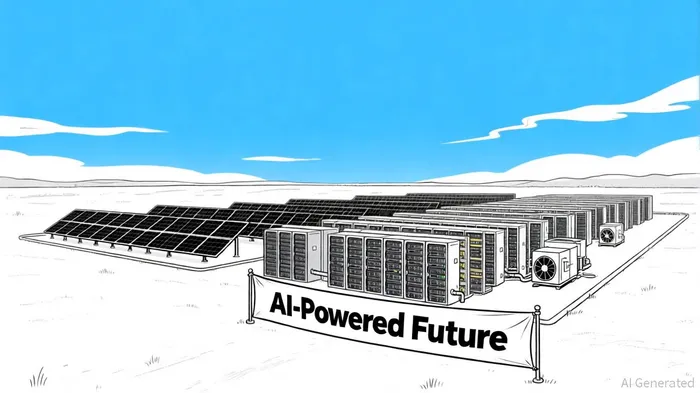
Galaxy's pivot is emblematic of a broader industry trend. Bitcoin miners, once reliant on energy-intensive SHA-256 hashing, are now retrofitting their facilities to host AI and HPC workloads. The technical overlap between the two is striking: both demand massive power consumption, efficient cooling, and low-latency networking. Galaxy's Helios campus in Dickens County, Texas-a former Bitcoin mining hub-is being redeveloped to deliver 133 MW of critical IT load by mid-2026, with plans to scale to 3.5 GW at full buildout, according to a Galaxy announcement. This transformation is not just operational but strategic. By securing a 15-year lease with CoreWeaveCRWV--, a leading AI cloud provider, Galaxy has locked in $4.5 billion in projected revenue over the contract period, according to Business News Today.
The $460 million investment from a top-tier asset management firm underscores the credibility of this pivot. The infusion includes 9.02 million new shares and insider sales, with proceeds earmarked for corporate initiatives and Helios expansion, the Galaxy announcement said. This capital raise is more than a financial lifeline-it's a reputational endorsement. Traditional institutional investors, who once shunned crypto, are now flocking to firms with physical compute infrastructure, a trend highlighted by analysts at Business News Today. Galaxy's CEO emphasized that the investment strengthens its balance sheet, enabling scalable data center operations while retaining flexibility for future opportunities, the Galaxy announcement added.
Technical Adaptations: Bridging the Gap
Repurposing Bitcoin infrastructure for AI is no small feat. While the power and cooling systems of mining facilities align with AI needs, the hardware and software stack require overhauls. Galaxy's Helios campus is being retrofitted to support GPU-based operations, though specific GPU models (e.g., NVIDIA H100 or AMD MI300X) remain undisclosed, according to a Galaxy commitment. Networking upgrades, including high-speed interconnects like InfiniBand or 100G Ethernet, are critical for distributed AI training, as noted in a Datacenters.com piece. Storage solutions, such as NVMe SSDs and distributed file systems, are also being integrated to manage petabytes of training data, the Datacenters.com piece reported.
The challenges are significant. Unlike Bitcoin's continuous workloads, AI tasks are bursty and require dynamic load balancing. Galaxy must reprofile power systems, upgrade UPS infrastructure, and implement thermal mapping to ensure stability, the Datacenters.com piece explains. Software expertise in frameworks like PyTorch and orchestration tools like Kubernetes is another hurdle, the Datacenters.com piece adds. Yet, the economic incentives are compelling: AI hosting margins can exceed 90% EBITDA, with revenue per megawatt outpacing Bitcoin mining by an order of magnitude, according to an Aethir analysis.
Competitive Positioning: A New Breed of AI Infrastructure Player
Galaxy's move places it in direct competition with peers like Core Scientific and traditional cloud giants such as Microsoft and Amazon. Core Scientific, which has also pivoted to AI, secured a $3.5 billion 12-year deal with CoreWeave, redirecting 200 MW of capacity from Bitcoin to GPU hosting, as noted in the Aethir analysis. However, Galaxy's Helios campus, with its 3.5 GW potential, dwarfs Core Scientific's current offerings. Meanwhile, cloud providers face lengthy lead times for new data center builds, giving Galaxy and its peers a speed-to-market advantage, the Aethir analysis argues.
The financial stakes are high. Microsoft plans $80 billion in 2025 CapEx for AI expansion, while Amazon aims to raise its AWS CapEx to $100 billion, according to a TrendForce report. Galaxy's $1.4 billion project financing for Helios, combined with its $460 million capital raise, positions it as a niche but formidable player in a fragmented market, the Galaxy announcement noted.
Market Validation and Risks
The market is validating this shift. The Flexential report found 81% of IT leaders cite the C-suite as the primary driver of AI initiatives, with 70% allocating at least 10% of IT budgets to AI. Yet, infrastructure constraints remain a top barrier, with 44% of organizations struggling to scale, the Flexential report also found. Galaxy's Helios campus, with its pre-existing power interconnects and rapid deployment timelines, addresses these pain points directly, as the Aethir analysis argues.
Risks persist, however. Galaxy reported a $265 million net loss in Q2 2025, per a Panabee report. While the $460 million raise and $1.4 billion financing provide liquidity, execution risks-such as delays in retrofitting or GPU shortages-could derail the timeline. Additionally, enterprise clients may remain wary of crypto firms, despite Galaxy's pivot, a concern raised in the Aethir analysis.
Conclusion: A High-Conviction Play
Galaxy Digital's $460 million capital move is more than a strategic pivot-it's a bet on the future of computing. By repurposing legacy Bitcoin infrastructure for AI, the firm is leveraging its assets to meet a surging demand for scalable, energy-efficient compute. With Helios positioned to become one of the world's largest AI data centers and a long-term partnership with CoreWeave, Galaxy is well-placed to capitalize on the AI infrastructure boom. While challenges remain, the alignment of technical feasibility, economic incentives, and market demand makes this a high-conviction play for investors willing to ride the next wave of digital transformation.





Comentarios
Aún no hay comentarios