
GAIL's Arbitration Claim and Strategic Pipeline Expansion: Assessing Operational Resilience and Long-Term Growth
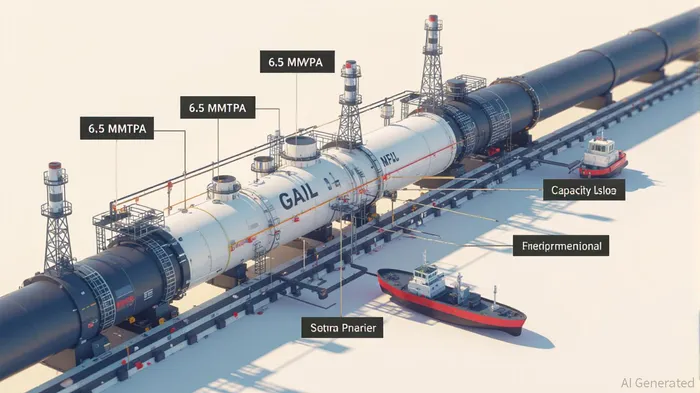
In the volatile landscape of global energy markets, GAIL (India) Limited's recent arbitration claims and infrastructure investments underscore its dual strategy of mitigating contractual risks while capitalizing on India's surging energy demand. As the country's largest gas transmission company, GAIL's ability to navigate legal disputes and scale infrastructure will determine its resilience amid regulatory and operational headwinds.
Arbitration Claims: A Double-Edged Sword
GAIL's recent arbitration claim of Rs 639.18 crore (USD 80 million) against Focus EnergyEFOI-- Ltd and others for non-supply of make-up gas highlights the fragility of long-term supply contracts in a sector prone to geopolitical and market volatility[1]. This follows a landmark settlement with SEFE Marketing & Trading Singapore Pte Ltd, a former Gazprom unit, where GAIL secured USD 285 million to resolve a USD 1.817 billion dispute over LNG non-deliveries linked to Russian sanctions[2]. While these legal battles drain resources, they also underscore GAIL's commitment to enforcing contractual obligations—a critical factor in maintaining investor confidence.
The financial implications are significant. The SEFE settlement, for instance, injected a one-off income of ₹2,440 crore into GAIL's Q3 FY2025 results, boosting Profit Before Tax (PBT) by 52% sequentially[3]. Such windfalls, however, are not sustainable. The real test lies in GAIL's ability to convert these settlements into operational stability, ensuring that supply disruptions do not recur.
Pipeline Expansion: A Strategic Bet on Demand
To counteract supply uncertainties, GAIL has prioritized infrastructure expansion. The recent approval to double the capacity of its Jamnagar-Loni LPG pipeline to 6.5 MMTPA (from 3.25 MMTPA) is a case in point[1]. This move aligns with India's LPG demand growth of 6% over the past decade, driven by urbanization and government initiatives like the Ujjwala Yojana. By 2030, the offshore pipeline infrastructure market—where GAIL is a key player—is projected to grow to USD 74.4 billion from USD 63.3 billion in 2025[4], offering a tailwind for the company's transmission and marketing segments.
Financial Resilience and Analyst Outlook
GAIL's Q1 FY2025-26 results revealed a mixed picture: consolidated revenues rose 1.4% YoY to ₹35,454.81 crores, but net profit fell 25.2% YoY to ₹2,382.24 crores[1]. However, standalone performance was robust, with a 28% YoY increase in profit after tax, driven by higher gas transmission and marketing volumes[2]. Management's optimism for FY2026—targeting 138–139 MMSCMD transmission volumes and major CapEx project completions—signals confidence in operational efficiency[3].
Analysts remain cautiously bullish. A 12-bank consensus projects a target price of ₹251.43 for GAIL by the medium term, citing its expanding pipeline network and digital transformation initiatives[4]. The integration of AI in energy permitting and licensing, for instance, could streamline operations and reduce regulatory delays[4].
Risks and Opportunities
While GAIL's arbitration settlements and pipeline expansion bolster its long-term prospects, risks persist. Regulatory scrutiny of gas pricing, geopolitical tensions affecting LNG imports, and the cyclical nature of arbitration outcomes could temper growth. However, the company's strategic focus on diversifying supply sources and digitizing operations positions it to weather these challenges.
Conclusion
GAIL's dual strategy of enforcing contractual discipline and investing in infrastructure reflects a pragmatic approach to navigating India's energy transition. While arbitration claims highlight the sector's inherent risks, the company's ability to convert settlements into liquidity and scale its pipeline network demonstrates operational resilience. For investors, the key will be monitoring how effectively GAIL balances short-term legal challenges with long-term growth opportunities in a market poised for expansion.







Comentarios
Aún no hay comentarios