
The FXS-to-FRAX Transition: A Strategic Opportunity in Binance's Ecosystem Shift
The FXS-to-FRAX transition in April 2025 marked a pivotal evolution in the FraxFRAX-- ecosystem, rebranding the governance token as the native gasGAS-- token for the Fraxtal blockchain. This shift, part of the North Star upgrade, consolidated FRAX's utility as both a governance and transactional asset, replacing frxETH as the primary gas token while introducing a tail emission schedule starting at 8% annual inflation, gradually decreasing to 3%. The rebranding also reduced circulating supply by ~12%, signaling technical maturity and attracting speculative interest. For investors, this transition represents a strategic opportunity to analyze how tokenomics and exchange-driven liquidity migration-particularly on Binance-shape the asset's long-term value proposition.
Tokenomics: Balancing Inflation and Deflation
The North Star upgrade introduced mechanisms to balance supply dynamics. The Flox Capacitor, for instance, incentivizes long-term holding by boosting conversion efficiency for users locking tokens in dedicated contracts, potentially offsetting inflationary pressures. 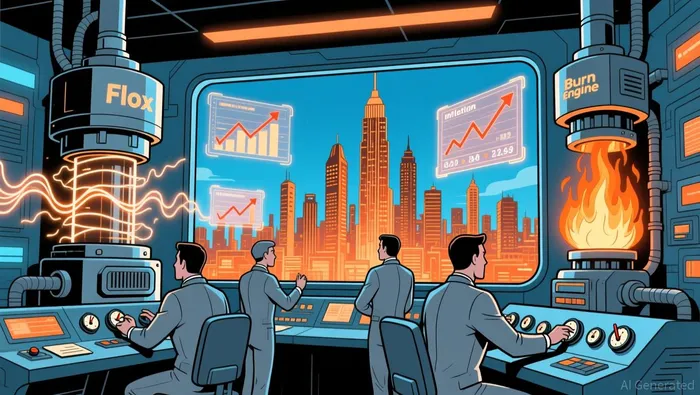 Simultaneously, the Frax Burn Engine aims to counterbalance supply growth through token destruction via activities like domain registrations and transaction fees, introducing deflationary dynamics. These dual forces-controlled inflation and targeted burning-create a framework where FRAX's utility expands across DeFi protocols, staking, and governance, while its role as a gas token for Fraxtal enhances demand.
Binance's role in this transition was critical. The exchange suspended FXS deposits and withdrawals on January 13, 2026, to facilitate the 1-to-1 swap to FRAX, later reopening FRAX deposits on January 15, 2026. This timing aligned with Frax's broader strategy to reduce circulating supply, which historically precedes price rallies. By acting as a bridge between legacy FXS liquidity and the new FRAX ecosystem, Binance positioned itself to capture a share of the rebranded token's growing utility.
Liquidity Migration: Binance's Strategic Leverage
Liquidity migration during the transition was managed through a combination of internalisation and exchange-driven incentives. In April 2025, dealer banks absorbed significant client trading on their own books, minimizing market impact and maintaining liquidity despite volatility. This trend, particularly pronounced in Asian financial hubs with internalisation ratios exceeding 80%, stabilized FRAX's price during the swap. Binance, with its $20 billion daily trading volume across 1,600 pairs, leveraged its liquidity flywheel to handle large trade flows, ensuring minimal slippage for FRAX pairs.
While specific incentives for the FXS-to-FRAX swap on Binance are not explicitly detailed in the research, Frax's broader ecosystem introduced liquidity provider (LP) rewards for the Legacy FRAX/frxUSD Curve pool, ensuring market-based swaps with minimal slippage. Additionally, governance proposals like FIP-429 allocated joint incentives for pools such as Zivoe's zveUSD/frxUSD, signaling Frax's commitment to liquidity expansion. These mechanisms, combined with Binance's infrastructure, created a fertile ground for FRAX to attract both retail and institutional capital.
Investor Implications: Navigating Risks and Rewards
The transition's success hinges on adoption rates and post-migration liquidity. While the 12% supply reduction and enhanced utility are bullish signals, post-swap liquidity for FRAX was initially thin, with a 24-hour trading volume of $5.35 million, raising concerns about slippage during large trades. However, Binance's risk mitigation frameworks, including collateral reforms in 2025, provided a buffer against volatility. For investors, this duality-technical strength versus liquidity fragility-demands a nuanced approach.
Strategically, FRAX's integration with platforms like NEAR ProtocolNEAR-- and Echo Market, alongside veFRAX governance staking, enhances its cross-chain utility. These developments align with Binance's 2025 vision of expanding yield programs through liquid staking and tokenized real-world assets. Investors who position early in FRAX's liquidity pools or staking mechanisms may capitalize on its expanding role in DeFi, particularly as the Fraxtal ecosystem matures.
Conclusion: A Strategic Inflection Point
The FXS-to-FRAX transition exemplifies how tokenomics and exchange-driven liquidity migration can redefine a digital asset's trajectory. Binance's infrastructure and Frax's protocol upgrades have created a symbiotic relationship, where FRAX's utility as a gas token, governance asset, and stablecoin collateral drives demand. For investors, the key lies in balancing the token's technical strengths-controlled inflation, deflationary mechanisms, and cross-chain interoperability-with the evolving liquidity landscape. As the Fraxtal ecosystem expands, FRAX's strategic position within Binance's ecosystem offers a compelling case for long-term value creation.






Comentarios
Aún no hay comentarios