
Is FXG a Viable Smart Beta ETF for Income-Oriented Investors?
In the ever-evolving landscape of passive investing, smart beta ETFs have emerged as a compelling middle ground between traditional index funds and active management. For income-oriented investors, the allure of these products lies in their promise of enhanced risk-adjusted returns and strategic exposure to market factors. However, the First Trust Consumer Staples AlphaDEX ETF (FXG), a smart beta fund focused on the consumer staples sector, raises critical questions about cost efficiency and performance. As the sector remains a staple for dividend-seekers, the debate over FXG’s viability hinges on its expense ratio and risk profile relative to lower-cost alternatives like the Vanguard Consumer Staples ETF (VDC) and the Consumer Staples Select Sector SPDR ETF (XLP).
Cost Efficiency: A Sticking Point
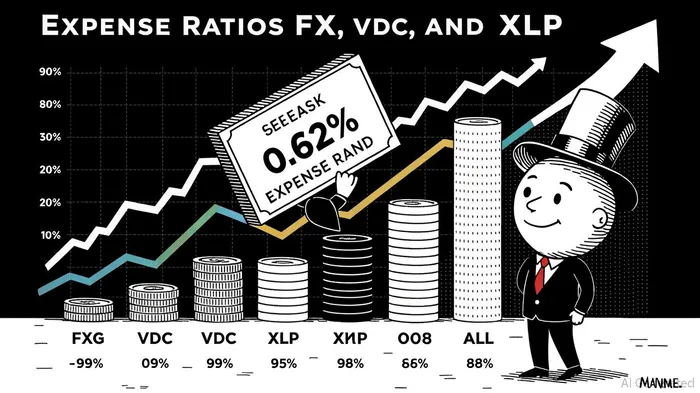
FXG’s expense ratio of 0.62% places it in stark contrast to VDC (0.09%) and XLP (0.08%), both of which offer market-cap-weighted exposure to the same sector [1][2]. For income-oriented investors, who often prioritize compounding returns over time, the 530-basis-point difference between FXG and its peers is significant. According to a report by Nasdaq, this cost disparity could erode long-term gains, particularly for investors with smaller portfolios or those relying on dividend reinvestment [1]. While smart beta strategies often justify higher fees with claims of superior risk management or factor exposure, FXG’s performance data does not yet provide a clear justification for its premium pricing.
Risk-Adjusted Returns: Volatility vs. Sharpe Ratio
The consumer staples sector is inherently defensive, but FXG’s volatility complicates its appeal. Over a three-year period, FXG exhibited a standard deviation of 12%, outpacing the 9.6% volatility of the S&P Consumer Staples Index [2]. This suggests that FXG’s multi-factor, tiered equal-weighting approach—designed to diversify risk—may instead amplify short-term fluctuations. For income investors, whose primary goal is stable cash flow, such volatility could undermine confidence in the fund’s ability to preserve capital during market downturns.
Sharpe ratios, a key metric for evaluating risk-adjusted returns, further muddy the picture. While FXG’s Sharpe ratio is noted to lag behind the S&P Consumer Staples Index [2], VDC and XLP, with their lower expense ratios and market-weighted structures, appear to offer more favorable risk-return profiles. Though precise three-to-five-year Sharpe ratios for these funds remain elusive in recent data [3], their historical qualitative risk assessments—such as XLP’s lowest standard deviation among the trio—suggest they may better align with the risk-averse objectives of income-focused portfolios [2].
Strategic Considerations: Equal-Weight vs. Market-Weight
FXG’s strategy of equal-weighting stocks within the consumer staples sector aims to reduce concentration risk by giving smaller constituents a larger role in the portfolio. However, this approach comes at a cost: higher turnover and transaction expenses, which are already embedded in its 0.62% fee. In contrast, VDC and XLP’s market-cap-weighted methodologies mirror the sector’s natural hierarchy, favoring large, stable dividend payers like Procter & Gamble and Coca-ColaKO--. For income investors, the latter’s emphasis on established companies with predictable cash flows may outweigh the diversification benefits of FXG’s structure.
Conclusion: A Costly Premium for Uncertain Gains
For income-oriented investors, the decision to allocate capital to FXG hinges on a critical trade-off: paying a premium for a smart beta strategy that has yet to demonstrably outperform lower-cost alternatives in terms of risk-adjusted returns. While FXG’s equal-weight approach may appeal to those seeking diversification, its higher volatility and expense ratio make it a less attractive option for those prioritizing stability and cost efficiency. In a sector where dividends are the primary draw, the value of a smart beta strategy must be measured not just by its innovation but by its ability to deliver consistent, tax-efficient income. Until FXG can prove its risk-adjusted returns justify its price tag, VDC and XLP remain the more prudent choices for most income-focused portfolios.
**Source:[1] Is First Trust Consumer Staples AlphaDEX ETF (FXG) a Strong ETF Right Now? [https://www.nasdaq.com/articles/first-trust-consumer-staples-alphadex-etf-fxg-strong-etf-right-now-4][2] FXG First Trust Consumer Staples AlphaDEX Fund [https://www.etf.com/FXG][3] XLP Consumer Staples Select Sector SPDR Fund [https://etfdb.com/etf/XLP/]







Comentarios
Aún no hay comentarios