
The Future of Stablecoins: Vitalik's Vision for Decentralization and Resilience
The evolution of stablecoins has long been a balancing act between stability and decentralization. In 2025, EthereumETH-- co-founder Vitalik Buterin outlined a bold roadmap for the next generation of stablecoin protocols, emphasizing quantum-resistant cryptography, decentralized oracles, and a shift away from centralized dollar pegs. For investors, this vision represents not just a technical upgrade but a paradigm shift in how value is stored, transferred, and secured in the digital age.
Vitalik's 2025–2027 Roadmap: A New Era for Stablecoins
Buterin's 2025–2027 roadmap for Ethereum prioritizes three pillars: decentralization, quantum resistance, and resilience against oracle manipulation. In a speech at DevConnect 2025, he stressed that Ethereum's transition from a "centralized trust model" to a decentralized one is critical for long-term stability. He warned that reliance on U.S. dollar pegs exposes stablecoins to inflationary and geopolitical risks, advocating instead for broader price indexes or purchasing power metrics as alternatives.
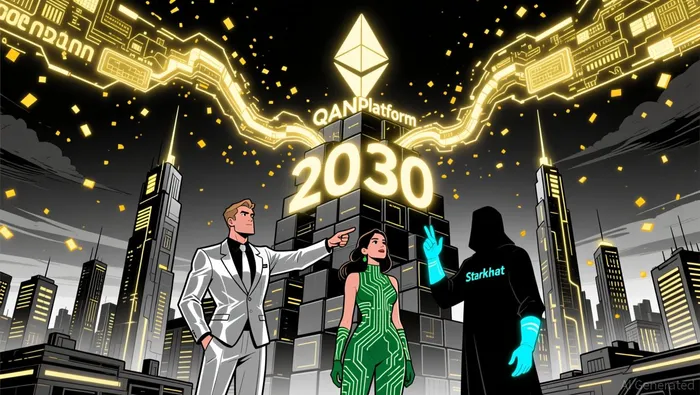
The roadmap also highlights Ethereum's commitment to quantum-resistant cryptography. Buterin noted that elliptic curve cryptography, currently the backbone of Ethereum's security, could become obsolete by 2028 due to advancements in quantum computing. To mitigate this, Ethereum is integrating lattice-based cryptography and zk-STARKs into its protocol upgrades, with a focus on Winternitz signatures and SPHINCS+ for post-quantum security.
Quantum-Resistant Protocols: The New Gold Standard
Quantum computing poses a existential threat to blockchain networks. According to a report by BTQ, Ethereum's roadmap includes a phased transition to quantum-resistant algorithms, starting with layer-2 solutions like StarknetSTRK-- and QANplatform. Starknet, for instance, leverages STARK proofs-a quantum-resistant zero-knowledge protocol-to ensure scalability and security. Meanwhile, QANplatform uses lattice-based cryptography to secure smart contracts, positioning itself as a quantum-safe infrastructure for stablecoins.
Investors should also consider projects like Abelian, which employs lattice-based algorithms to protect transaction details from quantum attacks. These protocols are not just theoretical; they are being tested in real-world applications, with QANplatform securing $15 million in funding for its quantum-resistant infrastructure.
Decentralized Oracles: The Linchpin of Stability
Stablecoins rely on oracles to maintain their pegs, but centralized oracle systems are vulnerable to manipulation. Buterin has repeatedly warned that oracle failures could destabilize entire ecosystems, emphasizing the need for decentralized oracle networks (DONs) like ChainlinkLINK-- and Band Protocol.
The U.S. GENIUS Act, enacted in January 2027, has accelerated the adoption of DONs by providing a regulatory framework for stablecoin issuers. This act has enabled Ethereum-based stablecoins like USDTUSDT-- and USDCUSDC-- to process $27.6 trillion in annual transfer volume, with decentralized oracles ensuring real-time data integrity. For investors, this regulatory clarity and institutional adoption signal a maturing market.
Investment Opportunities in Next-Gen Stablecoins
The intersection of quantum resistance and decentralized oracles has given rise to innovative stablecoin projects. Prof. Min DAI's dual-class stablecoin design, for example, uses option pricing theory and Ethereum smart contracts to separate speculative and real-world usage, enhancing resilience during market volatility. Similarly, The Hong Kong Polytechnic University's research on dual-class stablecoins offers a framework for separating stable value from speculative components, a critical feature for quantum-resistant protocols.
Investors should also monitor Ethereum's Pectra and Fusaka hard forks, which introduced programmable staking and PeerDAS for scalable data availability. These upgrades have positioned Ethereum as a robust data layer for stablecoin protocols, with projects like Base and ArbitrumARB-- leveraging its infrastructure.
The Road Ahead: A $393 Billion Market
The blockchain market is projected to grow from $33 billion in 2025 to $393 billion by 2030, driven by institutional adoption and regulatory clarity. Ethereum's focus on quantum resistance and decentralized oracles aligns with this growth trajectory, offering investors exposure to protocols that address both technical and economic challenges.
For example, QANplatform and Starknet are already attracting institutional interest, with QAN's lattice-based cryptography and Starknet's STARK proofs addressing scalability and security. Meanwhile, Abelian's privacy-focused design caters to a growing demand for quantum-safe transactions in finance and healthcare, according to Webopedia.
Conclusion
Vitalik Buterin's 2025–2027 roadmap paints a future where stablecoins are not just stable but resilient against quantum threats and oracle manipulation. For investors, this vision translates into opportunities in quantum-resistant protocols, decentralized oracles, and innovative stablecoin designs. As Ethereum continues to evolve, the next generation of stablecoins will likely redefine the boundaries of decentralized finance, offering both stability and security in an increasingly digital world.






Comentarios
Aún no hay comentarios