
The Future of Stablecoin Yield and the Battle for Financial Innovation in the U.S.
The U.S. financial system is undergoing a seismic shift as the GENIUS Act of 2025 reshapes the stablecoin landscape. By establishing a federal regulatory framework for USD-backed stablecoins, the act has introduced clarity, competition, and new risks into a market that has long been a gray zone for investors and institutions alike. For investors, the implications are profound: the act's reserve requirements, transparency mandates, and alignment with global standards are not just regulatory checkboxes-they are catalysts for a reimagined financial ecosystem.
The GENIUS Act: A New Baseline for Stablecoin Innovation
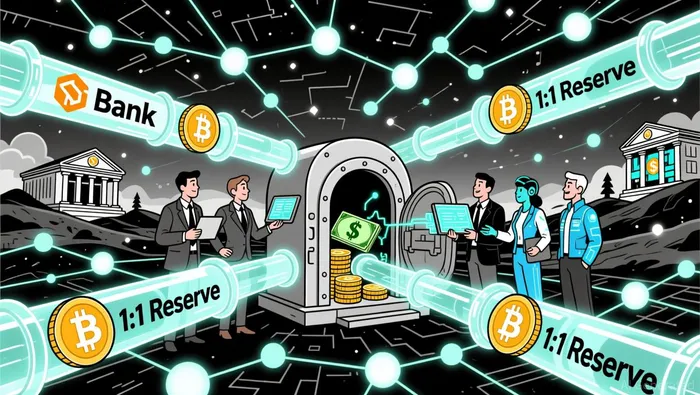
The GENIUS Act mandates that stablecoin issuers maintain 1:1 reserves of liquid assets like U.S. dollars or short-term Treasurys, with monthly public disclosures of reserve compositions according to the White House fact sheet. This requirement, while seemingly straightforward, has far-reaching consequences. It eliminates the risk of insolvency for stablecoins, a problem that plagued the sector during the 2022 collapse of TerraUSD. By doing so, the act has restored consumer confidence and attracted institutional capital. According to a report by JAMSADR, the law's clarity has spurred innovation in tokenized financial products and blockchain-based payment infrastructure.
However, the act's impact extends beyond technical compliance. It explicitly prohibits stablecoin issuers from making misleading claims about government backing or legal tender status according to the White House fact sheet. This consumer protection measure, while necessary, has also forced firms to rethink their value propositions. For example, the prohibition on paying interest directly to stablecoin holders has led to a surge in affiliated platforms offering yield-bearing products, creating a fragmented but dynamic market.
The Crypto-Bank Power Shift: Collaboration or Competition?
The GENIUS Act has created a regulatory playing field where traditional banks and crypto-native firms are both competing and collaborating. Banks, long sidelined in the digital asset space, are now exploring partnerships with stablecoin issuers or launching their own tokens according to Grant Thornton. The Office of the Comptroller of the Currency (OCC) has even granted conditional national trust bank charters to firms like BitGO Bank & Trust and Fidelity Digital Assets, enabling them to offer stablecoin services without engaging in traditional lending.
Yet this newfound access comes with risks. The Federal Deposit Insurance Corporation (FDIC) is drafting rules to determine how supervised institutions can issue stablecoins, with final regulations expected by July 2026 according to Freshfields. These rules will likely emphasize safety and soundness, but they also introduce uncertainty for banks navigating a sector where compliance costs are rising. As noted by Grant Thornton, the act's reserve and audit requirements could increase operational complexity, particularly for smaller institutions.
Meanwhile, nonbank issuers like CircleCRCL-- and PayPal are leveraging their agility to expand into yield-bearing products through partnerships with crypto exchanges according to Grant Thornton. This has created a two-tier system: banks, constrained by prudential regulations, focus on stablecoin issuance and infrastructure, while crypto firms prioritize user-facing yield opportunities. The result is a market where innovation thrives but where systemic risks-such as deposit flight to high-yield platforms-remain a concern according to Grant Thornton.
Investment Opportunities and Threats in a Regulated Era
For investors, the post-GENIUS Act landscape offers both opportunities and pitfalls. On the upside, the act's alignment with global standards like the EU's MiCA framework positions the U.S. as a leader in stablecoin innovation. This could drive demand for U.S. Treasurys as collateral for stablecoins, indirectly bolstering the dollar's reserve currency status. Additionally, the act's exemption of compliant stablecoins from SEC securities classification has opened the door for broader institutional participation according to JDSupra.
However, the regulatory environment remains complex. The Basel Committee's ongoing review of capital requirements for banks' crypto exposures introduces uncertainty for institutions with significant stablecoin holdings. Moreover, the proliferation of MiCA-compliant stablecoins in Europe could fragment the global market, forcing U.S. firms to compete on cross-border terms.
Investors should also watch for emerging business models. Real-time information-sharing platforms like the Beacon Network are helping mitigate illicit finance risks, while the Digital Asset Market Clarity Act of 2025 has created a framework for secondary trading of blockchain systems as commodities according to Global Legal Insights. These developments suggest a maturing ecosystem but also highlight the need for robust risk management.
Conclusion: Navigating the New Frontier
The GENIUS Act has redefined the stablecoin market, but it has also exposed the fragility of a system where innovation and regulation must coexist. For investors, the key lies in balancing the opportunities created by regulatory clarity with the threats posed by evolving compliance demands. As the FDIC and OCC finalize their rules, the next 12–18 months will be critical for determining whether the U.S. can maintain its edge in the global stablecoin race-or cede ground to more agile, less regulated jurisdictions.
In this new era, the battle for financial innovation is no longer just about technology. It's about governance, collaboration, and the ability to adapt to a regulatory landscape that is as dynamic as the market itself.





Comentarios
Aún no hay comentarios