
The Future of Sports Media: How Netflix's Streaming Model is Disrupting Pay-Per-View and Reshaping Boxing's Financial Ecosystem
The sports media landscape is undergoing a seismic shift, driven by the convergence of streaming technology, global audience scalability, and innovative monetization strategies. At the forefront of this transformation is NetflixNFLX--, a company that has redefined entertainment consumption and is now challenging the traditional pay-per-view (PPV) model in boxing. For investors, the implications are clear: the future of sports monetization lies in platforms that can scale live events, leverage data-driven engagement, and integrate advertising into a seamless user experience.
The Decline of PPV and the Rise of Subscription-Driven Sports
Pay-per-view has long been the gold standard for high-stakes boxing, with events like Floyd Mayweather's fights generating hundreds of millions in direct revenue. However, PPV's reliance on transactional fees creates a fragmented audience and incentivizes piracy, which has plagued the industry for years. Netflix's approach—offering live boxing matches for free to its 270+ million subscribers—addresses these pain points while unlocking new revenue streams.
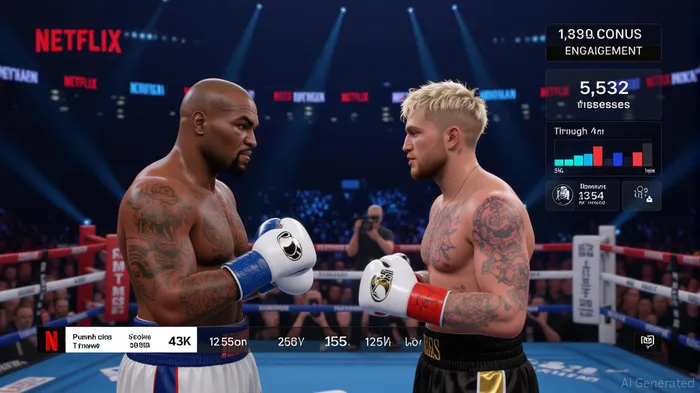
The 2024 Mike Tyson vs. Jake Paul fight, streamed for free on Netflix, drew an estimated 108 million global viewers. While this model sacrifices immediate PPV profits, it transforms live sports into a retention tool. By bundling live events with its subscription tiers, Netflix reduces churn and attracts casual viewers who might not otherwise engage with on-demand content. This strategy is particularly effective in boxing, where male audiences—traditionally underserved by streaming platforms—now have a reason to stay subscribed.
Netflix's Strategic Playbook: Partnerships, Production, and Global Reach
Netflix's success in live sports hinges on three pillars: high-quality production, strategic partnerships, and global scalability. For the Katie Taylor vs. Amanda Serrano III event, the platform collaborated with EverWonder Studio, Kwokman Productions, and NEP Group to deliver a cinematic experience. Advanced camera systems, augmented reality (AR) graphics, and multi-language support (English, Spanish, Portuguese, etcETC--.) ensured the event resonated with a global audience.
These partnerships are not just about technical execution—they're about building a sustainable ecosystem. NEP Group's Dallas datacenter, for instance, enabled real-time distribution to three U.S. production hubs, ensuring localized commercial insertion and disaster recovery. Such infrastructure allows Netflix to scale live events without compromising quality, a critical advantage over traditional broadcasters.
Monetization Beyond PPV: Advertising and Data-Driven Engagement
Netflix's ad-supported subscription tier (AST), now boasting 94 million monthly active users, is a game-changer. With an average of four to five ads per hour, the platform balances user experience with advertiser value. The 2024 NFL Christmas Day games, for example, generated $25–35 million in ad revenue, a figure expected to double in 2025 as live programming expands.
The company's AI-driven ad targeting and programmatic capabilities further enhance this model. By analyzing viewer behavior, Netflix can deliver hyper-relevant ads during live events, increasing engagement and CPM (cost per thousand impressions) rates. For investors, this represents a scalable, high-margin revenue stream that outpaces traditional PPV's one-time fees.
Long-Term Investment Opportunities in the Streaming-Sports Convergence
The convergence of streaming tech, sports rights, and global audience scalability presents a compelling investment thesis. Netflix's $150 million deal for NFL Christmas Day games until 2026 and its upcoming FIFA Women's World Cup rights (2027–2031) underscore its commitment to securing premium content. These rights, combined with its ad-tier infrastructure, position the platform to dominate live sports in the 2030s.
For investors, the key is to identify companies that:
1. Own or partner with streaming platforms with global reach (e.g., NEP Group, EverWonder Studio).
2. Leverage AI and data analytics to enhance ad targeting and user retention.
3. Secure exclusive sports rights in emerging markets, where live sports demand is growing.
Netflix's stock (NFLX) has already reflected this potential, with a 16% revenue increase in Q2 2025 and a revised full-year guidance of $44.8–$45.2 billion. While the stock's valuation remains tied to subscriber growth and ad revenue performance, its live sports strategy offers a durable competitive edge.
Conclusion: Betting on the Streaming Era
The shift from PPV to subscription-based viewing is not just a trend—it's a fundamental reimagining of how sports are consumed and monetized. Netflix's model, which prioritizes engagement over immediate profits, is reshaping boxing's financial ecosystem and setting a precedent for other sports. For investors, the opportunity lies in platforms that can scale live events, harness data, and adapt to a global audience. As the 2030s approach, the winners will be those who recognize that the future of sports media is not in the pay-per-view button, but in the streaming screen.







Comentarios
Aún no hay comentarios