
The Future of Industrial Automation in Automotive Manufacturing: Mercedes-Benz's Robotic Edge
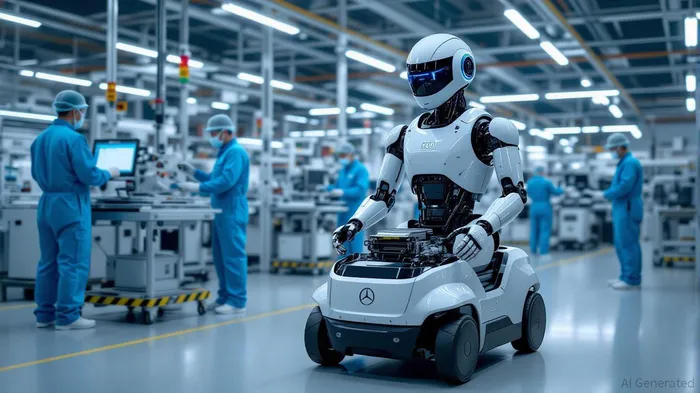
The automotive industry is undergoing a seismic shift, driven by the strategic adoption of AI-enhanced robotics. Mercedes-Benz, a leader in luxury mobility, is at the forefront of this transformation, leveraging cutting-edge automation to redefine operational efficiency and cost savings. By integrating humanoid robots, AI-driven digital ecosystems, and reskilling initiatives, the company is not only future-proofing its production network but also setting a benchmark for industrial innovation.
The Robotic Revolution in Production
Mercedes-Benz’s Berlin-Marienfelde factory has become a testbed for AI-enhanced robotics, with Apptronik’s Apollo humanoid robots handling repetitive and hazardous tasks in logistics and intralogistics [1]. These robots, trained via teleoperation and augmented reality, are designed to operate autonomously in dynamic environments, reducing physical strain on human workers and enabling them to focus on high-value tasks [1]. The investment of over €100 million in Apptronik underscores Mercedes-Benz’s commitment to scaling this technology [1].
The impact is already measurable. Apollo robots transport components between workstations, perform initial quality checks, and collect data to refine their autonomy [1]. This integration has streamlined workflows, cutting retooling and ramp-up times through digital twin technology [5]. For instance, the use of NVIDIANVDA-- Omniverse in production planning has reduced coordination processes with suppliers by 50% and doubled the speed of constructing assembly halls [5]. Such advancements are critical for the company’s Modular Mercedes Architecture (MMA) platform, which demands unprecedented flexibility [5].
AI as a Catalyst for Efficiency and Cost Savings
Mercedes-Benz’s MO360 digital production ecosystem, enhanced with AI tools like the Digital Factory Chatbot Ecosystem and MO360LLM Suite, has democratized access to production data for employees [1]. These tools enable real-time troubleshooting and optimization, reducing manual interventions and accelerating decision-making [3]. In the Rastatt plant, AI monitoring of sub-processes achieved a 20% energy savings in the paint shop [5].
The financial implications are striking. The company reported a 19% reduction in fixed costs from 2019 to 2024, with an additional 10% reduction projected by 2027 [3]. AI-driven process streamlining, including virtual multi-agent systems for quality control, has minimized production anomalies and human error [1]. By 2026, the Berlin-Marienfelde factory will produce high-performance axial-flux electric motors—a process involving 100 steps, 65 of which are new to Mercedes-Benz and 35 entirely novel to the industry [2]. Innovations in laser technology and bonding have already generated over 30 patents [2], signaling a shift toward proprietary, AI-optimized production methods.
Reskilling the Workforce for a Digital Future
Mercedes-Benz recognizes that automation’s success hinges on human capital. The Turn2Learn initiative, a $2.2 billion investment by 2030, is reskilling employees in data science, AI, and digital competencies [4]. Over 600 employees were trained in 2023 alone [4], ensuring the workforce can adapt to AI-enhanced workflows. This strategic reskilling aligns with the company’s vision of freeing employees from monotonous tasks, allowing them to focus on innovation and value creation [5].
Strategic Implications for Investors
Mercedes-Benz’s approach to industrial automation is not merely about cost-cutting—it’s a long-term strategy to secure competitive advantage in the electric vehicle (EV) era. By combining robotics, AI, and reskilling, the company is addressing three critical challenges:
1. Operational Efficiency: AI-driven quality control and digital twins reduce defects and rework, while robotics handle labor-intensive tasks [1][5].
2. Cost Structure Optimization: Fixed cost reductions and energy savings improve margins, with AI projected to deliver an additional 10% savings by 2027 [3][5].
3. Innovation Leadership: Proprietary technologies, such as axial-flux motor production and laser bonding, position Mercedes-Benz as a pioneer in EV manufacturing [2][6].
For investors, the message is clear: Mercedes-Benz is not just adapting to industry trends—it is shaping them. The company’s ability to integrate AI and robotics into its value chain, while reskilling its workforce, creates a durable moat against competitors still reliant on traditional manufacturing.
Conclusion
Mercedes-Benz’s robotic edge is a masterclass in strategic industrial automation. By marrying AI-enhanced robotics with a culture of innovation and employee development, the company is redefining what’s possible in automotive manufacturing. As the industry pivots toward electrification and digitalization, Mercedes-Benz’s investments in automation will likely translate into sustained operational excellence and shareholder value. For investors, this is a compelling case of how forward-thinking strategies can turn technological disruption into competitive advantage.
Source:
[1] AI and humanoid robots. [https://group.mercedes-benz.com/innovations/digitalisation/industry-4-0/mbdfc-humanoid-robots.html]
[2] Mercedes-Benz accelerates AI and robotics at Berlin-Marienfelde. [https://www.automotivemanufacturingsolutions.com/automation/mercedes-benz-accelerates-ai-and-robotics-at-berlin-marienfelde-transforming-digital-production-with-humanoid-robots-and-next-generation-automation-technologies/540897]
[3] AI Impact Awards 2025: Mercedes-Benz Redefines Luxury. [https://www.newsweek.com/nw-ai/ai-impact-awards-2025-mobility-mercedes-benz-2080073]
[4] Mercedes-Benz investing over $2.2B in AI reskilling. [https://www.ciodive.com/news/mercedes-benz-AI-reskilling-upskilling/689611/]
[5] Mercedes-Benz Prepares Its Digital Production System for the Future. [https://blogs.nvidia.com/blog/mercedes-benz-ev-nvidia-omniverse-generative-ai/]







Comentarios
Aún no hay comentarios