
The Future of Digital Lending in Nigeria: Oxygen X's Strategic Edge in Financial Inclusion and Risk Innovation
The Regulatory Tightrope: Compliance as a Competitive Edge
The Federal Competition and Consumer Protection Commission (FCCPC) has reshaped the sector with its 2025 Digital Lending Regulations, removing state-level interest rate caps while imposing strict licensing, data-sharing mandates, and penalties for non-compliance, according to an MFW4A report. These rules have raised the bar for entry, with compliance costs now accounting for 7% of operating expenses (the MFW4A report also notes this). While this has led to consolidation, favoring well-capitalized players, it also creates a fertile ground for innovation. Oxygen X, for instance, leverages data analytics and alternative data points (e.g., social impact indicators, customer behavior) to refine credit scoring models, reducing default risks, as described in a Tekedia article. This contrasts with competitors like FairMoney, which reported loan impairment costs of ₦59.4 billion in 2024 despite a ₦5.85 billion net profit, according to an OpenAfrica piece.
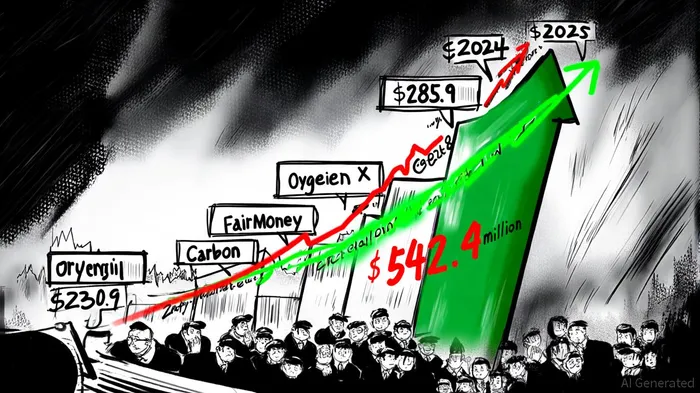
Oxygen X: A Bank-Backed Disruptor with a Fintech Soul
Oxygen X, the digital lending arm of Access Holdings, has emerged as a unique hybrid: a bank-backed entity with the agility of a fintech. By 2025, it had disbursed over ₦3.5 billion in loans to 4,000 active customers, expanding into asset financing for solar products, electric vehicles, and devices, according to a Techpoint Africa post. Its 2024 financials-N4.1 billion in revenue and N805 million in pre-tax profit-underscore its profitability (see the Tekedia article cited above). Crucially, Oxygen X's first-year post-tax profit of N631 million, as reported in an IrOrun comparison, demonstrates its ability to balance aggressive lending with prudent risk management.
The company's strategic edge lies in its access to Access Bank's customer data and its integration of embedded finance. For example, its partnerships with HPZ Thermocool and Zoome Energy allow it to offer tailored financing for solar panels and EVs, addressing Nigeria's energy and mobility challenges (as noted in the Techpoint Africa post). This aligns with the broader trend of buy-now-pay-later (BNPL) services, which are projected to grow to $3.5 billion by 2029 (the MFW4A report outlines this projection). Oxygen X's "You Are Next" campaign further positions it as a champion of financial inclusion, targeting MSMEs and retail customers who lack access to traditional banking (see the Techpoint Africa post).
The High-Stakes Game of Default Rates and ROI
While Oxygen X's financials are robust, the sector's default rates remain a critical concern. In Q2 2025, small businesses saw their default index plummet from 0.5 to -7.2, while household secured loan defaults dropped from 3.9 to -7.0, according to a Skyweb analysis. This reflects broader economic pressures, including inflation and liquidity constraints. Oxygen X's use of alternative data and credit lifecycle management tools (discussed in the Tekedia article) likely mitigates these risks, but its ROI must be weighed against competitors like Carbon, which offers loans at 4.5%–30% monthly interest but faces scrutiny over aggressive debt collection (the IrOrun comparison examines these practices).
FairMoney's high impairment costs highlight the fragility of relying on traditional credit scoring in a market where 60% of borrowers lack formal credit histories (the OpenAfrica piece discusses this). Oxygen X's data-driven approach, however, allows it to price risk more accurately, potentially yielding higher ROI. For instance, its 2024 pre-tax profit margin of 19.5% (N805 million on N4.1 billion revenue) outperforms FairMoney's 10.7% margin (N5.85 billion on N54.7 billion revenue), suggesting superior risk-adjusted returns (see the Tekedia article and the OpenAfrica piece for the underlying figures).
The Road Ahead: Embedded Finance and Regulatory Resilience
The future of Nigeria's digital lending sector hinges on two pillars: embedded finance and regulatory adaptability. Oxygen X's foray into asset financing and BNPL positions it to capitalize on open banking frameworks, which will deepen data access and enable hyper-personalized lending (the MFW4A report explores these trends). Meanwhile, the FCCPC's 2025 regulations-while stringent-create a level playing field by penalizing opaque practices and mandating data protection, according to an SHQ Legal overview. This favors players like Oxygen X, which can absorb compliance costs and innovate within the new guardrails.
However, challenges persist. The lack of consistent default reporting to credit bureaus, highlighted in a TechCabal article, and the economic volatility of Nigeria's informal sector mean that even the most sophisticated models cannot eliminate risk entirely. Investors must also consider the political and macroeconomic risks inherent in emerging markets, where policy shifts and currency fluctuations can disrupt cash flows.
Conclusion: A Calculated Bet on Financial Inclusion
Oxygen X represents a compelling investment opportunity in Nigeria's digital lending sector. Its bank-backed capital, data-driven risk innovation, and focus on financial inclusion align with long-term trends in embedded finance and sustainable lending. While the sector's high default rates and regulatory scrutiny pose risks, Oxygen X's profitability and strategic partnerships position it to outperform peers like FairMoney and Carbon. For investors willing to navigate the complexities of a high-growth, high-risk market, Oxygen X offers a rare blend of scalability, social impact, and financial resilience.







Comentarios
Aún no hay comentarios