
Fury Gold Mines’ Eau Claire Gold Deposit and Its Attractive Development Potential
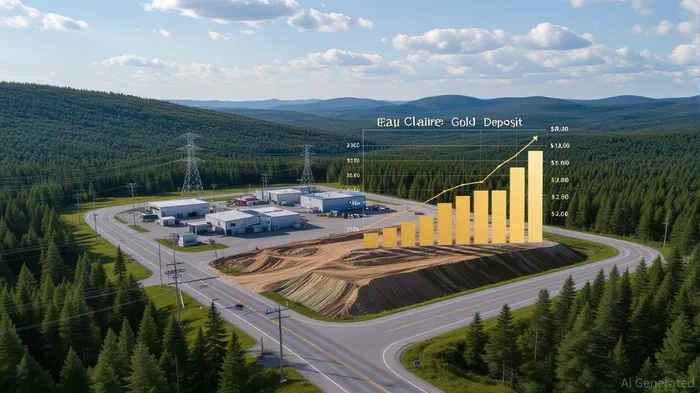
In the ever-shifting landscape of resource investing, projects that combine robust economics with rapid capital deployment are rare gems. Fury GoldFURY-- Mines’ Eau Claire Gold Deposit in Quebec, however, appears to fit this mold. According to a report by the company, the preliminary economic assessment (PEA) for Eau Claire reveals a project with an after-tax net present value (NPV5) of $554 million and an internal rate of return (IRR) of 41% under the Base Case scenario, assuming a gold price of US$2,400/oz [1]. These metrics are not just impressive in isolation—they signal a strategic inflection point for FuryFURY--, offering a clear pathway to unlock shareholder value through disciplined capital allocation and operational efficiency.
Strategic Project Economics: A Blueprint for Value Creation
The Eau Claire deposit’s economic allure lies in its flexibility. The PEA outlines three development scenarios—Base Case, Hybrid Case, and Toll Milling Case—each tailored to different capital and operational constraints. The Base Case, which involves standalone processing, requires an initial capital expenditure (CapEx) of $217 million but delivers a 2.5-year after-tax payback period [2]. By contrast, the Toll Milling Case, which leverages third-party processing, slashes initial CapEx to $117 million and accelerates payback to just 1.1 years, with an IRR of 84% and an NPV5 of $639 million [3]. This range of options allows Fury to optimize its capital structure while minimizing risk, a critical advantage in a sector where liquidity and flexibility are paramount.
Data from the PEA also underscores the project’s cost discipline. All-in sustaining costs (AISC) are projected to range between US$1,140 and US$1,170 per ounce, depending on the processing method [2]. These figures are competitive with industry benchmarks, particularly given the project’s access to low-cost hydroelectric power and existing infrastructure. As stated by Fury in its assessment, 76% of the ounces in the mine plan are classified as Measured and Indicated resources, reducing the need for additional drilling and expediting the path to a pre-feasibility study [3]. This de-risking is a boon for shareholders, as it shortens the timeline to production and aligns with Fury’s broader strategy of prioritizing high-margin, near-term projects.
Rapid Payback as a Catalyst for Shareholder Value
The Eau Claire project’s rapid payback periods are perhaps its most compelling feature. In an industry where projects often take a decade or more to recoup initial investments, a 1.1- to 2.5-year payback is transformative. According to a report by Canadian Mining Journal, such speed reduces exposure to commodity price volatility and enhances the project’s resilience to macroeconomic headwinds [4]. For Fury, this means capital can be redeployed more quickly to other opportunities or returned to shareholders, amplifying the compounding effect of value creation.
Moreover, the project’s 11-year mine life, with an average annual output of 76,000 ounces, positions Fury to benefit from a prolonged period of cash flow generation. At current gold prices, this translates to roughly $182 million in annual revenue under the Base Case, assuming full production [1]. Even if gold prices dip below the $2,400/oz assumption, the project’s low AISC and high IRR provide a buffer, ensuring profitability remains intact.
Risks and Considerations
No investment is without risk. While the PEA paints an optimistic picture, execution risks—such as permitting delays, inflationary pressures on CapEx, or metallurgical challenges—could temper outcomes. Additionally, the Toll Milling Case’s reliance on third-party processing introduces counterparty risk, though Fury’s proximity to established infrastructure mitigates this to some extent. Shareholders should also monitor the company’s balance sheet and its ability to fund the Base Case without dilution.
Conclusion: A Strategic Win for Fury and Its Shareholders
Fury Gold Mines’ Eau Claire Gold Deposit is more than a project—it’s a masterclass in strategic project economics. By offering a menu of development scenarios with rapid paybacks, competitive costs, and high returns, Eau Claire aligns perfectly with the company’s thesis of creating near-term value in a volatile market. For investors, this represents a rare opportunity to back a project that balances ambition with pragmatism, all while leveraging Fury’s operational expertise and Quebec’s favorable mining environment. As the company moves forward, the key will be maintaining discipline in capital allocation and execution, ensuring that the PEA’s promise translates into reality.
Source:
[1] Fury Announces Results of Preliminary Economic Assessment for the Eau Claire Gold Deposit with a Base Case After-Tax NPV (5%) of $554M and After-Tax IRR of 41 [https://www.globenewswire.com/news-release/2025/09/02/3142474/0/en/Fury-Announces-Results-of-Preliminary-Economic-Assessment-for-the-Eau-Claire-Gold-Deposit-with-a-Base-Case-After-Tax-NPV-5-of-554M-and-After-Tax-IRR-of-41.html]
[2] Fury's preliminary study values Eau Claire at $554M NPV, 41% IRR [https://www.canadianminingjournal.com/news/furys-preliminary-study-values-eau-claire-at-554m-npv-41-irr/]
[3] Fury Gold Mines Sees Opportunity In Eau Claire Assessment [https://finimize.com/content/fury-gold-mines-sees-opportunity-in-eau-claire-assessment]
[4] Fury Announces Results of Preliminary Economic Assessment for the Eau Claire Gold Deposit with a Base Case After-Tax NPV (5%) of $554M and After-Tax IRR of 41 [https://furygoldmines.com/fury-announces-results-of-preliminary-economic-assessment-for-the-eau-claire-gold-deposit-with-a-base-case-after-tax-npv5-of-554m-and-after-tax-irr-of-41/]





Comentarios
Aún no hay comentarios