
FuriosaAI: A High-Potential Challenger to Nvidia in the AI Inference Chip Market
The AI inference chip market is undergoing a seismic shift as enterprises increasingly prioritize energy efficiency and cost optimization over raw computational power. While NvidiaNVDA-- has long dominated this space with its GPUs, a new wave of specialized hardware startups is emerging to challenge the status quo. Among them, FuriosaAI stands out as a particularly compelling investment opportunity. By leveraging its Tensor Contraction Processor (TCP) architecture and strategic partnerships, the South Korean semiconductor startup is positioning itself to disrupt Nvidia's near-total control of the AI inference landscape.
Nvidia's Dominance and the Rising Cost of Energy Inefficiency
Nvidia's AI GPUs have been the de facto standard for inference workloads, with the company holding an estimated 90–94% market share in AI GPUs as of 2025 according to market analysis. However, this dominance comes at a cost. As data centers scale to meet the demands of large language models (LLMs) and multimodal AI, energy consumption has become a critical bottleneck. According to a report by Intuition Labs, inference-applying trained models to real-world applications-now accounts for a larger portion of AI operations than training, making energy efficiency a key differentiator.
Nvidia's H100 GPU, while powerful, struggles to match the performance-per-watt of newer, purpose-built accelerators. This gap is where FuriosaAI's RNGD chip shines.
FuriosaAI's RNGD: A Game-Changer in Energy Efficiency
FuriosaAI's second-generation RNGD chip, built on a TSMC 5nm process, is designed specifically for tensor contraction operations-the backbone of LLM and multimodal AI inference. The chip's TCP architecture enables it to deliver 2.25x faster inference per watt compared to traditional GPUs, including Nvidia's H100 according to FuriosaAI. This efficiency is critical for enterprises like LG AI Research, which adopted RNGD for its EXAONE foundation models and achieved a 2.25x improvement in performance-per-watt over legacy GPU solutions.
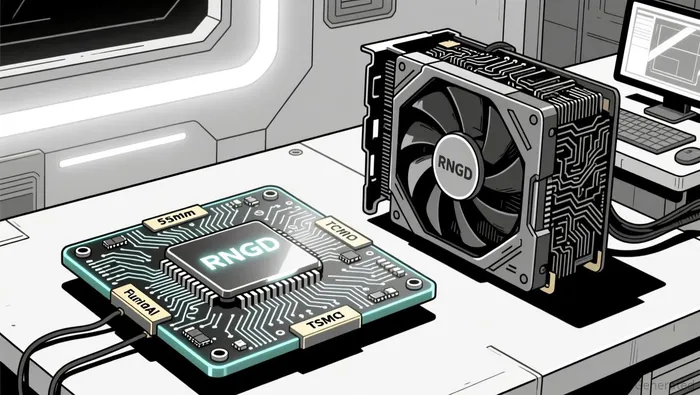
The RNGD's 180W power profile further underscores its appeal in data centers where cooling and electricity costs are rising. As stated by FuriosaAI's CEO, June Paik, the company's focus on "sustainable AI compute" aligns with a broader industry trend toward reducing the environmental footprint of AI infrastructure according to FuriosaAI's blog.
Strategic Partnerships and Market Expansion
FuriosaAI's growth strategy hinges on strategic partnerships and ecosystem integration. In 2025, the company announced a collaboration with hosted·ai to deliver AI infrastructure powered by RNGD, while also securing a design win with LG AI Research-a rare feat for a semiconductor startup. Additionally, FuriosaAI plans to bring RNGD to Microsoft's Azure Marketplace, expanding its reach to cloud customers seeking energy-efficient alternatives to GPU-based inference according to company announcements.
These moves are bolstered by a robust financial foundation. In July 2025, FuriosaAI closed a $125 million Series C bridge funding round led by Korea Development Bank, the Industrial Bank of Korea, and Kakao Investment. The funding will accelerate RNGD production and the development of its next-generation chip, signaling confidence in the company's long-term vision.
Rejecting Acquisition Offers: A Bet on Independence
FuriosaAI's decision to reject a $800 million acquisition offer from Meta in March 2025 according to industry reports highlights its commitment to independent growth. While Meta sought to integrate RNGD into its AI infrastructure, FuriosaAI's leadership cited strategic disagreements over post-acquisition direction and a belief that the company could achieve greater value through standalone expansion according to analysis. This bold move underscores the startup's ambition to become a major player in the AI inference market rather than a component of a larger tech giant's ecosystem.
The Case for Specialized Hardware in a $102 Billion Market
The AI inference chip market is projected to grow to $102 billion by 2027, according to market analysis, driven by the increasing demand for on-premises solutions that balance performance with energy efficiency. FuriosaAI's RNGD has already demonstrated its viability in enterprise settings, with LG's EXAONE platform serving as a proof of concept for its cost-performance advantages according to market analysis.
While Nvidia's ecosystem of software tools and developer support remains a formidable barrier, the rise of specialized accelerators like RNGD is reshaping the competitive landscape. As The Economic Times noted, FuriosaAI's emergence could force Nvidia to innovate more aggressively in the inference space or risk ceding market share to nimble challengers according to market analysis.
Conclusion: A Strategic Investment in the Future of AI
FuriosaAI's combination of cutting-edge hardware, strategic partnerships, and a clear vision for sustainable AI compute positions it as a high-potential challenger to Nvidia. With a $125 million funding boost and a growing list of enterprise customers, the company is well-positioned to capitalize on the $102 billion inference chip market. For investors seeking exposure to the next phase of AI infrastructure, FuriosaAI represents a compelling bet on the future of energy-efficient, specialized hardware.







Comentarios
Aún no hay comentarios