
Fulton Financial's Dividend Strategy: Navigating Rising Rates and Shareholder Value
In the current economic climate, where rising interest rates are reshaping the landscape for regional banks, Fulton Financial CorporationFULT-- (FULT) stands at a crossroads of opportunity and risk. The company's dividend strategy—rooted in a 44-year streak of consistent payouts—has drawn attention for its balance between shareholder returns and financial prudence. Yet, as the Federal Reserve tightens monetary policy, investors must scrutinize whether FULT's approach can sustain its allure in a high-rate environment.
Dividend Sustainability: A Delicate Balance
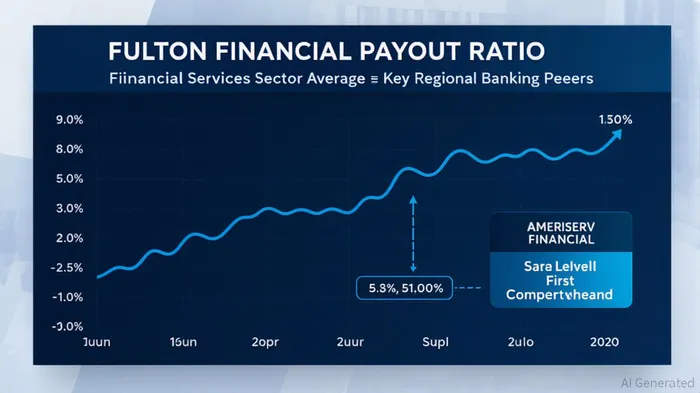
FULT's current dividend payout ratio of 41.3% sits slightly below the Financial Services sector average of 42.5%[2], suggesting a cautious approach to capital preservation. This moderation is critical in a rising rate environment, where net interest margins (NIMs) for banks often expand initially but face compression risks as deposit costs rise. For FULTFULT--, the 2025 first-half results underscore this dynamic: operating earnings hit $0.55 per share in Q2, driven by a 3.47% NIM and disciplined expense management[3]. However, the company's low Dividend Sustainability Score (30.21%) and Dividend Growth Potential Score (16.10%)[5] signal vulnerabilities. These metrics, which assess a company's ability to maintain and grow payouts, highlight the tension between rewarding shareholders and retaining earnings to buffer against economic shocks.
Management's guidance offers some reassurance. With a projected 2026 CET1 ratio of 11.3%[3] and $16.6 billion in liquidity to manage deposit outflows[4], FULT appears well-capitalized. Yet, the company's reliance on a 4.89% annual dividend growth rate over the past three years[3]—modest compared to its 10-year average of 7.70%[5]—suggests a recalibration of expectations. In a world where rate hikes could dampen loan demand and credit quality, FULT's dividend may trade off growth for stability.
Peer Comparisons: Lessons from the Sector
FULT's strategy contrasts with peers like Ameriserv FinancialASRV-- (ASRV), which maintains a more aggressive payout ratio of 54.5%[2], and First CommonwealthFCF-- (FCF), which aligns closer to FULT's 40.8%[2]. These differences reflect divergent capital allocation philosophies. While ASRVASRV-- prioritizes shareholder returns, FULT's approach—bolstered by a $125 million share repurchase program in 2025[4]—emphasizes a dual focus on dividends and buybacks. This duality is a double-edged sword: it enhances shareholder value in the short term but may limit flexibility during downturns.
Regional banks like UMB FinancialUMBF-- (UMBF) and Simmons First NationalSFNC-- (SFNC) offer instructive parallels. UMBF's 8.6% earnings beat in Q2 2025[1] and SFNC's 8.3% revenue growth[1] demonstrate how prudent interest cost management can offset rate pressures. Conversely, Coastal Financial's (CCB) 21.5% earnings miss[1] underscores the fragility of banks with weaker risk mitigation frameworks. FULT's “FultonFirst” efficiency program, which aims to generate $50 million in annual cost savings by 2026[3], positions it closer to the success stories, but its exposure to commercial real estate (CRE)—a sector-sensitive risk for regional banks[5]—remains a wildcard.
Risk Management: A Shield or a Chink?
FULT's risk profile is a mixed bag. On one hand, its CET1 ratio of 11.3%[3] and improved operating return on tangible common equity (16.26% in Q2 2025)[3] reflect robust capital management. On the other, its low DSSDSS-- and DGPS scores[5] imply that the company's dividend resilience is not invulnerable. Rising rates could exacerbate deposit competition, squeezing margins and forcing FULT to choose between hiking rates to retain deposits or accepting lower profitability.
Moreover, while FULT's credit quality has improved—evidenced by a $8.6 million reduction in provision for credit losses in Q2 2025[4]—the broader sector's CRE concentration remains a concern. A $5 billion community bank's CRE exposure at 350% of Tier 1 Capital[5], far above the peer average of 250%, illustrates the systemic risks lurking in regional banking. FULT's prudent underwriting standards[5] are a mitigant, but they cannot fully insulate the company from macroeconomic headwinds.
Conclusion: A Dividend That Can Weather the Storm—For Now
FULT's dividend strategy is a testament to its management's ability to navigate a complex macroeconomic environment. With a moderate payout ratio, strong earnings growth, and a capital buffer that exceeds regulatory requirements, the company is well-positioned to sustain its payouts in the near term. However, the low DSS and DGPS scores[5], coupled with sector-wide risks like CRE exposure and fintech competition[1], suggest that investors should temper expectations for aggressive dividend growth.
For income-focused investors, FULT's 3.77% yield[2] and 44-year dividend streak are compelling. Yet, in a world where rate hikes could persist into 2026, the key question remains: Can FULT's disciplined approach evolve to match the volatility of its environment? The answer will likely determine whether its dividend remains a cornerstone of shareholder value or a relic of a lower-rate era.





Comentarios
Aún no hay comentarios