
Fujifilm's $3.2 Billion Biotech Hub in North Carolina and Its Implications for the Biopharma Supply Chain
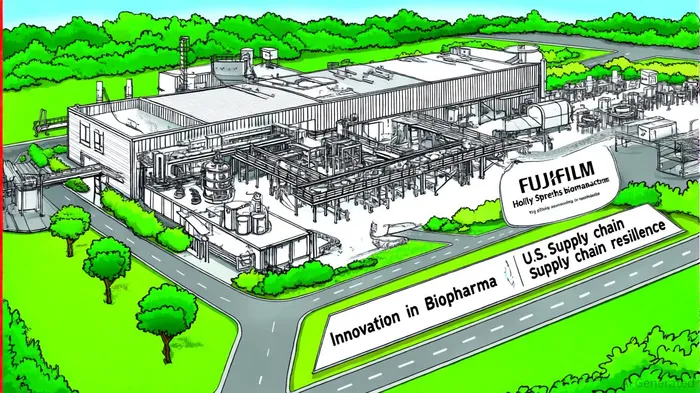
Fujifilm's $3.2 billion biotech hub in Holly Springs, North Carolina, represents a seismic shift in the biopharmaceutical industry's approach to downstream manufacturing and supply chain resilience. By 2025, this facility—part of a broader $8 billion global investment—has emerged as one of North America's largest end-to-end cell culture CDMO (contract development and manufacturing organization) sites, equipped with eight 20,000-liter bioreactors and advanced fill-finish capabilities[1]. The project underscores Fujifilm Diosynth Biotechnologies' strategic pivot toward securing domestic production of monoclonal antibodies, vaccines, and other biologics, a move that aligns with U.S. policy priorities to de-risk global supply chains[2].
Strategic Role in Downstream Biomanufacturing
The Holly Springs facility is a cornerstone of Fujifilm's kojoX™ modular production model, which standardizes processes across global sites to enable rapid technology transfer and scalable capacity[3]. This approach addresses a critical bottleneck in biopharma: the high cost and complexity of downstream processing. By 2025, the site will produce drug substances and finished products for partners like JohnsonJNJ-- & Johnson's Janssen Supply Group and RegeneronREGN--, with whom Fujifilm has inked a $3 billion, 10-year agreement[4]. These partnerships are not merely transactional; they reflect a broader industry trend of pharma firms outsourcing to CDMOs with vertically integrated capabilities to mitigate delays and ensure compliance with evolving regulatory standards[5].
The facility's expansion also highlights Fujifilm's focus on automation and sustainability. For instance, its automated fill-finish lines reduce human error and contamination risks, while its commitment to carbon neutrality by 2040—achieved through 100% renewable energy offsets—positions it as a leader in green biomanufacturing[6]. According to a report by Pharma Manufacturing, such investments are critical for CDMOs to remain competitive in a market projected to grow at a 9.1% CAGR through 2030[7].
Impact on North Carolina's Industrial Ecosystem
North Carolina's life sciences sector has long been a magnet for biotech investment, and Fujifilm's hub accelerates this trend. The state's $15 million in incentives, coupled with workforce training partnerships with institutions like Wake Technical Community College, ensures a pipeline of skilled labor for roles in engineering, quality assurance, and bioprocessing[8]. By 2031, the facility is expected to create 1,400 jobs, contributing an estimated $4.7 billion to the state's economy over the next decade[9]. This aligns with North Carolina's broader economic strategy: leveraging its existing biotech cluster—home to over 225,000 workers and $88.3 billion in annual output—to attract ancillary industries, from logistics to advanced materials[10].
The ripple effects extend beyond direct employment. Local governments have reported a surge in commercial development around the Holly Springs site, with new retail and housing projects catering to the influx of high-skilled workers[11]. As noted by Expansion Solutions Magazine, such clustering effects amplify regional economic resilience, creating a self-reinforcing cycle of innovation and investment[12].
Implications for Biopharma Supply Chain Resilience
Fujifilm's expansion directly addresses vulnerabilities exposed by the pandemic and geopolitical tensions. By 2025, the Holly Springs facility will produce 40% of U.S.-based monoclonal antibody supply, a category critical for treating oncology and autoimmune diseases[13]. This capacity is further bolstered by Fujifilm's Hillerød, Denmark site, which added six mammalian cell bioreactors in 2024 and plans to expand to 20 bioreactors by 2026[14]. Such geographic diversification reduces reliance on single-source manufacturing, a key priority for regulators and pharma firms alike[15].
The strategic value of Fujifilm's investments is also evident in its partnerships. Johnson & Johnson's $2 billion commitment to secure long-term capacity at Holly Springs, for example, ensures a stable supply of monoclonal antibodies for its oncology portfolio[16]. Similarly, Regeneron's $3 billion agreement locks in U.S.-based production for its biologics, aligning with the Biden administration's push to localize critical drug manufacturing[17].
Conclusion
Fujifilm's biotech hub in North Carolina is more than a capital-intensive project; it is a blueprint for the future of biopharma. By integrating advanced manufacturing, workforce development, and supply chain security, the facility exemplifies how strategic investments can transform regional ecosystems while addressing global challenges. As the industry grapples with rising demand for biologics and the need for resilient supply chains, Fujifilm's model offers a compelling case study in innovation and collaboration.





Comentarios
Aún no hay comentarios