
Fuji Nihon's Undervalued Opportunity Amid Stable Margins and Defensive Fundamentals
A Significant Discount to DCF Fair Value
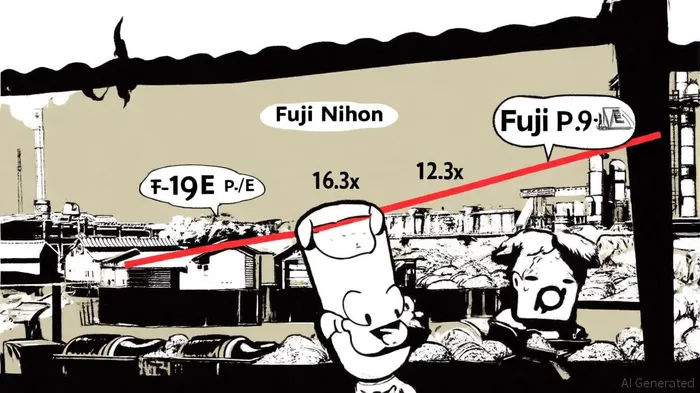
Fuji Nihon's current share price of ¥1,051 represents a stark 65% discount to its calculated DCF fair value of ¥3,002, according to a Simply Wall St analysis. This valuation gap is even more pronounced when compared to its peers: the company trades at a price-to-earnings (P/E) ratio of 9.9x, well below the sector average of 16.3x and the peer average of 12.3x, per that analysis. Such a discount suggests that the market is either underestimating the company's operational reliability or overcautious about its growth prospects.
The stability of Fuji Nihon's 9.5% net profit margin, maintained consistently despite inflationary pressures, reinforces its appeal as a defensive play, as noted in the Simply Wall St analysis. In an industry where margins often fluctuate with commodity prices and input costs, Fuji Nihon's ability to preserve profitability underscores its operational discipline. This resilience is critical in volatile markets, where investors seek companies that can withstand shocks without compromising cash flow.
Dividend Sustainability: A Double-Edged Sword
While Fuji Nihon's low payout ratio of 18% suggests dividend sustainability, according to the Simply Wall St dividend page, investors must weigh this against the company's limited reinvestment in growth. The firm's dividend history includes a decade of increases but also volatility, raising questions about its ability to balance shareholder returns with capital allocation for innovation or expansion, as detailed on that dividend page. For income-focused investors, the current yield appears secure, but long-term sustainability hinges on management's willingness to prioritize growth initiatives without eroding margins.
The company's risk management framework further complicates this calculus. Fuji Nihon's parent group, the Fuji Oil Group, identifies 12 significant risks, including financial and ESG-related challenges, according to the Fuji Oil risk page. These risks, coupled with the absence of major product innovations or market expansions, could constrain the company's ability to grow earnings and sustain dividends in a competitive sector.
Catalysts for Re-rating: Strategic Initiatives and Partnerships
Fuji Nihon's recent strategic moves offer glimmers of hope for a valuation re-rating. The company has expanded its Dongguan office in China and commenced construction on a new plant in Okazaki, signaling geographic diversification, according to a Fuji press release. Additionally, that press release highlights collaborations with entities like Standard Robots and J.A.M.E.S for additive electronics, underscoring the company's foray into automation and technological partnerships. These initiatives, though not yet transformative, suggest a gradual shift toward innovation-driven growth.
However, the lack of explicit growth strategies for 2023–2025 remains a concern. Unlike peers leveraging AI or digital ecosystems to drive margins, Fuji Nihon's roadmap appears incremental. Investors must assess whether these steps are sufficient to justify the current discount or if further catalysts-such as a strategic acquisition or product line expansion-are required to unlock value.
Conclusion: A Calculated Bet for Defensive Portfolios
Fuji Nihon's undervaluation, stable margins, and defensive positioning make it an attractive candidate for investors prioritizing downside protection. Yet, its dividend sustainability risks and reliance on unproven catalysts necessitate a measured approach. For those willing to accept the trade-off between margin resilience and growth potential, Fuji Nihon offers a rare combination of low volatility and upside potential in a sector often plagued by cyclicality.
As markets grapple with uncertainty, the key question for investors becomes whether Fuji Nihon's management can evolve from a margin-preserving operator to a growth-oriented innovator-transforming its discount into a premium.







Comentarios
Aún no hay comentarios