
The FTX Collapse's Ripple Effect: How Volatility Could Create Alpha in ETH, XRP, and the Undervalued Digitap ($TAP)
The collapse of FTX in November 2022 sent shockwaves through the crypto market, amplifying volatility and reshaping investor behavior. While the immediate aftermath saw panic-driven liquidations and a $152 billion market value loss across 15 major cryptocurrencies[2], this crisis also created unique entry points for savvy investors. Today, EthereumETH-- (ETH), XRPXRP--, and the emerging Digitap ($TAP) stand at inflection points, where post-FTX volatility, regulatory clarity, and on-chain dynamics could unlock alpha for those who understand the interplay of risk and reward.
Ethereum (ETH): A Golden Cross Amid Lingering Volatility
Ethereum's post-FTX trajectory has been defined by a tug-of-war between bullish technical signals and bearish sentiment. The 50-day moving average (EMA) of ETHETH-- currently sits at $4,188, above its 200-day EMA of $2,768—a “golden cross” often interpreted as a bullish trend[2]. However, the RSI (Relative Strength Index) at 50.6 suggests neutral conditions[2], while the MACD line remains below the signal line, indicating unresolved bearish momentum[2].
On-chain metrics add nuance. Ethereum's Network Value to Transactions (NVT) ratio, a valuation tool akin to a P/E ratio, has dipped to the 10th percentile historically, suggesting undervaluation relative to network activity[3]. Meanwhile, transaction recovery metrics show a rebound in active addresses and staking participation, signaling resilience in the face of macroeconomic headwinds[5]. For ETH, the key entry point lies in monitoring the 50-day EMA and RSI levels. A breakout above $4,500 with a RSI above 60 could validate a long-term bullish case, while a drop below the 200-day EMA would trigger caution[2].
XRP: Legal Clarity and Institutional Adoption Fuel a Quiet Bull Case
Ripple's XRP has navigated the post-FTX landscape with a mix of resilience and caution. After a 25% drop in the immediate aftermath of FTX's collapse[3], XRP has consolidated around $3, with key resistance levels at $4.40 and $15[4]. The recent legal victory against the SEC has provided critical regulatory clarity, with 87% odds of U.S. spot XRP ETF approval—a catalyst that could unlock institutional capital[4].
On-chain data tells a compelling story. Daily transactions on the XRP Ledger surged 500% in Q3 2025, driven by institutional adoption via RippleNet's cross-border payment corridors[1]. Santander's 40% growth in cross-border payments using Ripple's On-Demand Liquidity (ODL) service underscores XRP's utility in real-world applications[1]. However, retail engagement has waned, with daily active addresses plummeting from 557,000 to 34,000—a sign of broader market fatigue[1].
For XRP, the strategic entry point hinges on a breakout above $4.40, supported by a bullish RSI divergence and rising institutional on-chain activity. A failure to hold $2.70 would signal renewed bearish pressure[4].
Digitap ($TAP): The Undervalued Disruptor in Cross-Border Payments
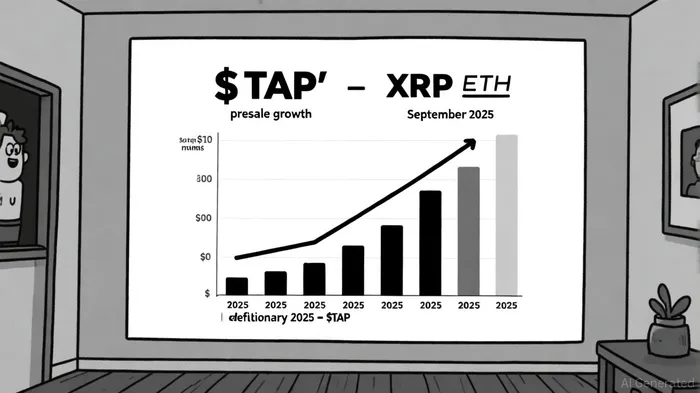
While ETH and XRP grapple with legacy volatility, Digitap ($TAP) emerges as a post-FTX innovation play. Priced at $0.0125, $TAP has sold over 13 million tokens in its presale, leveraging a deflationary model that burns 50% of profits to reduce supply[1]. Its omni-bank platform, featuring a Visa-integrated crypto card and AI-powered currency routing, targets the $414.6 billion cross-border payments market[4].
Technical indicators paint a bullish picture. $TAP's RSI and MACD show strong momentum, outperforming Ethereum and DogecoinDOGE-- in recent months[3]. On-chain metrics, including low gas fees and transaction speed upgrades, position it as a viable alternative to XRP in high-cost corridors[5]. Analysts project a 20-30x return in a base-case scenario, driven by adoption in underbanked regions and institutional partnerships[1].
Strategic Entry Points: Balancing Volatility and Catalysts
The post-FTX market demands a nuanced approach:
1. ETH: Buy dips above the 200-day EMA, with a stop-loss below $2,500.
2. XRP: Accumulate on a breakout above $4.40, hedging against retail disengagement.
3. $TAP: Enter during presale phases, leveraging its deflationary mechanics and cross-border utility.
Macroeconomic factors, including Trump-era tariffs and interest rate cycles, will continue to influence volatility. However, the approval of BitcoinBTC-- and Ethereum ETFs in 2024[1], coupled with XRP's regulatory clarity and $TAP's real-world adoption, suggests a multi-year bull case for these assets.
Conclusion
The FTX collapse was a watershed moment, exposing systemic risks but also creating asymmetric opportunities. For investors, the key lies in leveraging volatility metrics, on-chain signals, and regulatory tailwinds to identify undervalued assets. Ethereum's technical resilience, XRP's institutional adoption, and $TAP's disruptive utility form a compelling trio for those willing to navigate the post-crisis landscape with discipline and foresight.






Comentarios
Aún no hay comentarios