
FTSE 100 Earnings Momentum and Sector Vulnerability: Decoding Early Revenue Warnings as Leading Indicators of Market Rotation
The FTSE 100's record-breaking performance in Q3 2025, closing at 9,548 points, masks a complex interplay of resilience and fragility. While the index achieved its best quarterly gain since October 2022, driven by a weaker pound and optimism over the U.S.-UK trade agreement, according to Reuters, a surge in revenue warnings from constituent companies signals underlying vulnerabilities. These warnings, often tied to policy shifts, geopolitical uncertainty, and tariff impacts, are emerging as critical leading indicators of market rotation-a reallocation of capital toward sectors better positioned to navigate macroeconomic headwinds.
The Anatomy of Revenue Warnings: Policy, Geopolitics, and Tariffs
According to EY analysis, 59 profit warnings were issued by UK-listed companies in Q2 2025, with 46% explicitly attributing the issues to policy changes and geopolitical uncertainty. For instance, ASOS's 10% share price plunge followed its warning of weaker-than-expected annual revenue due to soft consumer demand, as reported by Reuters, while Close Brothers cited below-forecast net interest margins for fiscal 2026. These cases underscore how domestic and global factors-such as the UK's fiscal policy ambiguity and the U.S. pharma tariff regime-are amplifying sector-specific risks.
The EY-Parthenon analysis further highlights that nearly 60% of FTSE 100 returns historically correlate with major geopolitical or macroeconomic events. This sensitivity is particularly pronounced in sectors like Industrial Support Services and Retail, where companies face contract cancellations, margin erosion, and demand volatility, as noted in the EY analysis.
Market Rotation: From Vulnerability to Opportunity
The surge in revenue warnings has catalyzed a broadening of market leadership, as investors shift capital from concentrated growth sectors (e.g., technology) toward value-oriented and cyclical plays, as noted in The Great Rebalancing. For example, financials and consumer discretionary stocks have outperformed, buoyed by expectations of U.S. Federal Reserve rate cuts and a stronger global economy (reported by Reuters). Conversely, sectors like precious metals and gambling firms have underperformed, with Evoke shares dropping 1.8% amid concerns over potential UK tax hikes, according to Reuters.
This rotation reflects a recalibration of risk appetite. As stated by Morningstar, the FTSE 100's multinational exposure-75% of its earnings derived from international operations-has amplified gains for export-heavy firms like Shell and BP. However, domestic-focused companies, particularly those reliant on the UK's slowing service sector, face headwinds, according to a Facet review.
Sector Vulnerability: A Tale of Two Halves
The divergence in sector performance underscores the FTSE 100's dual nature. On one hand, global macroeconomic tailwinds-such as the U.S.-UK trade agreement-have bolstered multinational corporations (reported by Reuters). On the other, domestic challenges, including inflationary pressures and policy uncertainty, have eroded margins in sectors like energy and manufacturing, as highlighted in the EY-Parthenon analysis.
For instance, Mondi's earnings decline in late October 2025, coupled with political jitters in Europe, prompted a retreat from record highs. Similarly, the Industrial Support Services sector has grappled with tariff-related disruptions, compounding operational risks. These dynamics suggest that while the FTSE 100's global orientation offers resilience, its domestic segments remain exposed to structural vulnerabilities.
Strategic Implications for Investors
The interplay between early revenue warnings and market rotation demands a nuanced investment approach. Defensive sectors-such as financials and defense-have shown resilience amid uncertainty, per the EY-Parthenon findings, while cyclical plays like basic materials and consumer discretionary may benefit from a Fed pivot. However, investors must remain cautious about overexposure to sectors facing margin compression, such as retail and industrial services, as detailed in the EY analysis.
A visual representation of the FTSE 100's quarterly performance, annotated with key revenue warning events and macroeconomic triggers, would provide clarity on these dynamics.
Conclusion
The FTSE 100's record high in Q3 2025 is a testament to its global reach and adaptability. Yet, the proliferation of revenue warnings serves as a cautionary signal: while macroeconomic optimism fuels rotation into resilient sectors, structural vulnerabilities persist. Investors must balance the index's long-term appeal with short-term risks, leveraging early warnings as a compass for strategic reallocation. As the UK navigates fiscal and geopolitical crosscurrents, the FTSE 100's performance will hinge on its ability to harmonize global opportunities with domestic challenges. 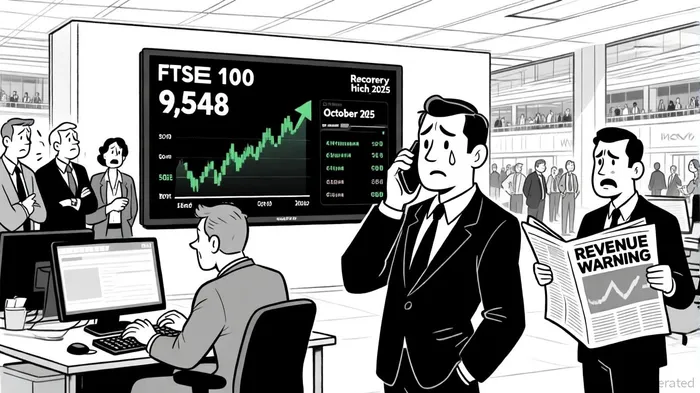







Comentarios
Aún no hay comentarios