
FTC's Regulatory Pressure on Ticketmaster and the Future of the Live Events Industry
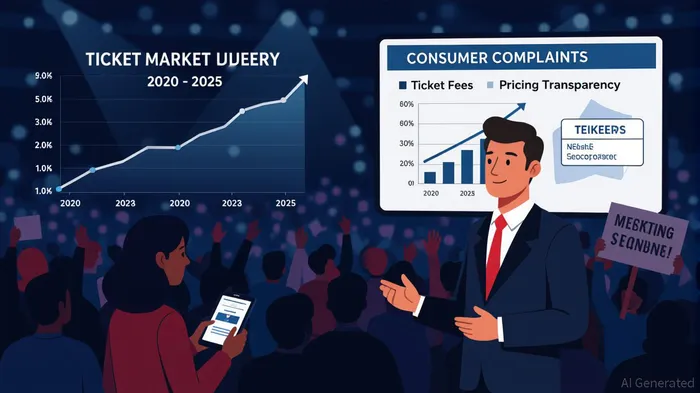
The live events industry, a cornerstone of cultural and economic activity, has long been shaped by the dominance of Ticketmaster. As the global pandemic recedes and live events rebound, the company's role in ticketing has drawn renewed scrutiny. While the Federal Trade Commission (FTC) has not yet launched direct antitrust enforcement against Ticketmaster in 2025, the regulatory environment suggests a growing appetite to address systemic issues in digital market fairness. This analysis explores the interplay between Ticketmaster's market position, consumer grievances, and the FTC's evolving enforcement priorities, offering insights for investors navigating this complex landscape.
Market Dominance and Antitrust Concerns
Ticketmaster's near-monopoly in the live events sector has raised persistent concerns about pricing practices and consumer choice. Critics argue that the company, alongside its parent firm Live NationLYV--, leverages its dominance to impose opaque fee structures, often inflating ticket costs beyond face value. For instance, reports indicate that in some cases, fees and taxes added during Ticketmaster transactions can surpass the base ticket price, leaving consumers with little recourse . Such practices, while not explicitly illegal, challenge the principles of transparency and fairness that underpin competitive markets.
The FTC's broader antitrust agenda in 2025 reflects a heightened focus on curbing anticompetitive behavior across digital platforms. While no direct enforcement actions against Ticketmaster have been documented, the agency's recent settlement with a therapist staffing company over wage-fixing allegations underscores its commitment to addressing collusion and market manipulation . This precedent suggests that the FTC is primed to act if evidence emerges of systemic harm to competition in the ticketing sector.
The FTC's Strategic Priorities
The FTC's 2025 enforcement priorities emphasize protecting consumers from deceptive practices and ensuring equitable access to markets. Chairman Ferguson's August 2025 warning against weakening data security at the behest of foreign powers highlights the agency's dual focus on digital integrity and antitrust enforcement [3]. While Ticketmaster's operations are not explicitly mentioned in these statements, the broader regulatory climate signals a willingness to probe industries where market concentration stifles innovation and inflates prices.
Investors should note that the FTC's approach to antitrust enforcement has shifted toward proactive intervention, particularly in sectors where digital platforms hold disproportionate power. The agency's 2025 enforcement actions against collusive behaviors in healthcare and staffing industries demonstrate a pattern of targeting systemic inefficiencies . If Ticketmaster's practices are deemed to similarly distort competition, the company could face regulatory pressure to alter its fee structures or divest assets.
Implications for Investors
For investors, the intersection of regulatory scrutiny and market dynamics presents both risks and opportunities. On one hand, potential FTC intervention could disrupt Ticketmaster's revenue model, which relies heavily on ancillary fees. A forced restructuring or price controls might erode profit margins, particularly in an industry where live events remain a critical driver of cultural engagement.
On the other hand, the live events sector is poised for long-term growth, fueled by the resurgence of in-person experiences and the integration of hybrid event models. Companies that adapt to regulatory expectations—such as enhancing pricing transparency or fostering competition through open ticketing platforms—could emerge stronger. For instance, the rise of secondary market platforms and blockchain-based ticketing solutions offers alternatives to Ticketmaster's dominance, potentially reshaping the industry's competitive landscape .
Conclusion
The FTC's regulatory posture in 2025, while not yet directed at Ticketmaster, reflects a broader commitment to enforcing antitrust principles in digital markets. As the agency continues to scrutinize industries where market concentration undermines consumer welfare, investors must weigh the risks of regulatory intervention against the sector's inherent growth potential. For Ticketmaster, the path forward will likely hinge on its ability to align with evolving regulatory expectations while maintaining its role as a gatekeeper to live events. In this context, adaptability—not just to market forces but to the shifting sands of regulatory policy—will define the industry's trajectory.





Comentarios
Aún no hay comentarios