
FSK's $400M 2031 Unsecured Notes Offering: Credit Risk and Yield Value in a Shifting Bond Market
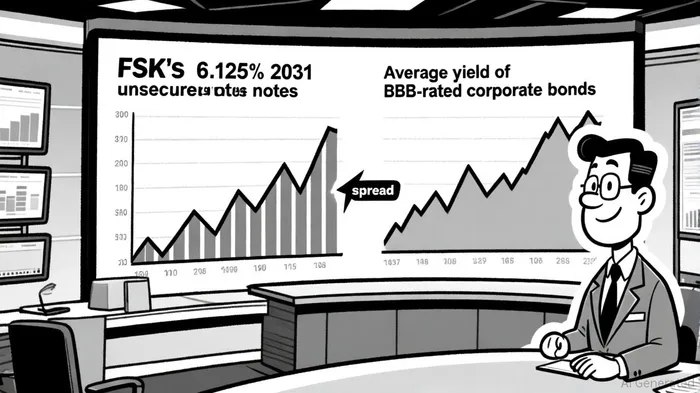
In September 2025, FS KKR Capital Corp.FSK-- (FSK) priced a $400 million offering of 6.125% unsecured notes due 2031, a move that underscores both the company's strategic capital management and the evolving dynamics of the corporate bond market. For investors, the offering raises critical questions: How does FSK's credit risk profile align with its yield? And does the 6.125% coupon adequately compensate for the risks inherent in a BBB-rated issuance?
Credit Risk: A Mixed Bag of Strengths and Vulnerabilities
FSK's 2031 notes carry a BBB rating from KBRA with a Stable Outlook, reflecting the company's ties to KKR's investment platform and its diversified portfolio[1]. However, the broader credit landscape tells a more nuanced story. Fitch Ratings, while affirming FSK's BBB- rating in April 2025, revised its outlook to Negative in August 2025 due to concerns over non-accruals and realized losses from portfolio restructurings[2]. Moody'sMCO-- has also cast a shadow, assigning a negative outlook to FSKFSK--, citing deteriorating asset quality and a doubling of non-accrual loans to 6.4% of outstanding balances[5].
These divergent assessments highlight a key tension: FSK's structural strengths—such as its robust capital position and access to capital markets—contrast with operational weaknesses, including elevated non-qualifying investments and sensitivity to economic downturns[4]. For context, FSK's return on equity (ROE) of 1.82% lags behind industry benchmarks[4], suggesting inefficiencies that could amplify risks during a recession.
Yield Competitiveness: A Premium Over the Curve
The 6.125% coupon on FSK's 2031 notes stands out in a market where the average yield for BBB-rated corporate bonds maturing around 2031 is approximately 4.91% as of September 2025[3]. This 123 basis point spread appears attractive at first glance, particularly given the current range-bound bond market, where 10-year Treasury yields are projected to hover between 3.5% and 5.0%[2]. However, the premium must be weighed against FSK's credit profile.
For comparison, the ICE BofA BBB US Corporate Index—a broad benchmark—showed an effective yield of 5.06% in late September 2025[2]. FSK's offering, therefore, trades at a meaningful discount to this index, suggesting either undervalued risk or a market discount for its specific vulnerabilities. The yield advantage is further amplified by the notes' call features: they can be redeemed at par plus a “make-whole” premium or one month before maturity[1]. This flexibility benefits FSK but limits investor upside if rates decline.
Market Environment: A Tightening Window for Investment Grade Bonds
The broader bond market in Q3 2025 has seen tightening spreads, with investment-grade (IG) corporate bond yields falling to 4.99% by June 2025 from 5.15% in Q1[1]. This trend, driven by a temporary pause in tariff implementations and steady U.S. growth expectations[2], has improved technical conditions for issuers like FSK. Yet, the resurgence of term premiums—investors demanding higher yields for long-duration assets—adds complexity[2]. FSK's 2031 notes, with a 15-year maturity from issuance, sit squarely in this high-premium zone.
The Bottom Line: A Calculated Trade-Off
FSK's 2031 notes offer a compelling yield premium over the BBB average, but the credit risk profile is far from benign. The BBB rating, while investment-grade, sits at the lower end of the spectrum, and the negative outlooks from Fitch and Moody's signal growing skepticism about FSK's ability to navigate a downturn. For risk-tolerant investors seeking income, the 6.125% coupon could justify the added risk, particularly if they believe in KKR's platform as a stabilizing force. However, those prioritizing safety may find the spread insufficient given the company's operational challenges and the potential for further downgrades.
In a market where yields are range-bound but volatility looms, FSK's offering exemplifies the delicate balance between yield hunger and credit caution. As the notes approach their September 25, 2025, closing date[1], investors must ask: Is the 123 basis point premium enough to offset the risks of a BBB issuer with a fragile outlook? The answer, as always, hinges on one's risk appetite and macroeconomic outlook.





Comentarios
Aún no hay comentarios