
FRP Holdings: Navigating Industrial and Multifamily Growth Amid Macroeconomic Headwinds
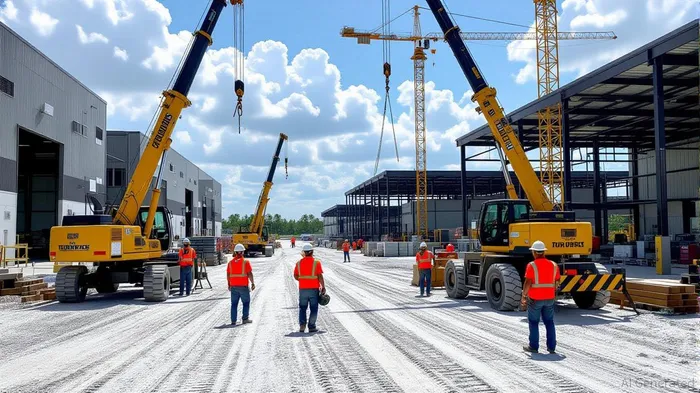
In an era of economic uncertainty and shifting real estate dynamics, FRP HoldingsFRPH-- (FRPH) has positioned itself as a strategic player in two of the most resilient sectors: industrial real estate and multifamily housing. While short-term net operating income (NOI) volatility and occupancy challenges persist, the company's long-term vision—anchored in geographic diversification, joint ventures, and capital discipline—suggests a compelling case for investors seeking exposure to growth-oriented real estate markets.
Industrial Real Estate: A Strategic Bet on Supply-Demand Imbalances
FRP's industrial segment has faced headwinds in 2025, with a 15% decline in Q2 NOI due to tenant evictions and lease expirations. However, the company's aggressive development pipeline and joint ventures signal a deliberate pivot toward high-demand markets.
The most notable initiative is the $377,892-square-foot warehouse project in Lake County, Florida, a joint venture with Strategic Real Estate Partners (SREP). This development, set to begin construction in late 2025, targets a critical gap in the Orlando submarket: shallow bay industrial buildings of a specific size range. With limited land availability in coastal gateway markets, Lake County's proximity to the Florida Turnpike and its status as a logistics hub make it a strategic location. FRP's 95% stake in this venture underscores its confidence in the project's long-term returns.
Complementing this is the $384,193-square-foot joint venture with Altman Logistics in Lakeland and Broward County, Florida, expected to add Class A industrial space by Q2 2026. These projects align with FRP's goal to double its industrial portfolio by 2030, leveraging a “three new assets every two years” cadence. The company's Maryland pipeline, including a 258,279-square-foot speculative warehouse in Aberdeen, further diversifies its geographic exposure.
While current occupancy rates in the industrial segment stand at 74.0% (down from 95.6% in 2024), the focus on high-quality, pre-leased developments mitigates risk. Industrial vacancy rates are projected to rise to 7.0% by year-end 2025, but FRP's emphasis on shallow bay logistics facilities—critical for e-commerce and 3PLs—positions it to outperform in a market where supply constraints persist.
Multifamily Resilience: Stabilization and Sun Belt Growth
The multifamily segment has shown greater resilience, with a 1% increase in pro rata NOI for Q2 2025. This growth is driven by stabilized assets like The Verge in Anacostia, DC, which transitioned from the development phase to the multifamily segment in July 2024. The property's 93.3% occupancy and $733,000 in pro rata NOI highlight the value of disciplined lease-up strategies.
FRP's $87.8 million Woven project in Greenville, SC, a joint venture with Woodfield Development, exemplifies its Sun Belt focus. With 214 units and 13,500 square feet of retail, the project leverages South Carolina's Textile Rehabilitation Credits to reduce costs. The state's population and job growth, coupled with lower supply pressures compared to coastal markets, make it an attractive long-term play.
The company's refinancing of BC Realty's office loans at a fixed 6.40% rate also underscores its capital efficiency. By locking in long-term financing, FRPFRPH-- insulates itself from rising interest rates, a critical advantage in a multifamily sector where rent growth is projected to moderate to 1.5–3.5% annually through 2028.
Financial Resilience: Debt Management and Liquidity
FRP's recent $50 million credit facility with Wells Fargo provides flexibility to fund its industrial and multifamily pipelines. The facility's interest rate of 2.25% over SOFR and a 0.35% commitment fee on unused funds reflects favorable terms, particularly in a tightening credit environment. While the company's debt-to-EBITDA ratio is not disclosed, its $461 million in equity and $261 million in liabilities suggest a conservative leverage profile.
The mining royalty segment, though smaller, added $1.657 million in operating profit before G&A in Q2, demonstrating diversification benefits. This segment's 21% NOI growth—driven by higher royalty payments—provides a non-cyclical revenue stream that complements real estate operations.
Macroeconomic Alignment: A Hedge Against Volatility
FRP's strategies align with broader macroeconomic trends. Industrial real estate is benefiting from a “flight to quality,” as businesses prioritize efficient logistics infrastructure amid supply chain disruptions. Meanwhile, multifamily demand remains robust in Sun Belt states, where population growth outpaces housing supply.
The company's focus on shallow bay industrial buildings and Sun Belt multifamily assets positions it to capitalize on these trends. While near-term NOI volatility is inevitable, the long-term fundamentals—driven by demographic shifts and e-commerce growth—favor FRP's model.
Investment Thesis: Balancing Risks and Rewards
FRP Holdings is not without risks. The industrial segment's occupancy challenges and the multifamily sector's sensitivity to interest rates require careful monitoring. However, the company's proactive approach to joint ventures, geographic diversification, and capital structure optimization mitigates these risks.
For investors, the key question is whether FRP's long-term growth trajectory justifies its current valuation. With a market cap of ~$500 million and a forward P/NOI of ~12x, the stock appears undervalued relative to peers. The company's $50 million credit facility and $87.8 million Woven project also suggest a disciplined capital allocation strategy.
Recommendation: Investors with a 3–5 year horizon should consider a position in FRPHFRPH--, particularly as the industrial and multifamily pipelines mature. A 5–7% allocation in a diversified real estate portfolio could offer exposure to high-growth sectors while balancing risk through FRP's capital-efficient model.
In conclusion, FRP Holdings is navigating macroeconomic uncertainty with a blend of strategic foresight and operational discipline. While short-term NOI volatility persists, the company's alignment with structural trends in industrial and multifamily real estate makes it a compelling long-term investment.





Comentarios
Aún no hay comentarios