
Frontline's Q3 Performance and Strategic Shift to VLCCs: A 33% Cash Flow Yield Opportunity in a Resurging Tanker Market
Financial Performance: Strong Earnings and Dividend Discipline
Frontline reported third-quarter 2025 net income of $40.3 million and revenues of $432.7 million, driven by strong charter equivalent (TCE) earnings across its fleet. The company's average daily TCE rates for VLCCs, Suezmax tankers, and LR2/Aframax tankers stood at $34,300, $35,100, and $31,400, respectively. These figures reflect the company's ability to capitalize on tightening freight markets, particularly for VLCCs, where Q4 2025 spot rates have surged to $83,300 per day-75% of which FrontlineFRO-- has already secured.
The company's commitment to shareholder returns was evident in its $0.19 per share cash dividend, declared alongside the earnings report. This payout, combined with a stock price of $25.20 as of November 2025, highlights the growing appeal of Frontline as a yield-driven investment.
Fleet Optimization: Strategic Asset Sales and Debt Restructuring
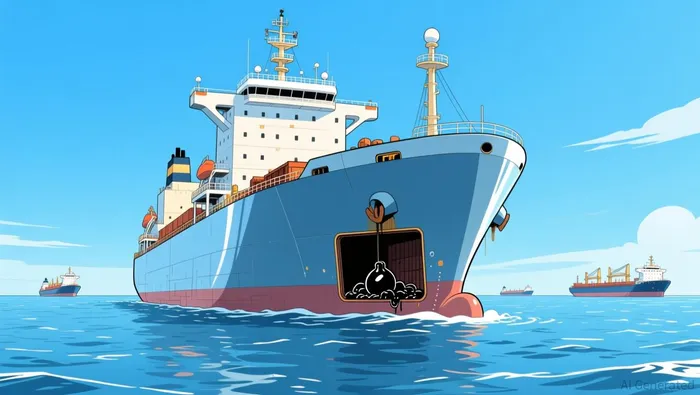 Frontline's Q3 strategy emphasized fleet rationalization and financial flexibility. The company sold its oldest Suezmax tanker for $36.4 million, generating $23.7 million in net cash after repaying existing debt. This move aligns with its broader objective of maintaining a modern, efficient fleet capable of capturing higher-margin opportunities.
Simultaneously, Frontline executed a significant debt restructuring, converting $405.5 million in term loans to revolving credit facilities and prepaying $374.2 million in debt. This action reduced the fleet's average cash breakeven rate by approximately $1,300 per day for the next 12 months. By extending maturities and lowering interest costs, the company has fortified its liquidity position, with $819 million in cash and cash equivalents as of September 30, 2025.
Strategic Shift to VLCCs: Capitalizing on Market Dynamics
Frontline's pivot to VLCCs is a masterstroke in a market increasingly dominated by geopolitical and regulatory tailwinds. The company's CEO, Lars Barstad, highlighted the strengthening freight rates for VLCCs, driven by India's reduced reliance on Russian feedstock and a global shift toward compliant crudes. These trends have created a supply-demand imbalance, with spot rates for VLCCs surging to levels not seen in years.
The strategic focus on VLCCs is further validated by Frontline's forward bookings: 75% of available VLCC days for Q4 2025 are already contracted at $83,300 per day. This visibility into high-margin revenue streams positions the company to outperform peers reliant on lower-yielding segments.
Investment Case: A 33% Cash Flow Yield Opportunity
Frontline's disciplined capital allocation has unlocked a compelling cash flow yield for investors. With $1.8 billion in projected cash generation over the next 12 months-equivalent to $8.15 per share-and a current stock price of $25.20, the company offers a cash flow yield of approximately 33%. This metric, combined with a robust balance sheet (no meaningful debt maturities until 2030) and a proactive management team, makes Frontline an attractive candidate for long-term value creation.
Analysts have echoed this sentiment, with a "Buy" rating and a one-year price target averaging $25.25 as noted in the earnings preview. While short-term volatility remains a risk-evidenced by the Q3 earnings miss of $0.19 per share versus the $0.27 forecast-the company's revenue beat of $432.65 million versus $266.48 million underscores its operational resilience.
Conclusion: A Model of Prudent Capital Allocation
Frontline's Q3 2025 performance exemplifies the power of disciplined capital allocation and strategic foresight. By optimizing its fleet, restructuring debt, and focusing on high-margin VLCC operations, the company has positioned itself to thrive in a resurging tanker market. For investors seeking a combination of yield and growth, Frontline's 33% cash flow yield represents a rare opportunity-one that is underpinned by a strong balance sheet, favorable market dynamics, and a management team that prioritizes shareholder value.
As global oil demand remains resilient and freight rates continue to climb, Frontline's strategic pivot to VLCCs is not just a tactical move-it is a long-term value proposition that merits serious consideration.





Comentarios
Aún no hay comentarios