
The New Frontier of Regulatory Risk: Local Government Enforcement and Crypto Asset Seizures
The cryptocurrency market, long celebrated for its decentralized ethos, is now navigating a rapidly evolving regulatory landscape. While federal agencies like the U.S. Department of Justice (DOJ) and the Securities and Exchange Commission (SEC) dominate headlines, local governments and state-level authorities are increasingly asserting their influence through aggressive enforcement actions and asset seizure practices. These developments are reshaping the risk profile for crypto investors, particularly as jurisdictions experiment with novel legal frameworks to manage digital assets tied to fraud, money laundering, and cybercrime.
Federal Enforcement: From Liquidation to Strategic Reserves
The DOJ's recent establishment of the United States Strategic Bitcoin Reserve marks a paradigm shift in how seized crypto assets are managed. Previously, the government liquidated seized cryptocurrency at auction to fund operations or compensate victims. Now, the reserve retains these assets as long-term holdings, aiming to hedge against inflation, support law enforcement funding, and avoid market volatility from sudden sales[1]. This policy aligns with broader national security goals and reflects a growing recognition of Bitcoin's value as a store of wealth.
Notable cases underscore this trend. In 2025, the DOJ seized $2.8 million in cryptocurrency, $70,000 in cash, and a luxury vehicle from Ianis Aleksandrovich Antropenko, a cybercriminal linked to the Zeppelin ransomware attacks[3]. The assets were traced using blockchain analysis tools and cryptocurrency mixers, highlighting the DOJ's enhanced technical capabilities. Meanwhile, the $3.6 billion in BitcoinBTC-- tied to the 2016 Bitfinex hack—seized in 2022—remains in the Strategic Reserve, pending allocation for victim restitution or public programs[4].
State-Level Aggression: From Dormant Wallets to Staking Schemes
At the state level, enforcement actions have grown more aggressive, often outpacing federal efforts. California's Assembly Bill AB-1052, for instance, allows the seizure of dormant Bitcoin and other cryptocurrencies after three years of inactivity, targeting custodial wallets on exchanges[2]. Critics argue this infringes on user privacy and penalizes long-term holders, but proponents view it as a tool to recover unclaimed assets for public benefit.
New York and Oregon have also made headlines. In March 2025, New York's Attorney General secured a $200 million settlement with Galaxy DigitalGLXY-- Holdings over its role in promoting the failed LunaLUNA-- cryptocurrency[5]. A month later, Oregon sued CoinbaseCOIN-- for allegedly selling unregistered securities to residents[5]. These cases reflect a broader trend: states are leveraging “blue sky laws” to address crypto fraud, with the North American Securities Administrators Association (NASAA) reporting 343 crypto-related enforcement actions in 2023 alone[1].
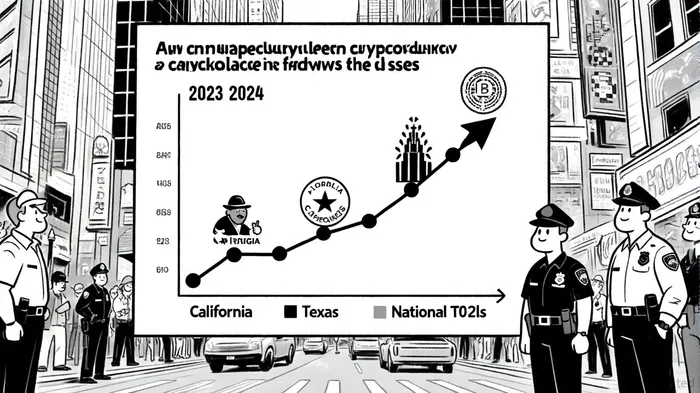
Texas and California, meanwhile, reported the highest crypto fraud losses in 2024—$1.39 billion and $738.5 million, respectively[5]. These figures have spurred legislative action, with at least 40 states introducing or considering crypto-related bills in 2025. Arizona, for example, established the Bitcoin and Digital Assets Reserve Fund, enabling local governments to securely store and manage seized assets[6].
Legal Frameworks and Market Implications
The legal tools underpinning these actions are robust. Federal statutes like 18 U.S.C. § 981 (civil forfeiture) and 28 U.S.C. § 524(c) (DOJ forfeiture fund) now explicitly classify cryptocurrencies as “property,” enabling their seizure in cases of fraud, money laundering, and cybercrime[1]. States like Arizona have further codified blockchain technology and smart contracts into law, creating a patchwork of regulations that complicate compliance for cross-border crypto businesses[2].
For investors, the implications are twofold. First, the risk of asset seizure—particularly for those holding large sums in custodial wallets—has increased. Second, the DOJ's 2025 policy shift away from “regulation by prosecution” signals a focus on criminal enforcement rather than broad regulatory overreach[5]. While this may reduce uncertainty for compliant operators, it leaves room for states to fill the regulatory vacuum, as seen in Oregon's Coinbase lawsuit.
Strategic Considerations for Investors
The evolving enforcement landscape demands a nuanced approach to risk management. Investors should:
1. Diversify storage methods: Use cold storage for significant holdings to minimize exposure to custodial wallet seizures.
2. Monitor state legislation: Stay informed about local laws, such as California's dormancy rules or Arizona's reserve fund policies.
3. Engage with compliance frameworks: Prioritize platforms that adhere to state-level “blue sky” regulations and transparent staking practices.
Conclusion
Local government enforcement and asset seizure practices are redefining regulatory risk in the crypto market. While the DOJ's Strategic Bitcoin Reserve and state-level initiatives aim to enhance financial stability and investor protection, they also introduce new uncertainties for market participants. For investors, the path forward lies in balancing innovation with vigilance—a lesson as old as finance itself.





Comentarios
Aún no hay comentarios