
The New Frontier: Investment Opportunities in Private-Sector Mars Exploration
The Strategic Imperative of Reusable Rocket Technology
Reusable rocketry is the linchpin of cost-effective space exploration. Blue Origin's New Glenn, which achieved a successful sea-based booster landing in November 2025, exemplifies this shift. According to a Bloomberg report, the mission reduced launch costs by 40% compared to traditional expendable systems, a critical factor for scaling Mars missions. This technological leap mirrors SpaceX's Falcon 9 but introduces a new competitor in a market projected to grow from $512 billion in 2025 to $1.01 trillion by 2034.
The economic implications are profound. Reusability enables frequent, affordable access to orbit, which is essential for deploying satellite constellations, conducting scientific research, and eventually establishing human settlements on Mars. For instance, the EscaPADE mission-carrying two satellites to study Martian atmospheric loss-was made possible by Blue Origin's ability to offer competitive pricing while partnering with Rocket LabRKLB-- and NASA according to economic analysis. Such collaborations highlight the growing interdependence between startups and established players, creating a fertile ground for investment.
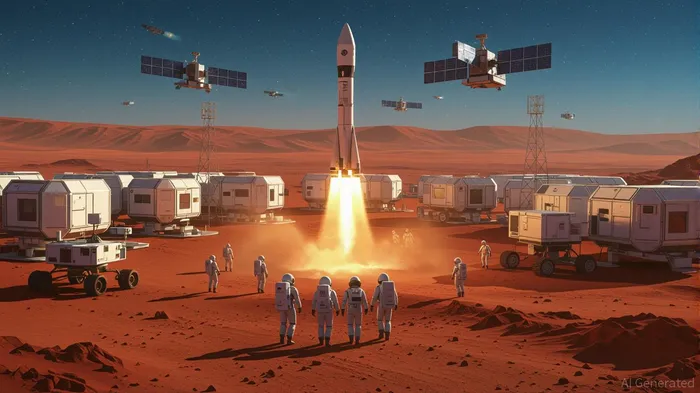
Emerging Startups: The Next Wave of Innovation
Beyond Blue Origin and SpaceX, a cohort of aerospace startups is emerging as key players in Mars exploration and reusable rocketry. These companies are attracting significant venture capital and strategic partnerships, positioning them as high-growth opportunities.
- HyImpulse (Germany): This startup has raised $58.9 million to develop small orbital launchers optimized for reusability. Its focus on lightweight, modular rocket systems aligns with the demand for cost-effective Mars payload delivery according to industry reports.
- Isar Aerospace (Germany): With $615 million in funding, Isar is building the Spectrum rocket, designed for rapid, reusable launches of small satellites. Its partnership with the European Space Agency (ESA) for lunar and Mars missions underscores its strategic relevance according to space analysis.
- Firefly Aerospace (USA): Having secured $796 million in capital, FireflyFLY-- is advancing its Alpha rocket and Alpha 3 variants, targeting both Earth orbit and lunar missions. Its recent contract with NASA for a Mars sample return payload demonstrates its expanding role in interplanetary logistics according to official announcements.
These startups are not only innovating in propulsion and materials but also leveraging AI-driven manufacturing and autonomous recovery systems to reduce operational costs. For example, Rocket Lab's rapid development of the EscaPADE spacecraft in just 3.5 years showcases how startups can accelerate timelines and lower barriers to entry according to industry insights.
Risk and Reward: Navigating the Investment Landscape
While the potential is vast, investors must navigate technical, regulatory, and geopolitical risks. For instance, reusable rocket systems require rigorous testing to ensure reliability, and regulatory frameworks for Mars resource extraction remain uncharted. However, the market's projected 7.86% CAGR from 2025 to 2034 suggests that these challenges are being addressed through public-private partnerships and international collaboration.
Moreover, the diversification of players-ranging from U.S. startups to European and Chinese firms-reduces overreliance on any single entity. China's CASC, for example, is advancing lunar and Mars missions with state-backed funding, creating a competitive yet complementary ecosystem according to global analysis. This multipolar landscape enhances resilience and broadens investment horizons.
Conclusion: A Golden Age of Space Capitalism
The New Glenn launch is more than a technical achievement; it is a harbinger of a new era in space exploration. As reusable rocketry becomes the industry standard, aerospace startups will play a central role in democratizing access to Mars and beyond. For investors, the key lies in identifying companies that combine technological ingenuity with strategic partnerships, as well as those that address critical bottlenecks in propulsion, materials, and mission logistics.
The next decade will likely see a surge in private-sector-led Mars missions, driven by the same entrepreneurial spirit that transformed Silicon Valley. Those who recognize this shift early-and back the innovators shaping it-stand to reap substantial rewards in what is becoming the most consequential frontier of human innovation.





Comentarios
Aún no hay comentarios