
Is Frontier Group Holdings (ULCC) Trading at a Bargain or a Trap?
The low-cost airline sector, long characterized by razor-thin margins and cyclical volatility, has entered a new phase of turbulence in 2025. Frontier Group HoldingsULCC-- (ULCC), a key player in this competitive landscape, presents a paradox: its stock trades at a seemingly attractive intrinsic value while grappling with severe financial leverage and consistent quarterly losses. This analysis examines whether ULCC's valuation dislocation reflects a mispriced opportunity or a precarious trap, contextualized within the broader industry dynamics.
Valuation Dislocation: A Tale of Two Metrics
Frontier's enterprise value to EBITDA (EV/EBITDA) ratio of 45.03 as of August 2025 starkly contrasts with the low-cost airline industry average of 7.47. This disconnect is even more pronounced when compared to peers like Southwest Airlines (LUV), which trades at an EV/EBITDA of approximately 17.3–18.7, and Spirit Airlines (SAVE), whose negative EBITDA yields an EV/EBITDA of -8.87. ULCC's elevated multiple appears to reflect a market that is either undervaluing its operational efficiency or overestimating its ability to service its staggering $5.032 billion in debt.
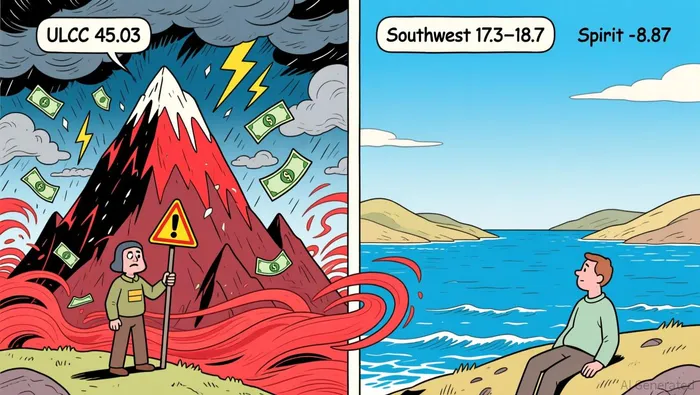 The debt-to-equity ratio further underscores the imbalance. ULCC's 153.9% leverage ratio dwarfs the industry average of 0.89 and Southwest's conservative 0.51 as reported. This financial structure leaves ULCCULCC-- vulnerable to interest rate hikes and economic downturns, compounding risks already exacerbated by its Q2 and Q3 2025 net losses of $70 million and $77 million, respectively. Yet, intrinsic value estimates suggest the stock is undervalued by 156.1% at $11.68, compared to its $4.56 price in August 2025. This divergence raises a critical question: Is the market overcorrecting for risks, or is ULCC's financial fragility a legitimate red flag?
Industry Positioning: Efficiency vs. Leverage
ULCC's operational metrics offer a glimmer of hope. Its fuel efficiency-105–106 available seat miles (ASMs) per gallon in Q2–Q3 2025-positions it as "America's Greenest Airline," a label that could attract environmentally conscious investors. However, operational efficiency alone cannot offset a debt burden that exceeds equity by 153.9%. The company's recent 12.76% stock price surge in late 2025 may reflect speculative bets on a sector rebound, but it also highlights the volatility of a stock with a "Hold" analyst consensus at $6.13 as reported.
Spirit Airlines, ULCC's most leveraged peer, offers a cautionary tale. With a debt-to-equity ratio of 542.31% and negative EBITDA, Spirit's financial profile is arguably more dire. Yet, ULCC's higher EV/EBITDA suggests the market is not treating it as a direct proxy for Spirit's distress. This could indicate a belief in ULCC's ability to differentiate itself through operational metrics or strategic restructuring-a belief that may or may not be justified.
The Risk-Reward Dilemma
The crux of the investment decision lies in reconciling ULCC's intrinsic value estimates with its financial realities. While the $11.68 intrinsic value calculation implies a compelling discount, it assumes a path to profitability that has eluded the company in 2025. The airline's Q3 2025 net loss of $77 million and EPS of $(0.34) as reported underscore the urgency of turning around its earnings.
For investors, the key variables are:
1. Debt Restructuring: Can ULCC negotiate favorable terms to reduce its $5.032 billion debt load?
2. Fuel Costs: Will its 105–106 ASMs per gallon translate into sustainable cost advantages as oil prices fluctuate?
3. Sector Recovery: Will the broader low-cost airline industry's 9.74% EBITDA margin improvement in Q2 2025 persist, or is it a temporary rebound?
Conclusion: A Dislocation with Caveats
ULCC's valuation dislocation is undeniable, but its classification as a "bargain" or "trap" hinges on the resolution of these variables. The stock's intrinsic value premium and operational efficiency suggest a potential bargain, but the company's leverage and earnings trajectory paint a trap-like scenario. For risk-tolerant investors, ULCC could represent a high-conviction bet on a sector rebound and successful deleveraging. For others, the risks of further earnings deterioration and liquidity constraints may outweigh the allure of a discounted price.
In a sector where margins are as thin as the line between opportunity and peril, ULCC's story is a testament to the volatility of low-cost airlines-and the fine art of distinguishing dislocation from distress.





Comentarios
Aún no hay comentarios