
Freeport-McMoRan's Q3 Setback: A Buying Opportunity Amid Supply Disruptions and Rising Commodity Prices?
Freeport-McMoRan's Q3 2025 earnings report, released in a year marked by both operational turbulence and soaring commodity prices, presents a complex investment puzzle. The company's financial performance exceeded expectations-earnings per share of $0.50 and revenue of $6.97 billion-yet these gains were shadowed by a catastrophic mud-rush incident at its Grasberg mine in Indonesia, which forced a temporary production halt and revised forecasts for 2026. This incident, coupled with volatile copper and gold prices, has sparked debates about whether the stock's recent volatility reflects a mispricing opportunity or a warning signal. To assess this, investors must weigh Freeport's financial resilience against its elevated operational and regulatory risks in a post-Grasberg environment.
Operational Setback and Market Impact
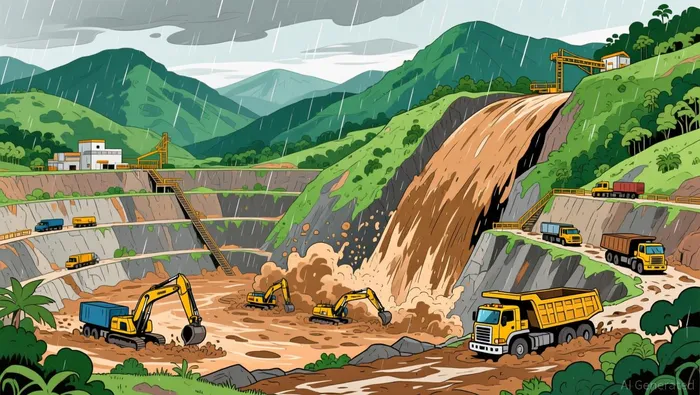
The Grasberg mine, Freeport's crown jewel, suffered a production halt in September 2025 after a mud-rush incident disrupted operations and triggered a force-majeure declaration. This event led to a 13.2% year-over-year decline in copper output to 912 million pounds and the loss of approximately 90 million pounds of copper and 80,000 ounces of gold. The company revised its 2026 production outlook downward and delayed full recovery until 2027, citing the complexity of restarting block-cave mining operations. Analysts at Benchmark Minerals warn that this disruption could push the global refined copper market into a steep deficit in 2026, amplifying Freeport's leverage to rising prices.
 Despite these challenges, Freeport's Q3 results benefited from a 9% year-over-year increase in copper prices to $4.68 per pound and a surge in gold prices to $3,539 per ounce. These gains offset production declines and supported a 21.95% beat on earnings forecasts. However, the incident has exposed vulnerabilities in the company's risk profile, including regulatory scrutiny in Indonesia and a class-action lawsuit alleging inadequate safety practices.
Financial Resilience Amid Uncertainty
Freeport's balance sheet remains a critical buffer against operational shocks. As of Q3 2025, the company held $4.3 billion in cash and $9.3 billion in total debt, resulting in a net debt-to-adjusted EBITDA ratio of 0.5x and a debt-to-equity ratio of 0.31. These metrics underscore its financial flexibility, enabling the firm to maintain a $3 billion share repurchase program and a stable quarterly dividend. A recent credit rating upgrade to 'BBB-' by S&P Global reflects confidence in its debt leverage position.
Yet, the Grasberg incident has introduced new uncertainties. The company's beta coefficient of 1.49 highlights its heightened sensitivity to market swings, driven by commodity price volatility and operational risks. While Freeport's long-term Sharpe ratio of 0.12 suggests reasonable risk-adjusted returns, its 1-year Sharpe ratio of -0.35 indicates underperformance relative to the broader market. This discrepancy underscores the tension between short-term disruptions and long-term growth prospects.
Long-Term Outlook: Copper Supercycle or Overhyped Narrative?
Freeport's strategic focus on copper positions it to benefit from the ongoing electrification and infrastructure booms. The company projects EBITDA growth exceeding $15.5 billion by 2027–2028, driven by robust demand and disciplined cost management. Analysts at UBS and Bank of America have raised price targets to $60 and upgraded ratings to "buy," citing Freeport's diversified asset base and leadership in the copper sector.
However, skeptics caution against overreliance on copper's bullish narrative. Regulatory challenges in Indonesia, including downstreaming policies and environmental concerns, could delay Grasberg's full restart. Additionally, falling ore grades and macroeconomic headwinds-particularly from China's slowing demand-pose risks to Freeport's margins.
Conclusion: A Calculated Bet for Risk-Tolerant Investors
Freeport-McMoRan's Q3 setback has created a mixed-value proposition. On one hand, the company's financial strength, strategic positioning in copper, and disciplined capital allocation make it an attractive candidate for investors betting on the energy transition. On the other, the Grasberg incident has exposed operational and regulatory risks that could weigh on short-term returns.
For risk-adjusted returns, the key lies in time horizons. Short-term volatility, reflected in the negative Sharpe ratio, may deter conservative investors. Yet, over the medium to long term, Freeport's low debt, strong cash flow, and exposure to a copper supercycle could justify its current premium to peer averages. As with any high-beta investment, the margin of safety is narrow-but for those willing to tolerate near-term uncertainties, the potential rewards may be substantial.





Comentarios
Aún no hay comentarios