
Franklin BSP Realty Trust Inc: Strategic Positioning in the Post-Pandemic CRE Recovery Amid High Interest Rates and Sector Shifts
The post-pandemic commercial real estate (CRE) recovery in 2025 is marked by a complex interplay of high interest rates, sector-specific demand dynamics, and evolving REIT performance benchmarks. Franklin BSP Realty Trust IncFBRT-- (FBRT) has positioned itself at the intersection of these forces, leveraging strategic acquisitions, capital recycling, and a focus on resilient sectors like multifamily properties. However, its high leverage ratios and dividend sustainability concerns underscore the challenges of navigating a volatile macroeconomic environment.
Strategic Moves in a High-Cost CRE Landscape
Franklin BSP's recent acquisition of NewPoint Holdings JV LLC for $425 million and a $1.1 billion securitization transaction highlight its proactive approach to capitalizing on the CRE recovery according to the company's announcement. These moves align with the broader trend of REITs prioritizing liquidity and portfolio optimization amid elevated borrowing costs. As of October 2025, the Federal Reserve's benchmark rate stood at 3.75–4.00%, but commercial mortgage rates remained stubbornly high, with multifamily loans priced at ~5.3% and riskier sectors like hospitality facing rates exceeding 7.5% according to industry analysis. By expanding its commercial real estate finance capabilities and freeing up capital through securitization, FBRTFBRT-- aims to mitigate refinancing pressures as nearly $1 trillion in CRE loans mature according to industry analysis.
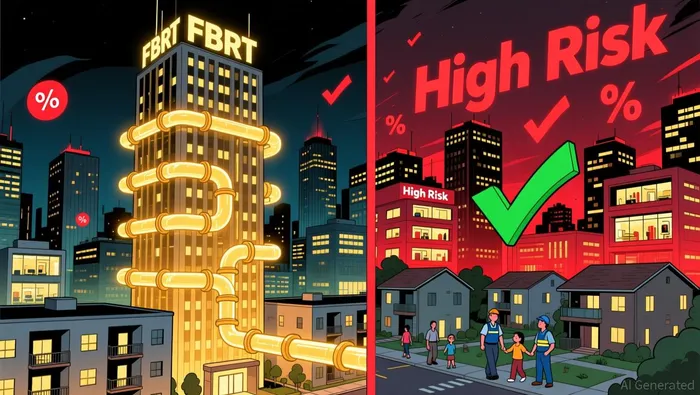 The company's core portfolio, with a $4.4 billion principal balance across 147 loans, is heavily weighted toward multifamily properties-a sector that has shown relative resilience despite overbuilding in some Sun Belt markets according to the company's results. This focus is strategic, as industrial and multifamily REITs have outperformed office and retail peers, driven by e-commerce demand and stable occupancy rates according to recent analysis. Franklin BSP's $2.2 billion in new loan commitments under Fannie Mae, Freddie Mac, and HUD programs further reinforce its alignment with low-risk, government-backed opportunities according to the company's announcement.
Financial Performance and Risk Metrics
Franklin BSP's third-quarter 2025 results revealed a GAAP net income of $17.6 million, down from $24.4 million in the prior quarter, with diluted earnings per share falling to $0.12 from $0.19 according to the company's results. Distributable Earnings, a key non-GAAP metric, declined to $26.7 million ($0.22 per share) from $29.0 million ($0.27 per share). These figures reflect the broader challenges facing debt-focused REITs, which reported a 17.3% year-over-year increase in funds from operations (FFO) but lagged behind equity REITs in total returns according to industry reports.
The company's dividend yield of 13.55%-well above the Real Estate sector average of 6.66%-is a double-edged sword according to financial data. While it attracts income-seeking investors, the payout ratio of 177.5% raises concerns about sustainability, particularly in a high-interest-rate environment. Franklin BSP's leverage ratios also stand out: a Debt/Equity ratio of 3.59 and a Debt/Assets ratio of 0.70, both higher than industry benchmarks for conservative balance sheets according to financial analysis. These metrics amplify exposure to refinancing risks as commercial mortgage rates remain elevated according to industry analysis.
Peer Comparisons and Market Sentiment
Relative to its peers, Franklin BSP's valuation appears attractive. Its price-to-earnings ratio of 10.5x is below the US mortgage REITs industry average of 12.3x according to financial data, and analysts project a 12-month target price of $14.38, 26.5% above its current share price of $10.57 according to market analysis. However, the company's revenue declined by 6.4% year-over-year, and its net profit margin has contracted from 38.7% to a projected 24.1% over the next three years according to financial data. This divergence between valuation optimism and operational headwinds reflects the market's cautious stance toward high-leverage REITs in a tightening credit environment.
The broader REIT sector has also faced mixed performance. While industrial and healthcare REITs have benefited from stable demand, office REITs continue to grapple with 23% vacancy rates and reconfiguration costs according to recent analysis. Franklin BSP's focus on multifamily and agency loan programs positions it to capitalize on these sectoral shifts, but its ability to maintain profitability will depend on its capacity to recycle capital into higher-yielding assets without overextending its balance sheet.
Conclusion: Balancing Opportunity and Risk
Franklin BSP Realty Trust Inc's strategic initiatives-such as the NewPoint acquisition and securitization-demonstrate a clear intent to navigate the post-pandemic CRE recovery. Its emphasis on multifamily and government-backed loans aligns with sectoral trends, and its valuation multiples suggest undervaluation relative to peers. However, the company's high leverage, declining margins, and dividend sustainability risks cannot be ignored. As the Federal Reserve's rate-cut cycle unfolds in 2026, Franklin BSP's ability to reduce borrowing costs and stabilize earnings will be critical to unlocking its full potential. For now, the stock offers a compelling risk-reward profile for investors willing to tolerate near-term volatility in pursuit of long-term capital appreciation.





Comentarios
Aún no hay comentarios