
Frankfurt Stock Market Stability Amid Mixed Economic Signals: Sectoral Divergence and Investor Caution in Q3 2025
The Frankfurt stock market navigated a complex landscape in Q3 2025, marked by divergent sectoral performance and cautious investor behavior amid flat market conditions. While global economic resilience and AI-driven optimism buoyed equity markets, Germany's political and economic uncertainties created a stark contrast with France's relative stability. This duality raises critical questions about the long-term stability of the Frankfurt exchange and the strategies investors might adopt in such an environment.
Sectoral Performance: Winners and Losers
The Frankfurt stock market exhibited pronounced sectoral divergence. Financials and healthcare emerged as standout performers, driven by robust corporate earnings and structural tailwinds. Bank shares, in particular, benefited from improved profitability and regulatory clarity, with the sector outperforming the broader DAX index, according to J.P. Morgan. Conversely, telecoms and communication services lagged, weighed down by regulatory headwinds and subdued demand growth, according to an iShares report. This bifurcation reflects shifting investor priorities, with capital flowing toward sectors perceived as resilient to macroeconomic volatility.
The DAX and MDAX indices, representing large-cap and mid-cap German equities respectively, demonstrated resilience. The DAX rose 8.52% year-to-date, while the MDAX surged 10.23%, supported by government investments in infrastructure and climate protection, J.P. Morgan noted. However, these gains masked underlying fragility. The MSCI Germany Index fell 1.2% in Q3 2025, underscoring concerns about political instability and a sluggish domestic economy, according to J.P. Morgan. This contrast highlights the importance of sector-specific analysis in assessing market stability.
Investor Behavior: Caution Amid Optimism
Investor sentiment in Frankfurt was characterized by a mix of optimism and caution. While international fund managers increased their overweight positions in eurozone equities-shifting from a net 25% underweight in December 2024 to a net 12% overweight-according to Börse Frankfurt-institutional investors remained bearish. A survey by Börse Frankfurt revealed that 58% of institutional investors predicted a declining DAX, with the Sentiment Index hitting -26 points, its lowest in weeks. This dichotomy underscores the tension between macroeconomic optimism and micro-level uncertainties.
Fund flows further illustrate this complexity. Global ETF/ETP inflows reached $377 billion in Q3 2025, with European investors redirecting capital toward U.S. equities for the first time since 2020, the iShares report found. Fixed-income ETFs also attracted $100 billion in flows, driven by anticipation of Federal Reserve rate cuts. However, domestic investors remained hesitant, with bearish positions in the DAX growing despite its rally. This suggests that while capital is flowing into high-performing assets, broader confidence in the German market remains fragile.
Flat Market Conditions: A Test of Resilience
Flat market conditions in Q3 2025, influenced by a weaker U.S. dollar and trade uncertainties between the U.S. and China, added another layer of complexity. While the MSCI Europe ex-UK Index returned 2.8% for the quarter, Germany's underperformance highlighted structural vulnerabilities, J.P. Morgan observed. Political instability and a 6% budget deficit in France, meanwhile, widened the yield spread between French and German 10-year bonds to its widest level since January 2025. These developments underscore the interconnectedness of European markets and the susceptibility of Frankfurt to cross-border shocks.
Outlook and Strategic Implications
For investors, the Frankfurt market's stability hinges on navigating sectoral imbalances and political risks. The MDAX's attractively valued mid-cap stocks offer potential for growth, while the DAX's structural shifts justify its premium valuations, J.P. Morgan advised. However, the bearish institutional outlook and elevated short-sell positions in the DAX suggest a possible short squeeze if the index continues to rise, Börse Frankfurt warned.
In the near term, the Federal Reserve's rate-cut trajectory and global trade dynamics will remain pivotal. As J.P. Morgan noted, "The potential inflationary impact of tariffs and political uncertainty in key markets like France and Germany added volatility to the Frankfurt stock exchange." Investors must balance exposure to resilient sectors like financials and healthcare with hedging against macroeconomic headwinds.
Conclusion
The Frankfurt stock market's stability in Q3 2025 reflects a delicate balance between sectoral strength and systemic risks. While financials and healthcare shine, broader economic and political uncertainties persist. Investors must adopt a nuanced approach, leveraging sectoral opportunities while mitigating risks from flat market conditions and geopolitical volatility. As the year progresses, the interplay between domestic policy and global macro trends will likely define the path forward for Frankfurt's equities.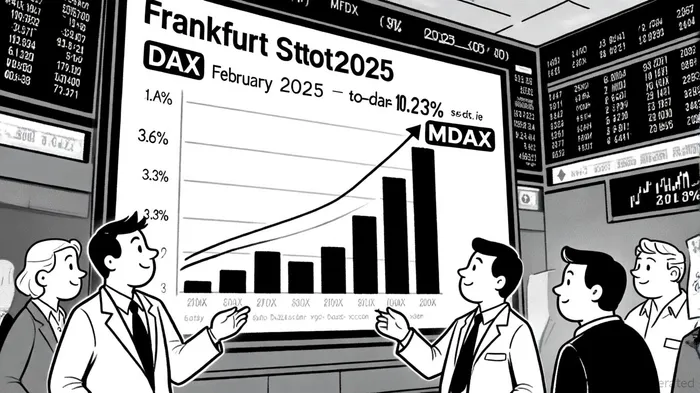







Comentarios
Aún no hay comentarios