
France's Strategic Bitcoin Reserve: A Bold Move to Diversify Sovereign Wealth and Boost Crypto Adoption
A Blueprint for Sovereign Crypto Diversification
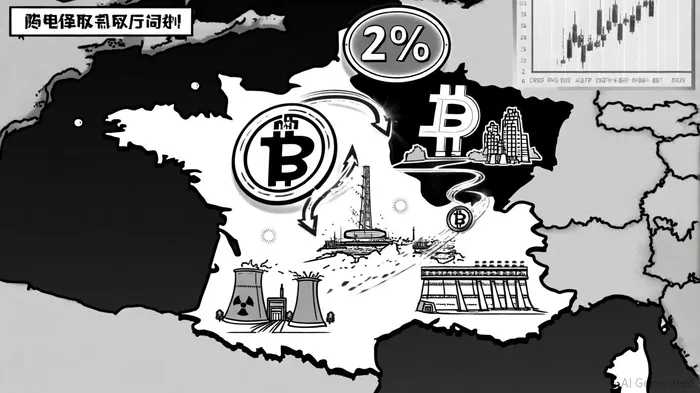
France's strategy mirrors global efforts to diversify reserves beyond traditional fiat currencies. The U.S., for instance, holds 212,000 BTCBTC-- (valued at $7.37 billion) from criminal seizures, while China's 194,000 BTC ($6.74 billion) stems from the PlusToken Ponzi scheme, according to CoinPedia's research. El Salvador, the first country to adopt BitcoinBTC-- as legal tender, has acquired 5,800 BTC ($201 million) for public infrastructure (CoinPedia's research). However, France's 2% target-equivalent to $48 billion at current prices-exceeds these efforts in scale and ambition, as the Cryptofront News report notes.
The French plan leverages three key mechanisms: 1. Public Bitcoin Mining: Utilizing surplus nuclear and hydroelectric energy to mine BTC, aligning with the country's renewable energy goals (Cryptofront News). 2. Judicial Seizures: Retaining Bitcoin confiscated in criminal cases, a tactic already employed by the U.S. and Ukraine (CoinPedia's research). 3. Savings Account Allocations: Daily purchases funded by the Livret A and LDDS, which hold over €100 billion in public savings (Cryptofront News).
This multifaceted approach not only diversifies France's reserves but also signals a strategic alignment between energy policy, financial sovereignty, and digital innovation.
Global Institutional Bitcoin Accumulation: A $100 Billion Shift
France's initiative aligns with a surge in institutional Bitcoin adoption. By 2025, institutional holdings exceed $100 billion, driven by firms like BlackRock and JPMorgan, which now offer Bitcoin ETFs, and, as an Andreessen Horowitz report notes, a broader institutional interest. Public companies such as MicroStrategy and Tesla have normalized Bitcoin as a treasury asset, while over 122 U.S. entities hold BTC, according to Bitget.
The French proposal to allocate public funds to Bitcoin mirrors this trend but introduces a novel dimension: state-backed perpetual accumulation. Unlike private firms, which treat Bitcoin as a speculative or hedging tool, France's reserve aims to build a long-term store of value. This mirrors the U.S. Treasury's gold reserves but with a digital asset that offers programmability, transparency, and resistance to devaluation, according to a Coinotag forecast.
Regulatory Framework and Market Implications
France's crypto-friendly measures-such as recognizing euro-backed stablecoins for small transactions and exempting under-€200 trades from taxes-further cement its role as a regulatory innovator (Cryptofront News). These policies align with the EU's MiCA framework but push for greater flexibility, particularly in stablecoin issuance, as Coinfomania argues.
The market response has been mixed. While the NVT Golden Cross metric-a key indicator of Bitcoin's network value-has improved (a Coinotag forecast), political challenges remain. The UDR's 16-seat minority in the National Assembly limits immediate passage, though the proposal's symbolic significance is undeniable (Coinfomania). Analysts suggest that even partial adoption could catalyze broader European interest in Bitcoin as a sovereign asset, the Cryptofront News report observes.
Comparative Sovereign Strategies and Future Outlook
France's 2% target places it among a growing list of nations reimagining their reserves. Bhutan, for example, has acquired 13,029 BTC ($780 million) through renewable energy-backed mining (CoinPedia's research), while Ukraine's 1,200 BTC ($41.7 million) reflects wartime donations (CoinPedia's research). However, France's scale and institutionalized approach set it apart.
If approved, the reserve could trigger a domino effect in Europe, where central banks have historically been cautious about crypto. The U.S. and China's existing holdings suggest a precedent for institutional adoption, but France's focus on energy-efficient mining and public savings integration offers a replicable model for other nations (Cryptofront News).
Conclusion: A New Era of Digital Sovereignty
France's Bitcoin Strategic Reserve is more than a financial experiment-it is a declaration of intent. By treating Bitcoin as a sovereign asset, the country challenges traditional paradigms of monetary policy and financial sovereignty. While risks-regulatory, political, and market-related-remain, the initiative underscores a critical truth: in an era of digital disruption, nations that adapt will lead.
As global institutions continue to allocate billions to Bitcoin, France's bold move may well define the next chapter of crypto adoption.






Comentarios
Aún no hay comentarios