
France's Stance on MiCA and the Future of EU Crypto Regulation
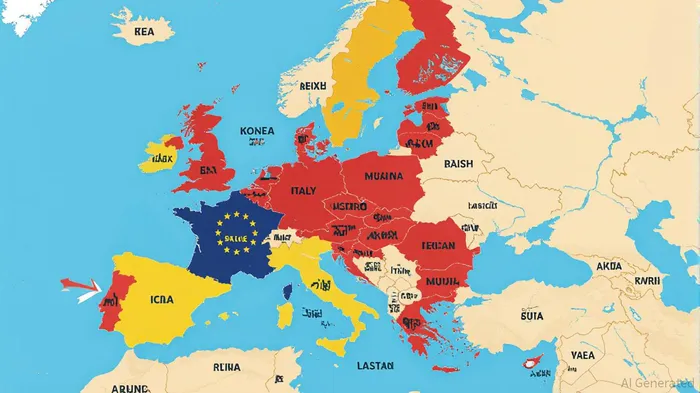
The European Union's Markets in Crypto-Assets (MiCA) framework, designed to harmonize crypto regulation across member states, is now at a crossroads. France, a pivotal player in EU financial policy, has emerged as a vocal critic of the passporting mechanism—a provision allowing crypto firms licensed in one EU country to operate across the bloc. By threatening to block this system, France is not only challenging the foundational principles of the single market but also reshaping the geopolitical and investment landscape for crypto firms and fintech innovators.
The French Position: Centralization vs. Fragmentation
France's financial watchdog, the Autorité des Marchés Financiers (AMF), has raised alarms about regulatory arbitrage, where crypto firms exploit lax licensing standards in countries like Malta or Luxembourg to gain EU-wide operational rights[1]. AMF President Marie-Anne Barbat-Layani has called passporting a “complex legal tool” and an “atomic weapon” against market stability[2]. France, alongside Italy and Austria, is pushing to centralize oversight of major crypto firms under the European Securities and Markets Authority (ESMA), arguing that national regulatory inconsistencies undermine investor protection[3]. This stance reflects a broader tension between larger EU states, which favor stricter, centralized control, and smaller jurisdictions that prioritize agility and competitiveness[4].
The AMF's concerns are not unfounded. A 2025 World Economic Forum report notes that regulatory fragmentation is already driving up compliance costs for fintech firms, with cross-border operations becoming increasingly complex[5]. For example, a crypto firm licensed in Luxembourg might face additional scrutiny in France, forcing it to duplicate compliance efforts or delay market entry. This creates a “patchwork” of rules that stifles innovation and deters investment[6].
Investment Risks and Opportunities in a Fragmented Market
The ripple effects of France's stance are evident in two key areas: compliance technology and blockchain infrastructure.
Compliance Tech as a Necessity
As regulatory requirements diverge, firms are investing heavily in compliance technology to navigate the maze of national laws. AI-driven systems for real-time transaction monitoring, automated reporting tools for cross-border data privacy mandates, and blockchain-based audit trails are becoming table stakes for EU-based crypto firms[7]. A 2025 analysis by the World Economic Forum highlights that 68% of surveyed fintech companies increased their compliance budgets by 20–40% in 2024–2025 to address fragmentation[8]. Startups like ChainGuard and RegTechX have seen valuation surges for their solutions tailored to EU regulatory complexity[9].Blockchain Infrastructure as a Workaround
Paradoxically, the same fragmentation is fueling demand for blockchain infrastructure that bypasses traditional regulatory bottlenecks. Cross-border payment platforms like StellarXLM-- and Ripple are gaining traction by leveraging decentralized networks to reduce reliance on fragmented EU licensing regimes[10]. Meanwhile, private blockchain solutions are being adopted by consortia of EU banks to create “regulatory sandboxes” that align with national rules while enabling seamless data sharing[11].
Strategic Implications for Investors
For investors, the key takeaway is clear: resilience and adaptability are paramount. The EU's regulatory fragmentation is not a temporary hurdle but a structural shift with long-term implications.
- Short-Term Risks: Firms relying on passporting for cross-border expansion face operational delays and higher costs. For instance, a French-based crypto exchange seeking to enter Germany may now need to secure a separate license, a process that could take 6–12 months[12].
- Long-Term Opportunities: Investors should prioritize compliance tech and blockchain infrastructure firms that offer modular, jurisdiction-specific solutions. Additionally, cross-border digital asset platforms that integrate AI-driven compliance layers—such as those using natural language processing to interpret EU regulations—are well-positioned to thrive[13].
The Geopolitical Dimension
France's actions also have broader geopolitical implications. By advocating for centralized oversight, France is aligning itself with Germany and other larger EU states to assert influence over the bloc's financial future. This contrasts with smaller, crypto-friendly nations like Malta, which fear that centralization will erode their competitive edge[14]. The resulting tug-of-war could delay MiCA's implementation, creating further uncertainty for market participants.
Conclusion: Navigating the New Normal
The EU's crypto market is at a crossroads. France's opposition to passporting underscores the tension between regulatory rigor and market integration. For investors, the path forward lies in embracing technologies that mitigate fragmentation—whether through compliance automation or decentralized infrastructure. As AMF's Barbat-Layani warned, the stakes are high: a fragmented EU could become a “battlefield” for regulators, investors, and innovators alike[15].






Comentarios
Aún no hay comentarios