
France's Market Resilience Under Political Uncertainty: Investor Sentiment and Economic Risks in 2025
France's Market Resilience Under Political Uncertainty: Investor Sentiment and Economic Risks in 2025
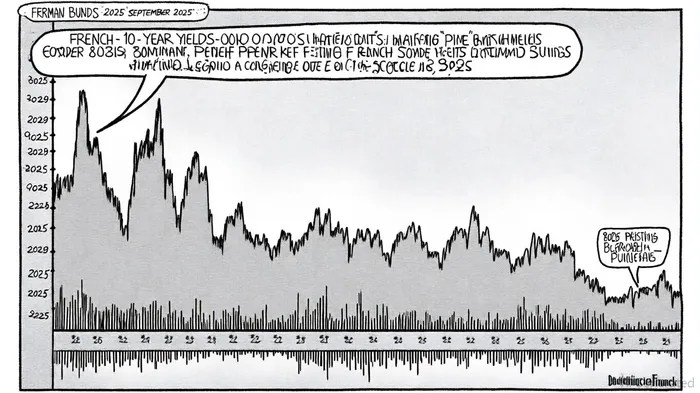
France's markets are under increasing strain as political instability in 2025 exacerbates investor uncertainty, threatening both economic recovery and financial stability. The resignation of Prime Minister Sébastien Lecornu in late September 2025-less than a month into his tenure-has left the government without a working majority, triggering a cascade of market reactions. This political paralysis has widened French bond spreads to 86 basis points above German Bunds, a level not seen since the eurozone debt crisis in 2012, according to a Euronews report. The CAC 40, France's benchmark equity index, plummeted 1.4% following Lecornu's resignation, as reported by MarketMinute, reflecting heightened risk aversion among investors.
Political Uncertainty and Fiscal Risks
The lack of a stable government has stalled critical reforms, including fiscal consolidation measures required by the European Union. Analysts warn that prolonged semi-governability-a scenario where no majority can pass legislation-could delay necessary budgetary adjustments, increasing the risk of a credit rating downgrade and higher borrowing costs, the Euronews report adds. France's public finances are already fragile, with a projected 5.4% deficit and a debt-to-GDP ratio of 117.6% in 2026, according to an Invezz analysis. If the government fails to meet EU fiscal targets, the European Central Bank's Transmission Protection Instrument (TPI) may be activated to stabilize markets, though the ECB has emphasized strict criteria for such intervention, the Euronews report notes.
Investor Sentiment: A Deepening Pessimism
Quantitative indicators underscore the erosion of investor confidence. INSEE's business climate index for France stood at 96 in April 2025, below its long-term average of 100, with construction and retail sectors showing particularly weak sentiment, according to INSEE data. Consumer confidence has also deteriorated, falling to 87 in August 2025-the lowest level since October 2023-according to Trading Economics. The OECD economic sentiment index for France, at 93 in September 2025, remains below its historical average of 99.54 since 1985, signaling subdued expectations, according to YCharts.
Historical parallels to the 2012 Eurozone crisis are particularly concerning. As noted by Invezz, the current political turmoil mirrors the systemic risks that once threatened the eurozone, with France's economic instability now posing spillover risks to countries like Italy and Belgium. The banking sector, utilities, and retailers-sectors heavily exposed to domestic conditions-are especially vulnerable, while multinational firms like LVMH and L'Oréal may remain relatively insulated, as highlighted in a MarketMinute piece.
Pathways to Resolution and Market Implications
France faces two potential outcomes: the formation of a new government or snap elections. Both scenarios carry risks of further fragmentation and delayed reforms. If no stable government emerges, the country risks prolonged semi-governability, leading to a gradual repricing of French assets and higher borrowing costs, the Euronews report warns. Corporate investment has already stalled, with businesses postponing hiring and capital expenditures amid uncertainty, the Invezz analysis finds.
For investors, the key risks lie in prolonged political instability and its impact on fiscal discipline. While the ECB's TPI offers a potential safety net, its activation remains conditional on France meeting stringent criteria. In the short term, markets will closely monitor the outcome of the September 8 confidence vote and the ECB's policy stance.
Conclusion
France's market resilience is being tested as political uncertainty deepens, with investor sentiment deteriorating across both equity and bond markets. The interplay of fiscal fragility, stalled reforms, and historical parallels to past crises underscores the need for urgent political resolution. For investors, the path forward requires a careful balance between risk mitigation and opportunistic positioning in sectors less exposed to domestic instability.







Comentarios
Aún no hay comentarios