
France's Budget Referendum: A Gamble with Investor Funds?
The French government’s 2025 budget, fraught with political drama and economic uncertainty, has investors on edge. Prime Minister François Bayrou’s attempt to fast-track austerity measures through constitutional loopholes has sparked fears of a government collapse—and now, whispers of a potential referendum. This is no small matter: the stakes for investors in French equities, bonds, and European markets are sky-high.
Let’s break it down.
The Budget Breakdown: Taxes, Cuts, and Political Torment
The budget, passed via Article 49.3 of France’s Constitution (which skips parliamentary votes), is a cocktail of corporate tax hikes, spending cuts, and social welfare reductions. Here’s the punchlist:
- Corporate Tax Bombshell:
- A 20.6–41.2% surtax on companies with over €1 billion in revenue—targeting giants like LVMH and Airbus—could drain €7.8 billion annually. Bernard Arnault, LVMH’s CEO, has already declared war, calling the tax “unfair.”
Why it matters: Luxury and industrial stocks face valuation pressure as profit margins shrink.
- Tobin Tax Surge:
The financial transaction tax (Tobin tax) jumps from 0.3% to 0.4%, hitting stock trades and investment funds. This could deter short-term traders and pressure asset managers like Amundi.
Green Transition Woes:
A 14% cut to environmental spending (€21 billion) slashes funding for energy efficiency programs like MaPrimeRénov’. Renewable energy stocks, such as Neoen, may see delayed projects.
Education and Culture Cuts:
- Universities and schools face a €1 billion reduction, while the Culture Pass for youth is gutted. France’s education and cultural sectors are already struggling—this could deepen the talent drain.
Political Instability: The Elephant in the Room
Bayrou’s government is teetering. With no parliamentary majority, his reliance on Article 49.3 has drawn no-confidence motions from the far-left and Greens. A collapse could trigger snap elections, and with France’s far-right Rassemblement National (RN) gaining traction, investors face a double whammy:
- Policy Volatility: An RN-led government might reverse austerity, but could also stoke market fears of populism.
- Debt Concerns: France’s public debt at 112% of GDP already exceeds EU limits. A political vacuum could push deficits to 6–6.5% of GDP, worsening bond yields.
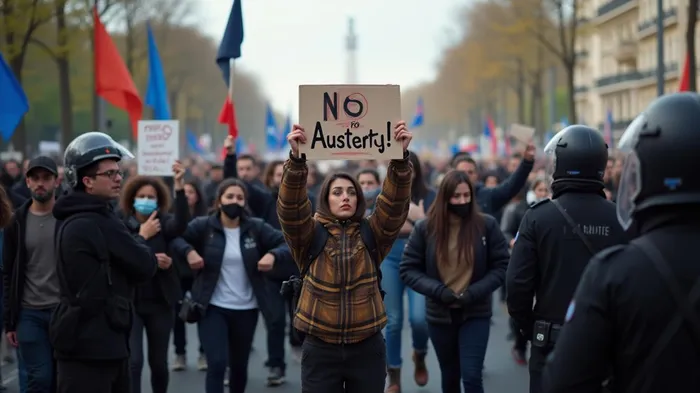
The Referendum Gambit: A Last Resorts?
While Bayrou hasn’t confirmed a referendum, the mere consideration adds fuel to the fire. A public vote would force France’s citizens to decide on austerity—a high-risk move. If voters reject the budget, markets could panic, fearing a fiscal freefall.
Investment Takeaways: Where to Look (and Run)
- Avoid the Green Sector:
With green funding slashed, renewable energy stocks (e.g., Neoen) face headwinds.
Watch Luxury Stocks Closely:
LVMH’s tax burden could hurt margins. Monitor its earnings revisions and currency exposure (weaker euro = mixed bag).
Embrace Defensive Plays:
Utilities (e.g., Engie) and pharmaceuticals (e.g., Sanofi) are less tied to austerity cuts.
Consider Eurozone Diversification:
- France’s instability could spill into the eurozone. Look to Germany’s industrials (e.g., Siemens) or Nordic tech stocks for stability.
Conclusion: A High-Wire Act for Investors
France’s budget saga is a masterclass in political brinkmanship—and a warning for investors. With Bayrou’s government clinging to power and a potential referendum looming, the risks are clear:
- Corporate tax hikes = lower earnings for LVMH and peers.
- Spending cuts = slower growth in green energy and education.
- Political collapse = bond sell-offs and market volatility.
The data tells the story: France’s debt-to-GDP ratio is unsustainable, and its deficit is spiraling. Investors should proceed with caution—keep cash reserves high, avoid overexposure to French equities, and pray for a stable government. This isn’t just about the budget—it’s about whether France can govern itself, and that’s a gamble none of us can afford to lose.
Final Note: Stay tuned for updates on the no-confidence vote and any referendum announcement. In the meantime, diversify and hedge—this is no time to bet the farm on French assets.*







Comentarios
Aún no hay comentarios