
The Fragility of Synthetic Stablecoins: Lessons from the deUSD Collapse
The Domino Effect: From Exploit to Collapse
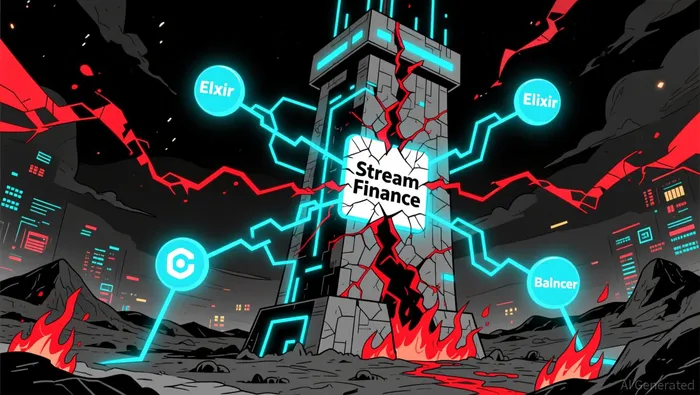
The deUSD crisis began with a $116.6 million exploit at BalancerBAL-- on November 3, 2025, which drained liquidity across EthereumETH-- and Base, according to a Bitget report. This event destabilized Stream Finance, a key borrower in the DeFi lending ecosystem, which subsequently reported a $93 million loss, as Bitget also reported. Stream Finance's default on a $68 million loan to Elixir Network-a critical backer of deUSD-triggered a liquidity freeze. Elixir, holding 65% of deUSD's reserves in Stream-related assets, was forced to suspend redemptions and minting to prevent further depegging, according to a BitcoinWorld report. Within days, deUSD's value plummeted to 1.5 cents per token, eroding trust in synthetic stablecoins and spilling over to destabilize other tokens like USDeUSDe--, which lost 45% of its value in a month, as Bitget reported.
This sequence of events highlights a critical flaw: DeFi protocols often operate as interconnected nodes in a web of dependencies, where the failure of one can rapidly amplify into a systemic crisis.
Risk Management Failures: Governance and Collateral Concentration
At the heart of the deUSD collapse lies a failure of risk management. Elixir's overreliance on Stream Finance-65% of deUSD's reserves were tied to a single platform-exposed the dangers of concentrated collateral structures, as BitcoinWorld reported. This lack of diversification left the stablecoin vulnerable to a single point of failure, a flaw that critics have long warned against in DeFi.
Compounding this issue were governance shortcomings. Protocols like Elixir and Stream Finance lacked robust mechanisms to stress-test liquidity or enforce conservative leverage ratios. As AaveAAVE-- founder Stani Kulechov noted, high-leverage trading and opaque fund deployment are "key contributors to systemic vulnerabilities," according to a Coinotag report. The absence of real-time monitoring and emergency response protocols meant that Elixir's actions-suspending redemptions and opening a 1:1 USDCUSDC-- redemption channel-were reactive rather than proactive, as BitcoinWorld reported.
Systemic Exposure and Contagion: A Network of Weakness
The deUSD collapse also revealed the broader fragility of DeFi's interconnected lending systems. Stream Finance's xUSDXUSD--, xBTC, and xETH tokens were repeatedly collateralized across platforms like EulerEUL--, Silo, and MorphoMORPHO--, creating a $285 million debt exposure, according to a Markets report. This over-collateralization amplified contagion risks, as the failure of one asset class could trigger cascading liquidations.
PeckShield's analysis further underscores this risk: TelosC vaults on Euler reached 100% utilization, locking $27 million and raising concerns about liquidity shortages spreading through the ecosystem, according to a U.Today report. Such scenarios highlight how DeFi's "interconnected risk networks" across seven blockchain networks can turn localized failures into systemic crises, as Markets reported.
Expert Recommendations: Building Resilience in DeFi
In the aftermath, industry leaders are calling for structural reforms. RedStone's Credora initiative, for instance, proposes risk ratings for lending pools to enhance transparency, as Bitget reported. Gauntlet has recommended freezing withdrawals and new loans until risk parameters are revised, emphasizing the need for governance-driven oversight, as Bitget reported.
Stani Kulechov advocates for immutableIMX-- oracle price feeds and standardized interest rate curves to mitigate losses during market shocks, according to a Coinotag report. Meanwhile, ProcessUnity's automation-driven risk management tools-recognized as a SPARK Leader in 2025-offer a blueprint for scaling vendor risk programs in DeFi, according to a GlobeNewswire report.
Conclusion: A Call for Prudence
The deUSD collapse is a wake-up call for the DeFi community. Synthetic stablecoins, while innovative, cannot thrive on optimism alone. Investors must demand protocols adopt diversified collateral structures, rigorous stress tests, and transparent governance. Developers, in turn, must prioritize systemic resilience over rapid growth.
As the DeFi landscape evolves, the lessons from deUSD will shape the next era of decentralized finance. The question is whether the industry will heed these warnings-or repeat history.






Comentarios
Aún no hay comentarios