
The Fragile Illusion: How Systemic Corruption in Financial Markets Fuels the Flight to Gold and Silver
The global financial system, long propped up by the illusion of stability, is unraveling under the weight of its own contradictions. Fractional reserve banking, central bank overreach, and institutional manipulations have distorted the true value of assets, creating a landscape where trust in paper promises is eroding faster than ever. As political instability and inflationary pressures mount, investors are increasingly abandoning fiat currencies and equities for tangible stores of value-chiefly gold and silver. This shift is not merely a market trend but a reckoning with the systemic rot that has plagued financial markets for decades.
The Mechanics of Distortion: Fractional Reserve Banking and Central Bank Manipulation
Fractional reserve banking, the cornerstone of modern finance, allows banks to lend multiples of their reserves, effectively creating money out of thin air. This system, while enabling economic growth, also introduces instability by inflating asset bubbles and distorting price signals. Central banks amplify this distortion through interventions like quantitative easing (QE) and interest rate manipulation. For instance, the Federal Reserve's accommodative policies from 2020 to 2023 suppressed real interest rates, reducing the opportunity cost of holding gold and driving its price to record highs in 2025.
Yet the manipulation runs deeper. Bullion banks and derivatives markets have historically engaged in practices such as strategic short selling and spoofing to manipulate precious metals prices. A 2020 settlement revealed JPMorgan Chase's $920 million fine for systematic spoofing in silver and Treasury markets between 2008 and 2016.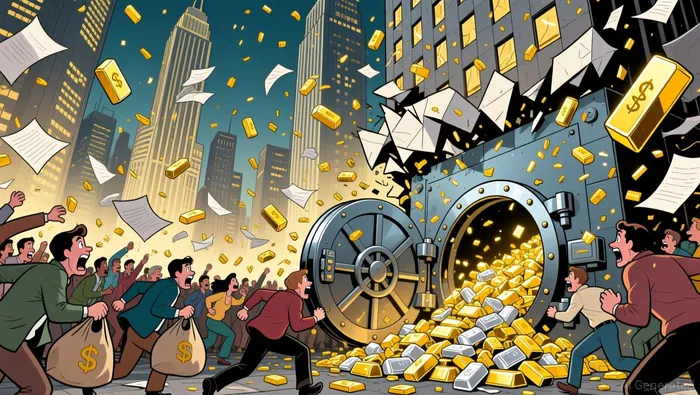 Similarly, Deutsche Bank faced litigation for silver price manipulation, exposing a systemic imbalance where paper trading volumes in silver often exceed annual mine production by orders of magnitude. These practices create artificial price disparities, undermining the integrity of both physical and paper markets.
The Erosion of Trust in Stocks and Fiat
Stock valuations, too, are distorted by monetary policy. The Fed's aggressive rate hikes in 2022–2023 caused market volatility as investors recalibrated expectations for inflation and future rate cuts. While equities have traditionally thrived in low-interest-rate environments, the inverse relationship between gold and the U.S. dollar has become a critical factor. A weaker dollar, driven by dovish Fed policies, boosts global demand for gold, indirectly influencing investor sentiment toward stocks.
The erosion of trust in fiat currencies is accelerating. Central banks' gold purchases in 2025-reaching 254 tonnes through October alone-reflect a structural shift away from dollar-based reserves. Countries like China, India, and Turkey are diversifying their reserves to hedge against geopolitical risks and currency devaluation. This trend underscores a loss of confidence in the U.S. dollar's hegemony, a currency that has long been the bedrock of global finance.
The 2025 Flight to Safety: Gold and Silver as Antidotes to Systemic Risk
By October 2025, gold prices had surged past $4,381.58 per troy ounce, while silver hit over $54 per ounce. These record highs are not merely a function of monetary policy but a response to geopolitical tensions, including conflicts in Eastern Europe and the Middle East. Gold's appeal as a "politically neutral" asset-unlike U.S. Treasuries, which can be seized or devalued-has made it the preferred reserve for central banks and private investors alike.
Silver's rally, meanwhile, reflects both industrial demand from renewable energy sectors and its role as a safe-haven asset. The disconnect between paper markets and physical supply remains acute, but surging demand for physical silver has begun to narrow this gap. For investors, this signals a correction in a market long manipulated by institutional players.
A Case for Reallocating to Tangible Assets
The case for reallocating assets toward tangible stores of value has never been stronger. Gold and silver, with their millennia-long track record as hedges against systemic risk, offer a counterbalance to the fragility of fiat currencies and equities. Central banks' gold purchases have institutionalized this shift, with global bullion holdings surpassing U.S. Treasury holdings for the first time in nearly 30 years.
For individual investors, the message is clear: diversification into physical precious metals is no longer a niche strategy but a necessity. The World Bank projects gold prices to remain elevated through 2026, while silver's industrial demand and supply constraints will likely drive further gains. In a world where systemic corruption and market distortions are the norm, tangible assets provide a rare form of certainty.
Conclusion
The financial system's reliance on fractional reserve banking and central bank manipulation has created a house of cards. As political instability and inflationary pressures mount, the flight to gold and silver is not a panic-driven reaction but a rational response to systemic risk. Investors who recognize this shift early will find themselves better positioned to navigate the inevitable corrections ahead. The illusion of stability is fading-what remains is the enduring value of what can be held in one's hands.







Comentarios
Aún no hay comentarios