
The Fragile Foundation of the U.S. Strategic Bitcoin Reserve: Enforcement Risks and Policy Uncertainty in 2025
The U.S. government's foray into BitcoinBTC-- as a strategic asset, formalized under Executive Order 14233 in March 2025, represents a bold-and arguably unprecedented-experiment in monetary policy. The Strategic Bitcoin Reserve (SBR) and the parallel U.S. Digital Asset Stockpile are designed to position the federal government as a long-term holder of Bitcoin, with the former explicitly prohibited from selling its holdings according to Vedder Price. On the surface, this framework signals a pro-crypto stance, aligning with broader regulatory rollbacks under the Trump administration as reported by Lathrop GPM. However, a critical blind spot emerges when analyzing the enforcement actions of the Department of Justice (DOJ) in 2025: the absence of publicly documented interventions or policy shifts raises questions about the sustainability and operational clarity of the SBR.
The SBR's Legal and Operational Constraints
Executive Order 14233 capitalizes the SBR through Bitcoin seized via criminal or civil asset forfeiture, a mechanism that ties its growth directly to law enforcement activity. According to a report by Vedder Price, the Treasury Department is barred from selling SBR Bitcoin, which is to be held as a "reserve asset". Meanwhile, the Digital Asset Stockpile-comprising non-Bitcoin digital assets-retains flexibility for sales or stewardship strategies as noted in the same report. This dichotomy highlights a key vulnerability: the SBR's expansion hinges on the DOJ's willingness (or ability) to seize Bitcoin from illicit actors.
Yet, as of December 2025, no credible reports of DOJ enforcement actions or digital asset seizures in 2025 have surfaced. This silence is troubling. Enforcement activity is not just a legal tool but a market signal. If the DOJ is either scaling back Bitcoin-related investigations or failing to secure high-profile seizures, the SBR's ability to accumulate assets could stagnate. Conversely, if enforcement efforts are ramping up but being underreported, the lack of transparency could erode public trust in the framework's legitimacy.
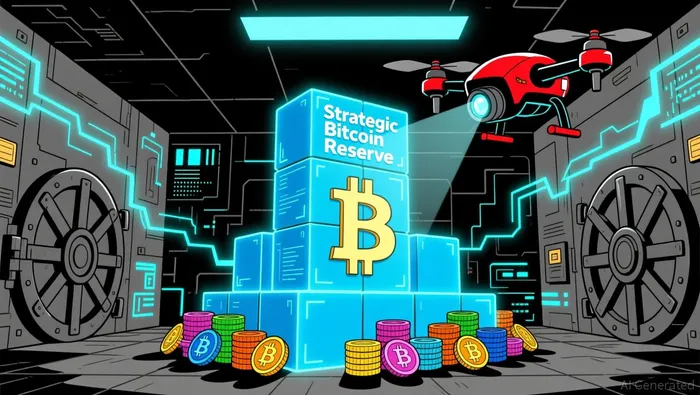
Enforcement Risks: A Double-Edged Sword
The DOJ's role in the SBR ecosystem is paradoxical. On one hand, aggressive enforcement against dark web markets, ransomware operators, or unregistered crypto exchanges could flood the SBR with seized Bitcoin, bolstering its reserves. On the other, overly aggressive actions might inadvertently destabilize the very markets the SBR aims to institutionalize. For example, a major takedown of a Bitcoin mixer or exchange could temporarily distort price dynamics or trigger regulatory backlash, creating friction for the SBR's long-term strategy.
Moreover, the absence of 2025 enforcement data suggests potential policy misalignment. If the DOJ is deprioritizing crypto enforcement in favor of other initiatives (e.g., AI regulation or traditional financial crime), the SBR could face a chronic shortage of incoming assets. This would force the Treasury and Commerce departments-authorized to pursue budget-neutral acquisition strategies-to rely on opaque mechanisms, potentially inviting scrutiny from Congress or the public.
The Broader Implications for Investors
For investors, the SBR's success is intertwined with three key variables:
1. DOJ Enforcement Trends: A decline in Bitcoin seizures would directly limit the SBR's growth, while increased activity could signal a robust, if controversial, funding model.
2. Legal Challenges: The SBR's reliance on asset forfeiture is not without precedent, but its application to Bitcoin remains untested in court. A single lawsuit challenging the legality of the reserve's holdings could force a reevaluation of its structure.
3. Market Perception: The SBR's non-sale clause is meant to instill confidence in Bitcoin's long-term value. However, if the public perceives the reserve as a politically motivated stunt rather than a serious policy tool, its symbolic impact-and thus its market influence-could dissipate.
Conclusion: A Work in Progress
The Strategic Bitcoin Reserve is an ambitious experiment, but its fragility lies in its dependence on enforcement outcomes and legal clarity. The lack of DOJ actions in 2025 is not merely an informational gap-it is a red flag for investors. Without visible enforcement, the SBR risks becoming a theoretical construct rather than a functional reserve. Conversely, if enforcement activity is simply being reported discreetly, the framework could gain momentum as a unique blend of law enforcement and monetary policy.
For now, the SBR remains a case study in the Wild West of digital asset governance. Investors should monitor two signals: (1) the DOJ's 2025 enforcement calendar and (2) congressional hearings on the reserve's operations. Until then, the SBR's future-and with it, the U.S. government's Bitcoin strategy-remains as volatile as the asset it seeks to control.






Comentarios
Aún no hay comentarios