
The Fragile Foundation: How Political Interference Undermines U.S. Economic Data and Market Stability
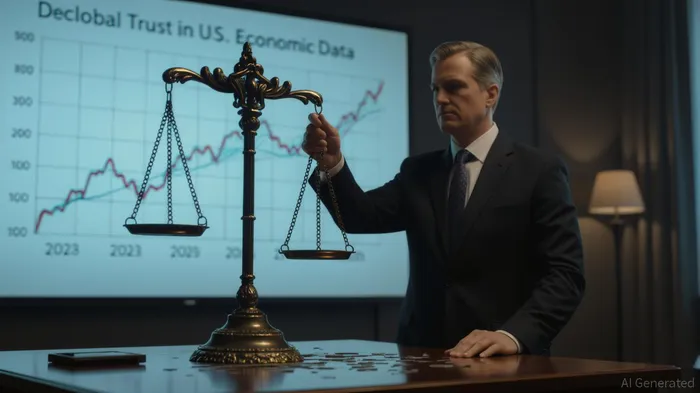
The U.S. economy has long been the global benchmark for stability and transparency. Yet, recent events have exposed a troubling erosion of trust in the data that underpins financial markets, corporate decisions, and investor confidence. Political interference in economic data collection and reporting—most notably the controversial removal of Bureau of Labor Statistics (BLS) Commissioner Erika McEntarfer in 2024—has cast a shadow over the reliability of key metrics like employment figures and GDP growth. This politicization threatens not only the integrity of U.S. economic statistics but also the stability of global markets and the long-term value of investments.
The BLS Controversy and Its Ripple Effects
The Trump administration's abrupt dismissal of McEntarfer, a commissioner appointed with bipartisan support, over a disputed July 2024 jobs report sparked immediate backlash. The report, which showed weaker-than-expected employment growth, was labeled “rigged” by the administration, despite no evidence of manipulation. This incident, coupled with broader efforts to dismantle advisory committees and reshape hiring practices at statistical agencies, has raised alarms about the politicization of data. The International Statistical Institute condemned the move as a violation of UN principles, while economists warned of a precedent that could allow future administrations to weaponize data for political gain.
The consequences are far-reaching. U.S. economic data has historically been a cornerstone of global market stability, guiding decisions by central banks, corporations, and investors. When trust in this data erodes, volatility spikes. For example, the July 2024 jobs report triggered a 500-point drop in the Dow Jones Industrial Average and a 1.6% decline in the S&P 500. The volatility was not solely due to the data itself but the perception of interference, which amplified uncertainty.
Global Implications and the Dollar's Fragile Dominance
The U.S. dollar's status as the world's reserve currency is increasingly under scrutiny. Central banks, particularly in emerging markets, have begun diversifying their reserves into gold and other currencies, reflecting a shift away from the dollar. Gold's share in official reserves rose from less than 10% in 2015 to over 23% in 2025, as countries like China, Russia, and Türkiye seek alternatives to U.S.-centric financial systems. This trend is compounded by the U.S.'s fiscal challenges, including Moody'sMCO-- 2025 downgrade of U.S. government debt, which has raised concerns about long-term fiscal sustainability.
The politicization of economic data exacerbates these concerns. If investors and central banks lose faith in the neutrality of U.S. statistics, they may further reduce their reliance on dollar-denominated assets. This could weaken demand for U.S. Treasuries, which are a cornerstone of global reserves, and accelerate the rise of alternative currencies like the Chinese yuan.
Investor Behavior: Diversification and Alternative Data
In response to this uncertainty, investors are recalibrating their strategies. A 2025 Gallup survey found that 60% of U.S. investors are concerned about market volatility, with Democrats twice as likely as Republicans to express “very high concern.” To mitigate risks, investors are diversifying portfolios, hedging with assets like gold, and prioritizing sectors less reliant on government data—such as technology and healthcare.
Alternative data sources are also gaining traction. Satellite imagery, freight metrics, and synthetic GDP models are being used to cross-check official statistics, particularly in emerging markets where data integrity has long been a concern. For instance, in China, independent analysis of electricity consumption and freight data has revealed discrepancies in official employment and output figures. This trend is now spreading to the U.S., where investors are increasingly relying on private-sector employment surveys and real-time payment data to gauge economic health.
Strategic Investment Advice for a Shifting Landscape
For investors navigating this uncertain environment, the following strategies are critical:
- Diversify Geographically and Sectorially: Reduce exposure to sectors heavily dependent on government data (e.g., energy, agriculture) and pair U.S. equities with emerging market debt or infrastructure bonds.
- Hedge Against Volatility: Allocate a portion of portfolios to safe-haven assets like gold and technology stocks with diversified revenue streams.
- Prioritize Transparency: Invest in companies with strong governance and transparent reporting, and advocate for regulatory reforms to protect the independence of statistical agencies.
- Leverage Alternative Data: Use real-time metrics and AI-driven analytics to verify official data and identify mispriced assets.
Conclusion: A Call for Vigilance
The politicization of U.S. economic data is not a transient issue but a structural challenge with long-term implications. While the U.S. remains a dominant economic power, the erosion of trust in its data threatens to undermine the dollar's reserve currency status and destabilize global markets. Investors must remain vigilant, adapting their strategies to a world where data integrity is increasingly contested. By prioritizing diversification, transparency, and alternative data, investors can navigate this shifting landscape and protect their portfolios from the fallout of political interference.







Comentarios
Aún no hay comentarios