
The Fragile Foundation: U.S. Manufacturing Under Trump-Era Trade Policies and the Path to Strategic Hedging
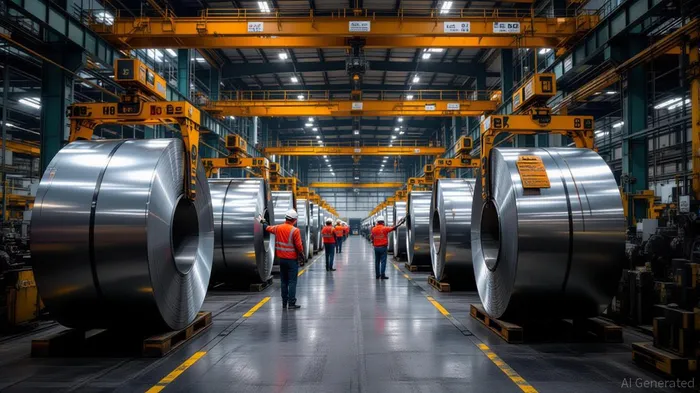
The U.S. manufacturing sector, once the backbone of American economic might, now faces a precarious crossroads. Trump-era trade policies—characterized by aggressive tariffs on steel, aluminum, and critical inputs—have created a landscape of volatility, inflationary pressures, and sector-specific vulnerabilities. For investors, the question is no longer whether these policies matter, but how to navigate the long-term risks they pose to industrial equities.
The Tariff-Driven Cost Conundrum
The 2018–2021 tariffs on steel and aluminum (25% and 10%, respectively, later escalated to 50%) were a double-edged sword. While they briefly bolstered domestic production, they also inflated input costs for downstream industries. By 2025, U.S. steel benchmarks had doubled compared to global prices, with hot rolled coil hitting $900 per ton versus $450 abroad. Aluminum prices followed a similar trajectory, driven by the sector's 50% import dependency. These costs were passed on to manufacturers, squeezing margins in sectors like automotive, aerospace, and consumer goods.
Consider General MotorsGM-- and Ford: their per-vehicle production costs rose by $700 annually due to steel tariffs. Similarly, the beverage industry faced a $1.4 billion hit from aluminum tariffs. These are not isolated cases. The Peterson Institute estimates that for every job saved in steel production, $650,000 was spent—while downstream sectors lost 75,000 jobs. The math is clear: protectionism has a steep price tag.
Sector Rotation: From Vulnerability to Opportunity
The fallout from these policies has forced a strategic reallocation of capital. Investors are increasingly shifting away from sectors like materials and consumer discretionary—hard-hit by tariffs—and into defensive plays like utilities and communication services. The latter, in particular, has gained traction as a hedge against inflation and a beneficiary of AI-driven growth narratives.
For example, communication services firms like MetaMETA-- and AmazonAMZN-- have thrived by leveraging domestic tech infrastructure, avoiding the supply chain bottlenecks faced by manufacturers. Meanwhile, utilities, with their stable cash flows and low sensitivity to global trade, have become a safe haven. This rotation is not just defensive—it's a recalibration of risk in a world where policy uncertainty reigns.
Hedging in a Policy-Driven Storm
The Trump administration's trade policies have introduced a new layer of macroeconomic instability. Tariffs have not only raised costs but also triggered retaliatory measures from trade partners, further straining U.S. exports. For instance, Canada's $20 billion in retaliatory duties on U.S. tools and servers, and the EU's $28 billion in tariffs on bourbon and denim, have eroded the competitiveness of export-oriented industries.
To mitigate these risks, investors are turning to hedging tools. Treasury Inflation-Protected Securities (TIPS) and VIX options are gaining popularity as buffers against inflation and market volatility. Currency hedging is also critical: with the U.S. core CPI projected to hit 4.1% by year-end 2025, the Federal Reserve's potential 3–4 rate cuts could weaken the dollar. Investors are capitalizing on this by favoring long AUD/NZD positions in a dovish environment or short EUR/JPY in a hawkish one.
Strategic Recommendations for Investors
- Overweight Communication Services and Utilities: These sectors offer resilience against trade-driven volatility and align with long-term trends like AI and energy transition.
- Underweight Materials and Consumer Discretionary: Tariff-exposed industries like automotive and steel remain fragile, with limited upside until global supply chains stabilize.
- Hedge Currency and Inflation Risks: Allocate to TIPS, VIX options, and diversified global bonds to cushion against policy shocks.
- Diversify Geographically: Emerging market debt and high-yield credits in the UK and Australia offer attractive yield differentials amid U.S. rate cuts.
The Road Ahead
The Trump-era trade policies have left a lasting imprint on U.S. manufacturing. While the short-term gains for steel and aluminum producers are undeniable, the broader economic costs—higher input prices, retaliatory tariffs, and sectoral imbalances—pose a significant threat to long-term growth. For investors, the key lies in agility: rotating into resilient sectors, hedging against macroeconomic headwinds, and staying attuned to the evolving trade landscape.
As the Fed grapples with inflation and the administration's policy playbook remains unpredictable, one thing is certain: the era of easy manufacturing profits is over. The path forward demands a strategic, diversified approach—one that balances risk with opportunity in a world where policy and markets are inextricably linked.





Comentarios
Aún no hay comentarios