
The Fragile Fortresses: Cybersecurity Risks in Digital Asset Management and the 2025 Hacks That Shook Investor Confidence
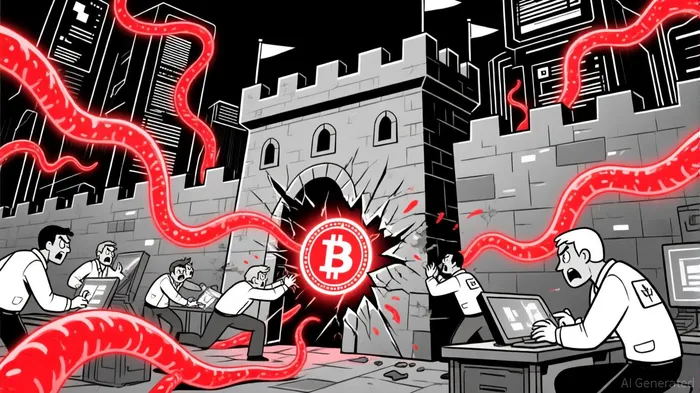
The 2025 Breach Tsunami: Scale and Sophistication
The most alarming incident of 2025 was the $1.46 billion theft from Dubai-based exchange ByBit, attributed to North Korean hackers, according to the Wedbush analysis. This heist, the largest in crypto history, exploited advanced social engineering tactics, including compromising IT personnel, to infiltrate the exchange's infrastructure. By mid-2025, cumulative losses from crypto services had already reached $2.17 billion, with ByBit's breach accounting for 69% of the total, according to a Kenson Investments study.
North Korea's cyber operations extended beyond single incidents. According to Chainalysis, the DPRK's cumulative thefts since 2017 surpassed $6 billion, with attacks in 2025 involving both large-scale exchange breaches and smaller, targeted heists reported by the Wedbush piece. These attacks often leveraged supply-chain vulnerabilities, as seen in the $56 million Atomic Wallet compromise, where a malicious update embedded in the installer drained user funds (detailed in the Kenson Investments study).
The financial impact was compounded by a shift in attack vectors. While centralized exchanges remained prime targets, personal wallet compromises accounted for $8.5 billion in losses by mid-2025-far exceeding the $1.28 billion lost through service breaches, as noted by Wedbush. This trend highlights a growing asymmetry: attackers are increasingly bypassing institutional defenses to target individual users directly.
Investor Confidence: A Shattered Mirror
The 2025 breaches triggered a seismic shift in investor behavior. A Coinbase survey revealed that 45% of users now prefer decentralized exchanges (DEXs) or cold wallets, up from 30% in 2024. This migration to self-custody solutions reflects a loss of trust in centralized platforms, particularly after incidents like the $100 million CoinVault hack, which caused a 10% dip in BitcoinBTC-- and EthereumETH-- prices within 24 hours (reported in the same blog post).
Regulatory scrutiny has also intensified. U.S. and EU regulators are pushing for mandatory security audits and insurance requirements for exchanges, signaling a move toward stricter oversight, as noted in the CoinbaseCOIN-- survey reporting. However, these measures come at a cost: increased compliance burdens may slow innovation and drive smaller players out of the market.
The geopolitical dimension adds another layer of complexity. North Korea's use of stolen crypto to fund weapons programs has raised alarms among global policymakers, prompting calls for enhanced sanctions enforcement and cross-border collaboration-an issue highlighted in the Wedbush analysis. For investors, this means not only financial risks but also geopolitical volatility that could disrupt markets.
Building Resilience: The Path Forward
To restore confidence, crypto firms must adopt a zero-trust security model. This includes:
1. Multi-Signature Wallets: Replacing single-key systems with multi-signature solutions to reduce the risk of unauthorized access.
2. Smart Contract Audits: Continuous, third-party audits of DeFi protocols to identify and patch vulnerabilities before exploitation.
3. Supply-Chain Security: Rigorous vetting of software updates and dependencies, as illustrated by the Atomic Wallet breach detailed in the Kenson Investments study.
4. Regulatory Compliance: Proactive alignment with evolving regulations to avoid penalties and rebuild trust.
Blockchain analytics firms like Chainalysis and Elliptic are also playing a critical role in tracing stolen assets. While recovery rates remain low, these tools provide transparency and deterrence, signaling to attackers that their actions are not anonymous (as discussed in the Wedbush analysis).
Conclusion
The 2025 cyberattacks have laid bare the fragility of the crypto ecosystem. While the industry's resilience is being tested, the response-ranging from self-custody adoption to regulatory reforms-demonstrates a growing awareness of the stakes. For investors, the key takeaway is clear: operational resilience is no longer optional. It is a prerequisite for survival in a landscape where threats evolve faster than defenses.





Comentarios
Aún no hay comentarios