
The Fragile Balance: Federal Reserve Credibility and the Political Tightrope of 2025
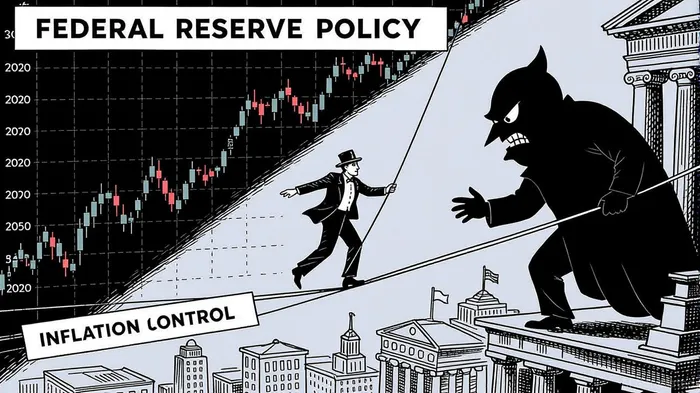
The Federal Reserve’s credibility has never been more scrutinized. In 2025, the central bank faces a dual challenge: maintaining its independence amid escalating political pressures while navigating the delicate trade-off between inflation control and financial stability. For investors, understanding this balancing act is critical to assessing risks and opportunities in U.S. financial markets.
The Credibility Premium: A Double-Edged Sword
The Fed’s credibility has long been a cornerstone of its influence. When the Federal Open Market Committee (FOMC) acts decisively, markets respond with predictability—until they don’t. Recent academic research highlights how dissenting votes within the FOMC can signal internal uncertainty, leading to heightened market volatility and negative stock returns [1]. For example, the Cleveland Fed’s Q2 2025 analysis estimated the medium-run neutral interest rate (r-star) at 3.7%, while the actual federal funds rate remained in the 4.25%–4.5% range, indicating a restrictive policy stance [2]. This gap between expectations and reality underscores the Fed’s struggle to maintain credibility as it resists calls for premature rate cuts.
However, credibility is not just about numbers—it’s about perception. The Fed’s ability to insulate itself from political interference has become a focal point. Former President Donald Trump’s public criticism of Chair Jerome Powell for maintaining rates above 4% exemplifies the risks of politicizing monetary policy. As Cresset Capital notes, such pressures threaten to erode investor confidence, which is essential for anchoring long-term expectations [3].
Political Pressures: A New Era of Uncertainty
The 2025 political landscape has introduced unprecedented volatility. Trump’s advocacy for a sharp rate cut to 1.0%—a move inconsistent with the Fed’s dual mandate of price stability and maximum employment—has created a rift between policy and politics [4]. This tension is not hypothetical: Morgan Stanley’s analysis suggests that tariff-driven inflationary pressures and mixed labor market signals have delayed the case for easing, yet political noise has already shifted market expectations [5].
The Fed’s response has been cautious. While some FOMC members have hinted at potential rate cuts by July 2025, the central bank remains focused on its mandate. This tension between political demands and institutional discipline raises a critical question: Can the Fed maintain its independence without sacrificing its credibility?
Global Spillovers: The Dollar’s Dominance and Systemic Risks
The Fed’s decisions ripple far beyond U.S. borders. As the U.S. dollar remains the world’s dominant reserve currency, tighter monetary policy in 2025 has amplified capital flows and exchange rate volatility, particularly in peripheral economies like China [6]. Meanwhile, emerging markets such as India have shown a nuanced response to central bank dissent—interpreting it as a sign of rigorous debate rather than instability [1]. These divergent reactions highlight the complex interplay between credibility and global market dynamics.
Risks and Opportunities for Investors
For investors, the Fed’s credibility crisis presents both risks and opportunities:
1. Risks: Political interference could force premature rate cuts, reigniting inflation and destabilizing markets. The commercial real estate sector, already under stress, could face further headwinds if liquidity tightens unexpectedly [7].
2. Opportunities: A Fed committed to its mandate may reinforce long-term stability, benefiting sectors like financials (which thrive on higher interest rates) and defensive assets (such as U.S. Treasuries). Additionally, investors could hedge against political risk by diversifying into markets less sensitive to U.S. policy shifts, such as India’s equity markets [1].
Conclusion: The Long Game
The Federal Reserve’s credibility is not just a policy issue—it’s an investment imperative. While political pressures threaten to disrupt its independence, the Fed’s ability to resist short-term demands will determine its long-term effectiveness. For investors, the key is to distinguish between noise and signal, betting on resilience rather than panic. As the 2025 elections approach, the Fed’s next moves will test not only its mandate but the very foundations of U.S. financial stability.
Source:
[1] Volume 34, Issue 1: Paper 3 | Issues in Political Economy [https://www.elon.edu/u/academics/business/ipe/about-the-journal/journal-issues/volume-34-issue-1/volume-34-issue-1-paper-3-2/]
[2] Neutral Interest Rates and the Monetary Policy Stance [https://www.clevelandfed.org/publications/economic-commentary/2025/ec-202508-neutral-interest-rates-and-monetary-policy-stance]
[3] Market Implications of the Battle for Fed Independence [https://cressetcapital.com/articles/market-update/7-22-2025-market-implications-of-the-battle-for-fed-independence/]
[4] The Federal Reserve, the new administration, and the outlook for the economy and monetary policy [https://cepr.org/voxeu/columns/federal-reserve-new-administration-and-outlook-economy-and-monetary-policy]
[5] Fed Rate Cut? Not So Fast [https://www.morganstanley.com/insights/articles/fed-rate-cut-september-2025-forecast]
[6] The spillover effect of US monetary policy on [https://www.sciencedirect.com/science/article/pii/S209623202400060X]
[7] U.S. Economy Under Stress: Warning Signs Beneath the Surface [https://discoveryalert.com.au/news/us-economy-2025-warning-signs/]







Comentarios
Aún no hay comentarios