
Foxconn's Q3 2025 Revenue: A Barometer for Tech Sector Resilience and Global Smartphone Demand
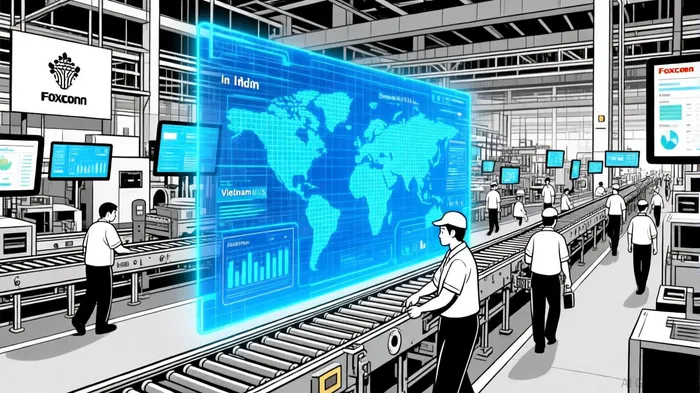
In Q3 2025, Foxconn's revenue surged 11% year-on-year to 2.057 trillion Taiwan dollars ($67.71 billion), marking a record performance driven by robust demand for artificial intelligence (AI) infrastructure, according to a Malay Mail report. While the figure fell short of the $68.5 billion forecast by LSEG SmartEstimate, the result underscores a critical shift in the tech sector: the decoupling of consumer electronics demand from cloud and AI-driven growth. This duality positions Foxconn as a barometer for global smartphone demand and manufacturing health, revealing both challenges and opportunities in an era of geopolitical uncertainty and technological transformation.
AI Servers as a Growth Engine, Smartphones as a Drag
Foxconn's cloud and networking products division, which includes AI servers, saw revenue nearly double in Q2 2025 compared to Q1, reflecting sustained demand from cloud providers and tech giants, according to a Foxconn outlook. Chairman Young Liu noted that AI servers could account for over 50% of the company's total server revenue in 2025. This aligns with broader industry trends, as enterprises increasingly allocate capital to AI infrastructure over consumer devices.
Conversely, the smart consumer electronics segment-primarily iPhones-experienced a slight revenue decline in Q3 2025, attributed to exchange rate impacts and softer demand as reported by Malay Mail. This mirrors the global smartphone market's modest 1% YoY growth in 2025, with China's shipments projected to decline 1% due to waning subsidies and economic headwinds, according to an IDC forecast. However, Foxconn's September 2025 revenue alone rose 14.2% YoY to $26.8 billion, signaling resilience in its diversified business model (reported by Malay Mail).
Supply Chain Resilience: Diversification and Digital Twins
Foxconn's strategies to bolster supply chain resilience in 2025 are emblematic of the tech sector's broader priorities. The company has expanded its manufacturing footprint to 24 countries, including India, Vietnam, and the U.S., to mitigate geopolitical risks, as detailed in a Foxconn India pivot piece. For instance, India's iPhone exports to the U.S. surged to $4.4 billion in 2025, up from $1.4 billion in 2023. This shift is partly a response to Trump-era tariffs, which have forced tech firms to rethink China-centric supply chains.
Technologically, Foxconn is leveraging NVIDIA's Omniverse platform to create digital twins of its factories, enabling real-time simulation and optimization of production lines. This aligns with industry trends emphasizing AI-driven analytics and digital twins for predictive maintenance and scenario planning, as highlighted in a KPMG supply-chain trends review. By virtualizing operations, Foxconn can rapidly adapt to disruptions, a critical advantage in an era of volatile demand and supply shocks.
Broader Sector Trends and Foxconn's Strategic Positioning
The tech sector's 2025 supply chain priorities-geographic diversification, AI integration, and sustainability-mirror Foxconn's initiatives. For example, 80% of industry executives now deem their supply chains "very resilient," though only 5% have comprehensive strategies, favoring targeted initiatives like adding regional nodes, according to Oliver Wyman. Foxconn's "3+3" strategy-focusing on EVs, digital health, robotics, AI, semiconductors, and next-gen communications-positions it to capitalize on high-growth sectors while mitigating risks in traditional markets (per the Foxconn outlook).
However, challenges persist. The appreciation of the Taiwan dollar has forced Foxconn to revise its 2025 revenue outlook from "strong growth" to "significant growth," underscoring currency-related vulnerabilities noted in the India pivot piece. Additionally, geopolitical tensions, such as U.S.-China trade policies, continue to complicate long-term planning for both Foxconn and its clients (the Trump-era tariffs analysis explores these pressures).
Investment Implications
Foxconn's Q3 performance and strategic investments suggest a company navigating a complex landscape with agility. Its AI server segment, projected to grow quarter-on-quarter in 2025 (per the Malay Mail report), offers a hedge against smartphone market volatility. Meanwhile, its supply chain innovations-digital twins, green manufacturing, and geographic diversification-align with sector-wide resilience trends described by NVIDIA and KPMG.
For investors, the key question is whether Foxconn can sustain its momentum amid macroeconomic headwinds. While its share price has risen 23% in 2025, outperforming the broader Taiwan market (reported by Malay Mail), risks such as currency fluctuations and geopolitical shifts remain. However, its proactive approach to diversification and technological adoption positions it as a bellwether for the tech sector's evolving resilience. Historically, earnings misses have not led to sustained selling pressure; instead, a mild relief rally often follows after the first trading week, with a tactical contrarian strategy (buying on the day after a miss, holding ~20 days) outperforming the market, according to a backtest study.







Comentarios
Aún no hay comentarios