
Foxconn's $20M Renewable Play: Riding China's Solar Dominance Amid Global Energy Transition
In a strategic move to capitalize on China's leadership in affordable renewable energy technology, Foxconn (Hon Hai Precision Industry Co.) has committed $20 million to the China Renewable Power Infrastructure LPF, a private equity fund focused on solar and wind infrastructure projects. This investment, while modest relative to Foxconn's $568 billion market cap, signals a bold pivot toward leveraging China's unmatched scale, subsidies, and supply chain efficiency in solar tech—a sector poised to grow 15% annually through 2030, per IEA forecasts.
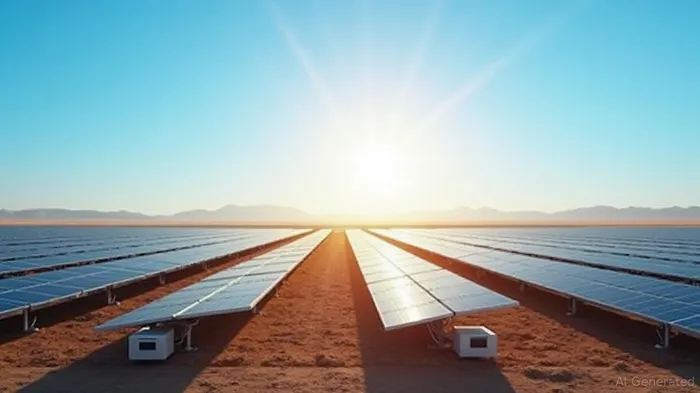
Global Renewable Energy Trends: A $13 Trillion Opportunity
The International Energy Agency (IEA) projects that global renewable energy investments will exceed $13 trillion through 2030, with solar photovoltaic (PV) capacity alone expected to triple by 2025. Solar's levelized cost of energy (LCOE) has plummeted 82% since 2010, now undercutting fossilFOSL-- fuels in most regions. For Foxconn, this aligns with its stated goal of achieving net-zero emissions in Taiwan by 2030 and pushing 45 major suppliers to 100% renewable energy by 2025.
Why China's Solar Supply Chain Dominates
Foxconn's bet hinges on China's $150 billion solar industry, which accounts for 80% of global polysilicon production and 70% of solar panel manufacturing. Key advantages include:
- Scale-driven cost efficiencies: Chinese firms produce modules at $0.18/W, 30% cheaper than U.S. competitors.
- State subsidies and R&D: Beijing's “Dual Carbon” policy allocates $300 billion annually to green tech, reducing financing costs for projects like those in the fund.
- Vertical integration: China controls 97% of polysilicon refining and 60% of silicon wafer production, ensuring supply chain resilience.
Foxconn's Strategic Calculus
By investing in the China Renewable Power Infrastructure LPF, Foxconn gains exposure to projects that:
1. Reduce operational carbon footprints: Aligning with its supplier decarbonization targets.
2. Diversify revenue streams: Expanding beyond its core electronics manufacturing (which accounts for 80% of revenue).
3. Leverage geopolitical leverage: China's solar dominance allows it to undercut U.S./EU tariffs, as seen in its 25% cheaper solar exports compared to U.S. domestic production.
Risks and Challenges
- Trade barriers: U.S. tariffs on Chinese solar imports (e.g., the 25% Section 201 tariff) could limit global market access.
- Overcapacity risks: China's solar oversupply has led to 20% price declines in polysilicon since 2022, squeezing margins.
- Regulatory shifts: Beijing's subsidy cuts for rooftop solar in 2024 reduced installations by 15%, hinting at policy volatility.
Investment Considerations
For investors, Foxconn's renewable pivot offers a high-reward, moderate-risk entry point into Asia's energy transition. Key metrics to monitor:
- Solar supply chain cost trends: Track polysilicon prices ().
- Fund performance: The China Renewable Power Infrastructure LPF's portfolio details (once disclosed) will reveal exposure to high-growth solar/wind projects.
- Geopolitical risks: U.S.-China trade talks (e.g., Section 301 tariffs) and domestic subsidy policies.
Recommendation:
- Aggressive investors: Buy Foxconn stock (TWSE: 2317) on dips below its 200-day moving average, pairing with long positions in Chinese solar ETFs (e.g., Guggenheim Solar ETF (TAN)).
- Conservative investors: Wait for the fund's portfolio disclosure and monitor polysilicon prices for margin stability.
Conclusion
Foxconn's $20 million bet is less about immediate profit and more about securing a seat at the table in China's $150 billion solar juggernaut. With solar now the fastest-growing energy source globally, this move positions Hon Hai to meet surging demand for clean infrastructure—provided it navigates trade wars and overcapacity. For investors, this is a strategic play on the energy transition, but one requiring close watch of geopolitical winds.
Final thought: As solar becomes the “new oil,” Foxconn's China-first strategy could make it an unlikely energy giant—unless trade barriers turn the lights out.







Comentarios
Aún no hay comentarios