
Fox Corporation's Secondary Offering and Its Implications for Shareholder Structure and Stock Valuation
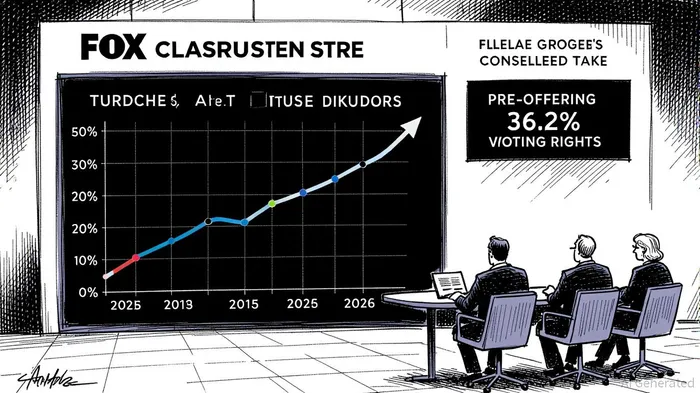
Fox Corporation’s recent secondary offering of 16,926,837 Class B shares—executed by trusts tied to Prudence MacLeod, Elisabeth Murdoch, and James Murdoch—has sparked significant scrutiny over its implications for corporate governance and market dynamics. Unlike traditional capital-raising efforts, this offering generated no proceeds for the company itself, with all funds flowing directly to the selling shareholders [1]. This insider liquidity event, coupled with the Murdoch family’s restructuring of voting control, raises critical questions about investor sentiment, stock valuation, and long-term strategic stability.
Insider Liquidity and Voting Power Consolidation
The secondary offering reflects a deliberate shift in the Murdoch family’s ownership structure. Prior to the sale, the family held approximately 40% of Fox’s voting rights through Class B shares, which carry 10 times the voting power of Class A shares [3]. By offloading 16.9 million Class B shares, the family reduced its voting stake to 36.2%, with Lachlan Murdoch’s trusts now consolidating sole control through 2050 [5]. This consolidation aligns with broader trends in dual-class corporations, where founders prioritize long-term strategic autonomy over dilution of influence.
However, the offering also signals a partial cession of control. As noted by Bloomberg, the departure of Prudence MacLeod and James Murdoch from the trust structure marks a generational transition, with Lachlan Murdoch emerging as the sole architect of Fox’s governance [4]. While this centralization may stabilize decision-making, it also heightens risks of governance entrenchment—a concern echoed in academic studies of dual-class firms [6].
Stock Price Volatility and Market Reaction
The immediate market response to the offering was mixed. Fox’s stock fell 0.8% in after-hours trading following the announcement, reflecting investor skepticism about the increased share supply and potential governance risks [2]. This aligns with historical patterns observed in dual-class firms: a 2024 study in the Journal of Financial Economics found that secondary offerings in such structures often trigger 15–20% higher volatility post-lock-up compared to single-class peers [7].
Broader macroeconomic factors further complicate the valuation picture. The S&P 500’s heightened volatility—driven by U.S. tariff policies and geopolitical tensions—has amplified Fox’s stock movements. For instance, the stock surged 13% in the month following the offering, suggesting short-term speculative activity amid market uncertainty [8]. Yet, this volatility may not be sustainable. As Reuters highlights, dual-class firms with concentrated voting power often face discounted valuations due to perceived governance risks [9].
Investor Sentiment and Strategic Stability
Investor sentiment remains divided. While some analysts view the Murdoch family’s restructuring as a positive step toward long-term stability—citing Lachlan’s proven leadership in media and tech ventures—others worry about the lack of checks on concentrated control. A cautionary example is Sable OffshoreSOC-- Corp. (SOC), where a misleading secondary offering led to a 15% stock plunge and a class-action lawsuit [10]. Though Fox’s offering was transparent, the absence of corporate proceeds and the Murdoch family’s opaque trust arrangements leave room for skepticism.
Long-term stability, however, hinges on Lachlan Murdoch’s ability to balance governance control with shareholder value. His consolidation of voting rights through 2050 mirrors strategies employed by tech giants like MetaMETA-- and Berkshire Hathaway, where dual-class structures have enabled long-term innovation [11]. Yet, as Harvard Law’s analysis of “stealth dual-class” mechanisms warns, even well-intentioned control can lead to misaligned incentives if not paired with robust transparency [12].
Conclusion
Fox Corporation’s secondary offering underscores the complex interplay between insider liquidity, voting control, and market dynamics in dual-class structures. While the Murdoch family’s strategic exit of certain trusts and consolidation of power under Lachlan may stabilize governance, it also raises concerns about long-term accountability. For investors, the key variables will be Fox’s ability to innovate under concentrated leadership and the market’s tolerance for governance risks in an era of heightened volatility. As the company navigates this transition, the broader debate over dual-class structures—balancing innovation with investor protection—will remain central to its valuation trajectory.
Source:
[1] FOXFOX-- CORPORATION ANNOUNCES PRICING OF SECONDARY OFFERING OF CLASS B COMMON STOCK, [https://www.prnewswire.com/news-releases/fox-corporation-announces-pricing-of-secondary-offering-of-class-b-common-stock-302549980.html]
[2] Fox stock falls after Murdoch family announces trust resolution and secondary offering, [https://www.investing.com/news/stock-market-news/fox-stock-falls-after-murdoch-family-announces-trust-resolution-and-secondary-offering-93CH-4229987]
[3] Fox Corporation's Murdoch Trust Resolution: A Strategic..., [https://www.ainvest.com/news/fox-corporation-murdoch-trust-resolution-strategic-reorganization-governance-boost-2509/]
[4] Fox Corp Resolves Murdoch Trust Dispute, Lachlan Takes..., [https://www.stocktitan.net/news/FOXA/fox-corporation-announces-resolution-of-murdoch-family-trust-wpoo803y117h.html]
[5] Murdoch Family Settles Battle Over Trust, [https://www.wsj.com/business/media/murdoch-family-settles-battle-over-trust-7ed736ba?gaa_at=eafs&gaa_n=ASWzDAibcUKFfbVfwrvFlGuhWHAixaCalz8IP8tuZjXwl4mg1UvziVBFNUi3&gaa_sig=JeWNbTEeCIvU_YRljb70p-d3qoZ-F9ODV3ZpJ_-bnlxhQlb74-66V2sjYdEYNAhuQV4lhbCoUfclF9dDZhOQog%3D%3D&gaa_ts=68bf82b2]
[6] Theory, Evidence, and Policy on Dual-Class Shares, [https://www.researchgate.net/publication/350848585_Theory_Evidence_and_Policy_on_Dual-Class_Shares_A_Country-Specific_Response_to_a_Global_Debate]
[7] The Unlocking of Voting Control in Anbio Biotechnology, [https://www.ainvest.com/news/unlocking-voting-control-anbio-biotechnology-post-lock-opportunity-dual-class-ipo-2508/]
[8] Fox Corporation's (NASDAQ:FOXA) Stock Has Seen Strong..., [https://finance.yahoo.com/news/fox-corporations-nasdaq-foxa-stock-125943711.html]
[9] Revisiting Dual-Class Stock, [https://scispace.com/pdf/revisiting-dual-class-stock-5clo611jh6.pdf]
[10] Securities Fraud and Shareholder Risk in Sable Offshore Corp. (SOC): A Cautionary Tale..., [https://www.ainvest.com/news/securities-fraud-shareholder-risk-sable-offshore-corp-soc-cautionary-tale-energy-sector-investors-2508/]
[11] Dual-class Stock Structure and Corporate Innovation..., [https://www.researchgate.net/publication/387449458_Dual-class_Stock_Structure_and_Corporate_Innovation_--_Evidence_from_Listed_Companies_on_the_Science_and_Technology_Innovation_Board]
[12] Misalignment Under the Radar: Stealth Dual-Class Stock, [https://corpgov.law.harvard.edu/2024/08/30/misalignment-under-the-radar-stealth-dual-class-stock/]





Comentarios
Aún no hay comentarios