
Forvia's Valuation After Share Price Pullback: A Bargain or a Warning?
Forvia's recent 19% share price plunge has sparked a heated debate among investors: Is this a golden opportunity to buy a fundamentally sound company at a discount, or a warning shot about structural challenges in the auto parts sector? Let's dissect the numbers and narratives to separate the signal from the noise.
The Catalyst: A Weak Outlook and Debt Concerns
Forvia's Q4 2024 results painted a mixed picture. While the company reported €27 billion in revenue and €1.4 billion in operating income, its operating margin dipped to 5.2%, below the 5.5% it had maintained in recent years, according to StockAnalysis statistics. The real shocker? Its 2025 guidance-projecting a 5.2%–6% operating margin-fell short of analyst expectations, which had been closer to 6.5%, according to an Investing.com report. This miss, coupled with the decision to forgo a dividend and focus on reducing net debt to €6.6 billion by 2026, sent investors fleeing.
The auto parts sector is no stranger to volatility, but Forvia's debt load is a red flag. With €10.1 billion in total debt and €4.5 billion in cash, its net debt-to-EBITDA ratio stands at a concerning 1.8x, well above the 1.5x target it set, according to Simply Wall St. Fitch's downgrade to a "negative" outlook underscores the risk of further deterioration if interest rates or commodity prices spike.
Valuation: A Tale of Two Models
On one hand, Forvia's valuation metrics scream "bargain." Its price-to-sales ratio of 0.08 is a fraction of the industry average of 0.93 (per StockAnalysis statistics), and a discounted cash flow (DCF) model suggests an intrinsic value of €49.51 per share-implying a 77.8% undervaluation, according to Simply Wall St. That's the kind of gap that makes value investors salivate.
On the other hand, the Altman Z-Score of 1.17 raises eyebrows (StockAnalysis statistics). This metric, which predicts bankruptcy risk, sits perilously close to the "distress" threshold of 1.8. Forvia's weak free cash flow conversion and interest cover of 2.4x (Simply Wall St) don't help. If the company misses its 2025 targets, its debt burden could spiral out of control.
Industry Headwinds: Can Forvia Weather the Storm?
The auto parts sector is facing a perfect storm. Supply chain bottlenecks, shifting consumer demand toward EVs, and rising trade barriers (like the U.S. One Big Beautiful Bill Act) are squeezing margins, a risk Fitch highlighted earlier. Forvia's exposure to traditional internal combustion engine (ICE) components-still 60% of its revenue-makes it particularly vulnerable, according to Forvia's first-quarter sales.
Yet, there's a silver lining. Forvia's first-quarter 2025 results showed organic sales growth of 2.1% (Forvia's first-quarter sales), and it remains on track to meet its €26.3 billion–€27.5 billion sales target (StockAnalysis statistics). The company's focus on cost discipline and its 5.2% operating margin, while below expectations, still outperforms peers like Magna International, which reported a 4.8% margin in Q1 2025, according to an AlphaValue note.
Analysts: Split Decisions and Price Targets
The analyst community is all over the map. Marketscreener's consensus target of €13.78 implies a 15.7% upside from current levels, while a more bullish forecast from Stocksguide pegs the price at €40.95-a 281% jump (Simply Wall St). This divergence reflects the uncertainty: Is Forvia's decline a temporary overcorrection, or a harbinger of deeper troubles?
The Bottom Line: A High-Risk, High-Reward Play
Forvia's valuation is undeniably compelling for long-term investors who believe in its ability to navigate the auto industry's transition. The DCF model's €49.51 intrinsic value and its strong first-quarter performance suggest the market may be overreacting. However, the debt load, weak Z-Score, and structural headwinds in the sector mean this isn't for the faint of heart.
If you're considering a position, treat it as a speculative bet with strict stop-loss parameters. Forvia's 2025 guidance is ambitious, and missing it could trigger a debt crisis. But if it executes-reducing debt, improving margins, and pivoting toward EV components-this could be a once-in-a-decade opportunity. 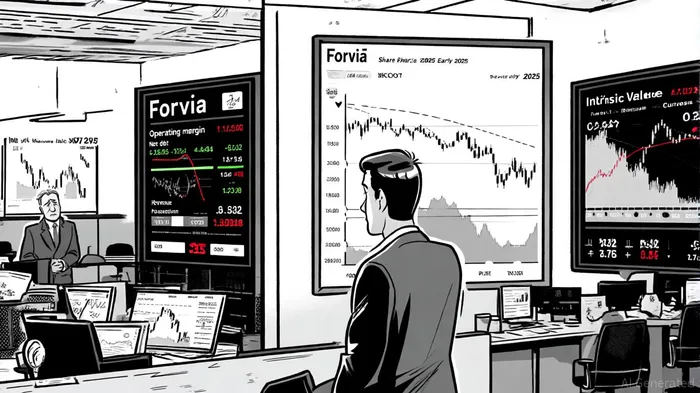







Comentarios
Aún no hay comentarios