
Fortune Minerals' Strategic Move to Secure the Alberta Refinery: A Critical Step Toward North American Supply Chain Independence in Critical Minerals
The global energy transition is accelerating demand for critical minerals, but geopolitical tensions and supply chain vulnerabilities are reshaping how companies and governments approach resource extraction and processing. In this context, Fortune Minerals' acquisition of a hydrometallurgical refinery in Alberta represents a pivotal case study in vertical integration-a strategy increasingly vital for securing supply chain resilience and capturing value in the critical minerals sector.
Vertical Integration as a Strategic Imperative
Fortune Minerals' decision to acquire a 76.78-acre refinery site in Lamont County, Alberta, underscores the growing importance of vertical integration in the critical minerals industry. The site, adjacent to the Canadian National Railway and within Alberta's Industrial Heartland, will process concentrates from the company's NICO Project in the Northwest Territories, producing battery-grade cobalt sulfate, bismuth ingots, copper cement, and gold doré. This move reduces reliance on third-party infrastructure, lowers capital and operating costs, and aligns with Canada's national interest in securing domestic processing capacity for minerals critical to clean energy and defense applications.
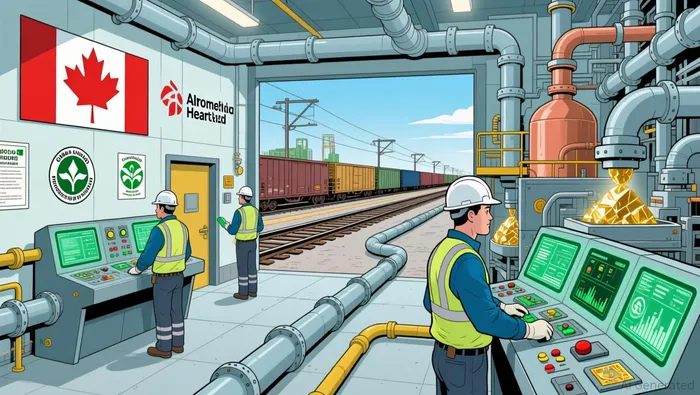 The strategic rationale is clear: by vertically integrating its operations, Fortune minimizes exposure to volatile global refining markets dominated by China, which processes 60–95% of critical minerals. The refinery's existing infrastructure-including serviced buildings and planning approvals-further de-risks development, a key consideration in an industry where capital intensity and regulatory complexity often deter investment.
Government Support and Policy Alignment
The acquisition is backed by significant public funding, including a C$3.8 million loan from Prosper NWT, a public agency of the Government of the Northwest Territories. This support reflects a broader trend of state intervention in critical minerals supply chains. For instance, the U.S. Inflation Reduction Act ties tax incentives to sourcing materials from domestic or allied jurisdictions, while Canada's Natural Resources Canada has allocated $8.21 million to advance Fortune's project. Such policies are reshaping the economics of critical minerals, making vertically integrated projects more competitive against Chinese-dominated supply chains.
The U.S. government's recent $1 billion commitment to a critical mineral stockpile further highlights the strategic value of vertical integration. By securing processing capacity in North America, companies like Fortune position themselves to benefit from these policy-driven tailwinds, which are likely to persist as geopolitical competition intensifies.
Financial Implications and Investment Risks
While vertical integration offers clear advantages, it also introduces operational and financial complexities. The critical minerals sector in 2025 is characterized by structural shortages of metals, driven by demand from electric vehicles, data centers, and renewable energy infrastructure. However, investors must weigh these opportunities against risks such as price volatility, declining ore grades, and rising production costs as noted by EY.
Fortune's project mitigates some of these risks through its focus on byproduct metals (e.g., gold) and its alignment with ESG standards. The NICO Project's reserves include over one million ounces of gold, providing a revenue stream that can offset fluctuations in cobalt or copper prices. Additionally, the refinery's location in Alberta-a region with tax incentives and industrial expertise-enhances its economic viability.
Broader Industry Trends and Lessons
Fortune's strategy mirrors global efforts to insulate supply chains from geopolitical shocks. Indonesia's nickel policies demonstrate how vertical integration can secure premium pricing by controlling the entire value chain. Similarly, the U.S. Department of Defense's $6.38 million investment in Fortune's project underscores the defense sector's reliance on secure, diversified mineral supplies. The investment highlights the strategic value of vertical integration in critical mineral supply chains.
For investors, the key takeaway is that vertical integration is no longer optional but essential. A 2025 industry report notes that over $493 billion was funneled into transition mineral mining between 2016 and 2024, yet many projects remain linked to deforestation and labor rights violations. Companies that align with ESG principles and demonstrate operational transparency-like Fortune-are better positioned to attract capital in an increasingly scrutinized sector. This aligns with global investor expectations.
Conclusion
Fortune Minerals' Alberta refinery acquisition is a textbook example of how vertical integration can address supply chain vulnerabilities while capturing value in the energy transition. By securing processing capacity in North America, the company aligns with both market demand and policy priorities, reducing exposure to global refining bottlenecks. For investors, this case highlights the importance of strategic positioning in critical minerals supply chains-a sector where geopolitical dynamics and technological innovation will drive returns in the coming decade.







Comentarios
Aún no hay comentarios