
Fortifying Europe's Arsenal: Defense Stocks in the Crosshairs of Geopolitical Realignment
The collapse of Ukraine's reliance on U.S. military support—and Europe's scramble to fill the void—has ignited a seismic shift in defense spending. With Russia's 2029 threat horizon looming and frozen Russian assets now funding 40% of Ukraine's war costs, European governments are doubling down on self-sufficiency. For investors, this is no mere tactical adjustment: it's a structural realignment of power, and the defense sector is its epicenter.
The Strategic Backdrop: From Dependence to Dominance
Germany's €38 billion military aid pledge to Ukraine (through 2029) is a microcosm of Europe's broader awakening. The U.S. pivot under President Trump—reducing direct aid to Ukraine while refocusing on Indo-Pacific dominance—has left European nations with no choice but to industrialize their defense capabilities. NATO's 2025 strategic assessment underscores the urgency: Russia's annual production of 1,500 main battle tanks and four million artillery rounds isn't just for today's war. It's a stockpile for tomorrow's.
The stakes are existential. NATO's eastern flank, particularly the Suwalki Gap, faces a “fight tonight” scenario, yet European militaries remain decades behind in modernizing systems like air defense and long-range missiles. The result? A goldmine for investors in firms positioned to bridge these gaps.
The Companies Leading the Charge: Where to Deploy Capital
The defense sector isn't monolithic. Success hinges on identifying firms with three traits: secured order backlogs, EU funding pipelines, and production resilience. Here's the lineup:
1. Rheinmetall (ETR:RHG)
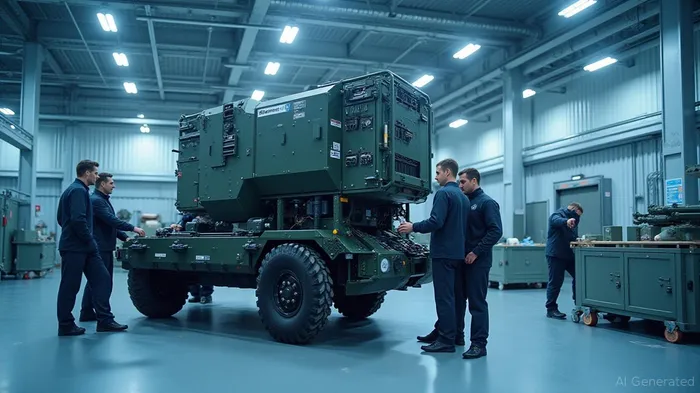
- Why It's Critical: Germany's flagship defense contractor is spearheading the GMARS missile system, a HIMARS alternative designed to reduce reliance on U.S. tech.
- Growth Catalyst: The €38 billion Ukraine aid package includes €5 billion for joint production of long-range weapons. Rheinmetall's HX chassis, paired with GMARS's dual rocket pod capability, positions it to capture 70% of European MLRS demand by 2026.
- Risk: Delays in Patriot missile deliveries (due to U.S. supply chain bottlenecks) could pressure margins.
2. MBDA (subsidiary of Airbus, Euronext: AIR)
- Why It's Critical: Europe's missile powerhouse is the go-to for systems like the Scalp cruise missile, now critical to Ukraine's “Porcupine Strategy” targeting Russian logistics hubs.
- Growth Catalyst: The EU's €150 billion SAFE loan facility earmarks funds for missile production. MBDA's €2.4 billion investment plan (2023–2028) aims to boost output by 40%, with contracts already secured from France and Poland.
- Key Insight: MBDA's partnership with Thales on the EuroPULS rocket system—though technically immature—signals a push to rival U.S. HIMARS.
3. Nexter (part of KNDS Group, Euronext: AIR)
- Why It's Critical: France's artillery specialist is fulfilling Ukraine's demand for 2 million 155mm artillery rounds by 2025, backed by €600 million in production scaling.
- Growth Catalyst: The Franco-German KNDS group's acquisition of a former Alstom rail factory (now repurposed for military production) slashes lead times by 30%.
- Data Point: Nexter's Caesar artillery system has a 90% export order fill rate, with Germany and Poland as top buyers.
4. Thales (Euronext: HO) and Diehl (ETR:DIHG)
- Why They Matter: These firms dominate air defense electronics and logistics systems, critical for NATO's “fight tonight” readiness.
- Growth Catalyst: Thales's €39 billion order backlog includes contracts for SAMP/T air defense systems (used in Ukraine) and AI-driven command networks. Diehl's rocket motor production for GMARS and HIMARS gives it a niche in propulsion tech.
The Bottleneck: Why Production Capacity is the New Gold
Europe's defense renaissance faces a catch-22: scaling production without U.S. tech. The solution? Sovereign supply chains.
- Ammunition Shortages: GMLRS rocket production is bottlenecked at Lockheed Martin's 14,000/year limit. European firms like Nexter and Diehl are now reverse-engineering propulsion systems—backed by €1.5 billion in EU grants—to achieve independence.
- Logistics Crunch: Rheinmetall's pivot from automotive to military chassis production (via repurposed BMW factories) highlights the need for industrial repurposing. Investors should prioritize firms with dual-use facilities.
The Investment Playbook: 3 Rules to Navigate the Sector
- Follow the Funding: The EU's ReArm Europe plan allocates €150 billion via the SAFE loan facility. Target firms with direct access to these funds (e.g., MBDA's missile contracts).
- Avoid U.S. Dependency: Firms reliant on American components (e.g., Patriot systems) face geopolitical risk. Opt for those with EU-owned IP (e.g., GMARS).
- Bet on Bottleneck Solutions: Companies addressing ammunition shortages (Nexter) or logistics bottlenecks (Thales/Diehl) will see disproportionate gains as NATO's 2029 deadline looms.
The Risks: A Minefield of Geopolitics
- U.S. Tech Embargoes: Washington could restrict exports of critical components, forcing European firms to innovate faster—or face penalties.
- Political Fragmentation: Hungary and Slovakia's pro-Moscow stance could delay NATO-wide procurement deals.
- Profitability Pressures: Scaling production often requires upfront capital. Firms without secured orders (e.g., EuroPULS developers) may struggle.
Final Analysis: A Strategic Bet on Self-Reliance
The defense sector isn't just a play on war—it's a bet on Europe's survival. With frozen Russian assets funding 40% of Ukraine's war costs and NATO's 2029 threat horizon accelerating, the sector's fundamentals are unassailable. For investors, the path is clear: allocate to firms with sovereign tech, order backlogs, and EU funding—while hedging against bottlenecks.
Investment Recommendation:
- Buy: Rheinmetall (RHG), MBDA (via Airbus: AIR), and Thales (HO).
- Hold: Nexter (KNDS: AIR) until its ammunition capacity expands.
- Avoid: U.S.-centric firms like Raytheon (RTX) lacking European partnerships.
The next three years will determine whether Europe becomes a military powerhouse—or a geopolitical afterthought. For investors, the stakes have never been higher.







Comentarios
Aún no hay comentarios